Grenada's Citizenship by Investment Programme — Funding a National Transformation Fund
Grenada
Since 2013, Grenada's Citizenship by Investment Programme has raised FDI averaging about 5% of GDP a year, funding a National …
Puerto Rico · San Juan · See the Puerto Rico profile · See the San Juan profile
Top 100% 24/100 · Ask Evidence Copilot about this practice
Puerto Rico's Act 60 investor tax break granted 5,852 decrees by 2024, but a federal audit found beneficiaries' relocation cut federal tax revenue by hundreds of millions a year with weak evidence of net local benefit.
Act 60 (consolidating earlier Acts 20 and 22) exempts qualifying new residents from Puerto Rico and federal capital-gains and investment income tax if they relocate to the island and meet minimum-presence and local investment requirements, aiming to attract high-net-worth individuals and export-services firms to grow the local economy after Puerto Rico's debt crisis.
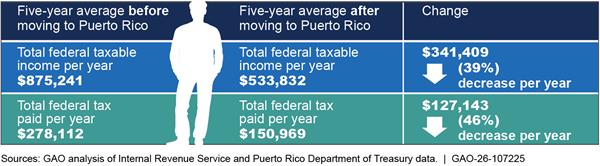
A 2026 US Government Accountability Office (GAO) audit found 5,852 resident-investor decrees granted between 2012 and 2024, with 3,165 unique taxpayers filing under one across 2021–2023. Beneficiaries' average federal taxable income fell 39% after relocating (from $875,241 to $533,832), cutting their average federal tax paid by 46% and reducing federal tax revenue by an estimated 'hundreds of millions of dollars' a year in aggregate; forgone Puerto Rico tax revenue from the resident-investor and export-services incentives combined is projected at roughly $6.2 billion for 2020–2026. The GAO also found 179 recipients who could not show they met Puerto Rico's residency requirement, and traced the largest single inflow of beneficiaries — 381 of 1,917 identified — to California.
Independent reporting corroborates a mixed-to-negative local picture: Act 60 beneficiaries bought over two-thirds of the real estate they acquired between 2015 and 2019, contributing to a post-Hurricane-Maria housing price surge that residents and grassroots groups such as the #AbolishAct60 collective say has priced native Puerto Ricans out of their own neighbourhoods, since most locals do not qualify for the exemptions available to new arrivals. Puerto Rico's government continues to defend the incentives as fiscally necessary, but the IRS has since expanded audits and data-sharing to curb non-compliance.
Read the full analysis: https://files.gao.gov/reports/GAO-26-107225/index.html
Implementation detail (cost, timeline, staffing, conditions for success) is not yet available for this practice.
Do you run this practice? Claim it — verified implementers get a public contact pathway and can propose corrections.
Where this practice's information was retrieved from, and when.
Grenada
Since 2013, Grenada's Citizenship by Investment Programme has raised FDI averaging about 5% of GDP a year, funding a National …
San Marino
San Marino's certification scheme, with taxes falling from 0% to 8% over 12 years, grew from 89 to 109 high-tech …
Saint Kitts and Nevis
Since 1984, St Kitts and Nevis has sold citizenship to foreign investors; revenue peaked near half of GDP in 2021. …
Russia
Tatarstan built a greenfield city, university and tax-privileged zone to attract IT talent. A decade on, roughly 4,200-5,200 people live …
Open full copilot Grounded in cited practices — always check the sources.