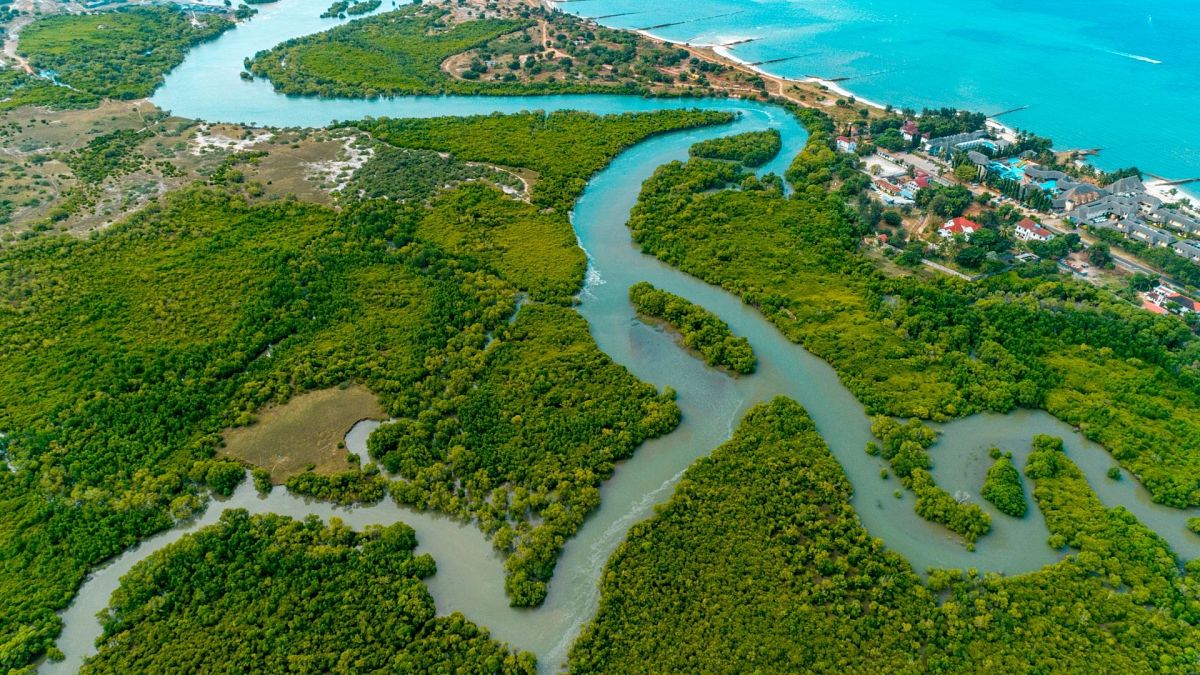
Egypt's Academy of Scientific Research ran a 2020–2022, EGP 4m Red Sea mangrove replanting programme with paid crews; only 3 of 6 sites were completed and it hit about a third of its seedling target — an honest, mixed-results case, not a clean win.
4 million EGP (~€200,000)
Programme budget (2020-2022)
210 hectares
Target area for replanting
6
Planned sites
3 of 6 (Safaga, Hamara, Al-Qala'n)
Sites completed
~10
Workers per site (April-October planting season)
300,000 seedlings/year
Seedling target
~50,000 seedlings/year
Actual seedling production
~200 kg
Honey sold (over six months)
200-300 EGP/kg (~€10-15)
Honey price
~10,000 seedlings/year
MERS annual seedling target (2021-2026)
Details
Promoter
Academy of Scientific Research and Technology (ASRT), Government of Egypt; MERS partnership with HSBC / American University in Cairo (CARES), FAO, ITTO
In April 2020, Egypt's government-run Academy of Scientific Research and Technology (ASRT) launched a two-year, EGP 4 million (roughly €200,000) programme to replant 210 hectares of mangroves across six sites on the Red Sea and Sinai coasts, employing paid crews of about 10 workers per site during the April-October planting season.
Activities
The programme targeted 300,000 seedlings a year and also piloted mangrove-adjacent honey production as an alternative livelihood, selling roughly 200 kg over six months at EGP 200-300 (about €10-15) per kilogram. A separate, better-funded initiative — the Mangrove Ecosystem Restoration in Egypt (MERS) project, a 2021-2026 partnership between HSBC and the American University in Cairo's Center for Applied Research on the Environment and Sustainability (CARES), with FAO and ITTO support — targets roughly 10,000 new seedlings a year across degraded sites from El Gouna to Halayeb and Shalateen, explicitly building in ecotourism and small-business livelihoods.
Results
Only three of the six planned sites — Safaga, Hamara and Al-Qala'n — were actually completed; a planned site at Al-Quweh village failed to launch. Actual seedling production reached only around 50,000 trees a year, about a third of the 300,000 target, with reporting citing lengthy security-approval processes and workforce commutes exceeding 400 km between sites as major obstacles. Where restoration did take hold, previously depleted fish and other marine species were reported to have reappeared.
Conclusions
This is a real, state co-funded restoration effort with a paid local workforce and a genuine livelihoods component, but the government-funded phase's own reporting is candid about under-achieving its planting target and about one site failing outright — an honest, moderate-evidence case rather than a polished success story. MERS's own quantified results were not yet separately reported at the time of the sources reviewed.
Implementation
Indicative cost
Low (< €50k) — Government phase budgeted at EGP 4 million (~€200,000) over two years (2020-2022) for six planned sites; the follow-on MERS partnership (2021-2026) is better-funded but its own budget figure was not reported in the source.
Time to results
Medium (1–3 years) — Government-run phase: April 2020 to 2022 (two years, April-October planting seasons); the related MERS initiative continues 2021-2026.
Staffing & skills
Academy of Scientific Research and Technology (ASRT), Government of Egypt, Paid local crews (~10 workers per site), MERS partnership: HSBC, American University in Cairo (CARES), FAO, ITTO
Conditions for success
Paid local workforce during the April-October planting season
Alternative-livelihoods component (mangrove-adjacent honey production, ecotourism in the MERS follow-on) to build community buy-in
Common failure modes
Lengthy security-approval processes and workforce commutes exceeding 400 km between sites were cited as major obstacles
Only 3 of 6 planned sites were completed and one site (Al-Quweh village) failed to launch
Actual seedling production reached only about a third (~50,000/year) of the 300,000/year target
Where it fits
Governance type
state-funded programme with later multi-funder partnership (MERS)
Scale
sub-national (Red Sea and Sinai coastal sites)
Income level
lower-middle-income
Commonly funded by
National / regional programmes
Indicative funding routes for practices of this type — always check each programme's current calls and eligibility rules.
Do you run this practice?
Claim it —
verified implementers get a public contact pathway and can propose corrections.
Data sources
Where this practice's information was retrieved from, and when.
Estonia's EAFRD-funded Rural Development Plan pays private landowners €60–134/ha for Natura 2000 management restrictions. By 2019: €4.3 M/year for 64,000 …