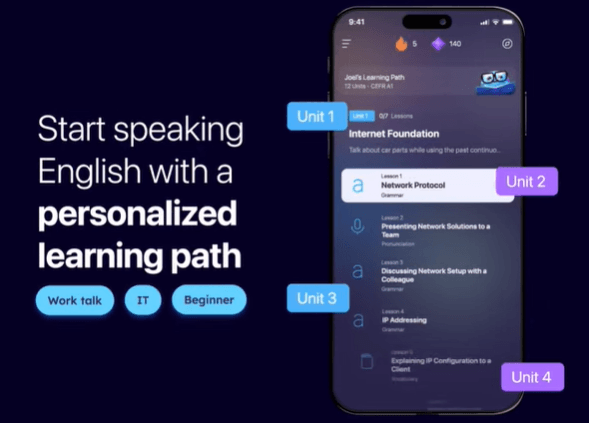
ELSA Speak uses deep-learning ASR to give EFL learners real-time phoneme feedback, making pronunciation coaching accessible regardless of income or location. 50M+ users; PLOS ONE (2025) and Vien Dong College study (2024) confirm gains in Vietnamese university cohorts.
50 million+
Users worldwide (as of 2024)
195 countries
Countries reached (as of 2024)
77.3 %
Students rating ELSA effective or highly effective (one semester, 2024)
81.8 %
Students reporting increased speaking confidence (2024)
ELSA (English Language Speech Assistant) was co-founded in Vietnam in 2015 to give EFL learners in Vietnam and across the Global South access to pronunciation coaching they could not otherwise afford, using deep-learning automatic speech recognition to detect errors at the phoneme level without a human teacher.
Objectives
The app aims to deliver real-time, personalised phoneme-level pronunciation feedback at a cost and scale that native-speaker tutoring cannot match. Several Vietnamese higher-education institutions have formally embedded it in English pronunciation courses in place of, or alongside, one-to-one tutoring.
Activities
Learners record spoken English into the app, which applies proprietary ASR to flag phoneme-level pronunciation errors and give instant personalised feedback. The platform has scaled to 195 countries and over 50 million users, with Vietnam historically its largest market (80-90% of early users, now around 20% as the platform globalised).
Results
A peer-reviewed PLOS ONE study (January 2025, n=205 English-major students at a Vietnamese university) found high self-reported satisfaction with usefulness, ease of use and pronunciation improvement. A pre-/post- study at Vien Dong College, Ho Chi Minh City (2024, n=63, one semester) found 77.3% of students rated ELSA effective or highly effective and 81.8% reported increased speaking confidence. A further study in IJIRSS documented high motivation and engagement among Vietnamese EFL learners.
Conclusions
The evidence base is consistent but modest: all published studies rely on self-reported satisfaction and small, non-randomised samples with no independent standardised proficiency measure, and the proprietary ASR model has not been independently audited for accuracy or bias. Data are governed under US CCPA rather than GDPR or Vietnamese law, and systematic integration into formal schooling — rather than self-study — remains the exception.
Short (< 1 year) — Immediate to adopt (app download); institutional embedding into a course typically takes one semester.
Staffing & skills
No teacher or institutional staff required for the core app — it is fully self-service and teacher-free by design, Institutions that embed ELSA in courses do so through existing English-language faculty rather than dedicated staff
Conditions for success
Smartphone and internet access for learners
Institutional willingness to formally embed the app in pronunciation courses rather than leave it to self-study
Common failure modes
Proprietary ASR model has not been independently audited for accuracy or bias
Data governed under US CCPA rather than GDPR or Vietnamese data-protection law
Evidence relies on small, non-randomised, self-reported samples
Where it fits
Governance type
private company (direct-to-consumer/institutional app)
Scale
global (195 countries, 50M+ users), strongest adoption in Vietnam
Income level
aimed at Global South / lower-cost-access learners
Commonly funded by
Own resources / municipal budget
Indicative funding routes for practices of this type — always check each programme's current calls and eligibility rules.
Do you run this practice?
Claim it —
verified implementers get a public contact pathway and can propose corrections.
Data sources
Where this practice's information was retrieved from, and when.
A peer-reviewed Fiji Ministry of Education study combined child-functioning survey data with learning-support-needs data in a rule-based algorithm that more …
A solar-powered tablet game teaches literacy and numeracy to out-of-school children in conflict-affected Sudan. A 2020 peer-reviewed study found significantly …