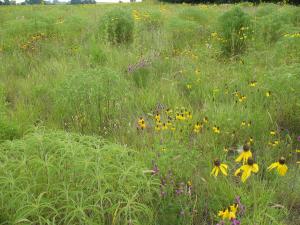
Since 1986 Minnesota has paid landowners a one-time fee for easements retiring marginal cropland, wetlands and prairie. State agency BWSR reports over $200M has secured 250,000+ acres across 6,000+ easements, funded chiefly via the Clean Water, Land and Legacy Amendment.
200 USD million+
Cumulative state funds secured (1986-present)
250,000+ acres
Acres protected (1986-present)
6,000+ easements
Easements (1986-present)
7,276 acres
RIM-WRP Phase 1 acres protected (2009-2012)
343 jobs
RIM-WRP Phase 1 jobs sustained (USDA estimate) (FY2010)
Details
Maturity
Established
Promoter
Minnesota Board of Water and Soil Resources (BWSR)
Period
1986-present
Keywords
agriculture, water quality, wetlands, wildlife habitat, conservation easements
Context
Reinvest in Minnesota (RIM) Reserve is a state conservation-easement programme created by the Reinvest in Minnesota Resources Act of 1986 (Minn. Stat. §§103F.505-103F.531), administered by the Minnesota Board of Water and Soil Resources (BWSR) with delivery through county Soil and Water Conservation Districts (SWCDs).
Objectives
Retire marginal cropland, wetlands and prairie from farming and restore conservation cover, protecting water quality and wildlife habitat while keeping land in private ownership and on the tax rolls.
Activities
Landowners receive a one-time payment, calculated from township average land values or a share of tax-assessed value, in exchange for a permanent or long-term easement. Funding comes chiefly from the Outdoor Heritage Fund and Clean Water Fund created by the 2008 Clean Water, Land and Legacy constitutional amendment, plus the Environmental and Natural Resources Trust Fund, state bonding and federal partnerships such as USDA NRCS's Wetlands Reserve Program (delivered jointly as RIM-WRP).
Results
Cumulatively, more than $200 million in state funds have secured over 6,000 easements on more than 250,000 acres since the programme began. A documented tranche, RIM-WRP Phase 1 (FY2010), allocated $9,059,500 in Outdoor Heritage Fund money, leveraged over $12.6 million in federal WRP funds, and paid landowners $6.3 million to protect 7,276 acres (2,423 wetland and 4,853 upland) across 63 easements between July 2009 and June 2012 — USDA estimated the work sustained 343 jobs. A BWSR project profile for one lake-restoration easement cluster documents over two tons of sediment, 16 pounds of phosphorus and six million gallons of annual runoff kept out of area lakes, illustrating the programme's water-quality logic rather than a statewide total.
Conclusions
RIM has real limitations. An agricultural-press column (Agweek) argues its permanent easements bind future landowners who received no compensation, sometimes removing high-yield farmland from production for good, with no re-evaluation mechanism beyond the initial 15-20 year impact window. The RIM-WRP Phase 1 tranche itself returned $1.14 million unspent, pointing to enrollment friction. No independent, peer-reviewed evaluation of statewide water-quality or wildlife outcomes could be located.
Implementation
Indicative cost
High (€500k–€5M) — One-time per-acre payment calculated from township average land values or a share of tax-assessed value; cumulative $200M+ in state funds since 1986, plus federal leverage (e.g. $12.6M federal WRP funds in one tranche).
Time to results
Long (> 3 years) — Permanent or long-term (15-20 year minimum impact window) easements; programme running continuously since 1986.
Staffing & skills
Minnesota Board of Water and Soil Resources (BWSR) state staff, County Soil and Water Conservation Districts (SWCDs) — local delivery and administration, USDA NRCS (joint delivery of RIM-WRP tranches)
Conditions for success
Dedicated, constitutionally protected funding stream (Clean Water, Land and Legacy Amendment)
Local delivery through county SWCDs close to landowners
Federal cost-share leverage via the USDA NRCS Wetlands Reserve Program partnership
Common failure modes
Permanent easements can bind future landowners who received no compensation, removing high-yield farmland from production with no re-evaluation mechanism (Agweek critique)
Enrollment friction — RIM-WRP Phase 1 returned $1.14 million unspent
No independent verification of statewide water-quality or wildlife outcomes
Where it fits
Governance type
state government programme with county-level delivery
Scale
state-wide (Minnesota)
Income level
high-income
Commonly funded by
National / regional programmes
Indicative funding routes for practices of this type — always check each programme's current calls and eligibility rules.
Do you run this practice?
Claim it —
verified implementers get a public contact pathway and can propose corrections.
Data sources
Where this practice's information was retrieved from, and when.
France's 2021–2024 national PES pilot paid nearly 3,500 farmers across 130 territories for water-quality, soil and biodiversity outcomes, contracting up …