The Matlab Family Planning–Health Services Programme, Bangladesh (icddr,b)
Bangladesh
Since 1977, icddr,b's family planning programme in Matlab, Bangladesh has been rigorously studied, cutting fertility ~25% — but 35-year follow-up …
Mali · Kayes · See the Mali profile
Evidence: Observational / pre–post Top 17% 89/100 · Ask Evidence Copilot about this practice
SWEDD (World Bank/UNFPA) in Mali: safe spaces, midwife deployment, husbands' clubs and school-retention support since 2015. Girls' dropout in project areas fell 53%→2% (2016–19); women's monthly income rose $5→$110 (2014–20); 15 midwife practices, 7,900 bicycles since 2019.
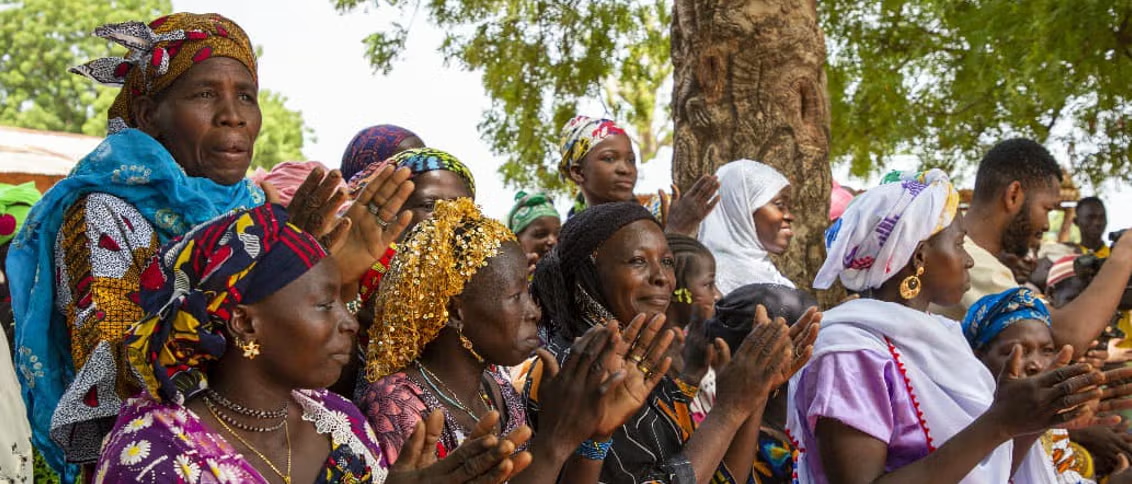
SWEDD is a multi-country initiative financed by the World Bank (IDA) with technical support from UNFPA and the West African Health Organisation (WAHO). Mali was one of the original five countries when the project was approved in December 2014 and launched in November 2015, remaining active today through successive additional financings and the SWEDD+ phase.
In Mali, activities are concentrated in Kayes, Koulikoro and Sikasso and combine girls' 'safe spaces', school-retention support, deployment of rural midwives, and community husbands'/future-husbands' clubs aimed at shifting norms around child marriage and household decision-making.
World Bank reporting shows the girls' school drop-out rate in Mali's SWEDD project areas fell from 53% in 2016 to 2% in 2019, and women's average monthly income from project-supported economic activities rose from about US$5 in 2014 to about US$110 in 2020. Since 2019 the project has helped establish 15 private midwifery practices and distributed bicycles to 7,900 girls; one flagship midwifery practice in Banankoro delivered 4,400 curative consultations, 2,100 antenatal consultations and 700 deliveries over four years.
Not all publicised figures are Mali-specific or independently verified — several widely cited totals are regional aggregates across all SWEDD countries, and the World Bank's own implementation review flags operational gaps, including menstrual-hygiene kits for Mali schoolgirls that did not reach them in time and in insufficient quantity. Results should be read as programme-reported achievements pending independent impact evaluation.
Implementation detail (cost, timeline, staffing, conditions for success) is not yet available for this practice.
National / regional programmes
Indicative funding routes for practices of this type — always check each programme's current calls and eligibility rules.
Do you run this practice? Claim it — verified implementers get a public contact pathway and can propose corrections.
Where this practice's information was retrieved from, and when.
Bangladesh
Since 1977, icddr,b's family planning programme in Matlab, Bangladesh has been rigorously studied, cutting fertility ~25% — but 35-year follow-up …
China
Since 1989, the China Children and Teenagers' Fund's Spring Bud Project has funded schooling, mentoring and skills training for 4.22 …
Pakistan
Since 1994 Pakistan has employed women (eight years' schooling minimum) as community health workers, about 90,000 serving roughly 115 million …
India
West Bengal's flagship conditional cash transfer for schoolgirls aims to delay marriage. A Warwick study estimates a 6.7% lower child-marriage …
Open full copilot Grounded in cited practices — always check the sources.