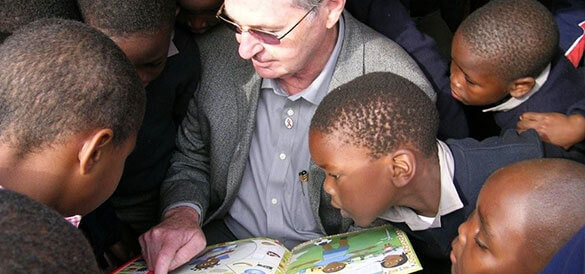
South African NGO Speaking Books embeds sound chips in illustrated 16-page books that narrate health information aloud in a reader's own language, reaching people who cannot read; it reports 200,000+ books across 35+ countries and 40 languages, though independent outcome evaluati
200000 books (200,000+)
Books distributed
35 countries (35+)
Countries reached
40 languages (~40)
Languages available
100 topics (100+)
Health topics covered
120 additional people per book (120+)
Estimated onward reach per book (UNICEF estimate)
20 years (2005-present)
Years in continuous operation
Details
Maturity
Established
Promoter
Speaking Books
Period
2005–present
Keywords
health literacy, audio technology, low-literacy inclusion, public health, NGO
Context
Speaking Books, a South African NGO founded in 2005 by Zane Wilson, embeds a small sound chip in illustrated 16-page booklets that narrate health information aloud in a listener's own language at the turn of a page — requiring no smartphone, electricity or reading literacy.
Objectives
Reach people that printed health materials alone cannot reach, covering topics such as HIV/AIDS, tuberculosis, malaria, maternal health, depression and suicide prevention, narrated by local voices, sometimes trusted public figures.
Activities
Over 20 years of continuous operation, Speaking Books has produced and distributed books with institutional partners including UNICEF, USAID and Save the Children.
Results
The organisation and independent reporting (the Borgen Project) report more than 200,000 books distributed, covering over 100 topics in around 40 languages across more than 35 developing countries; UNICEF estimates each book is shared onward to reach 120 or more additional people.
Conclusions
These are output figures — books produced and distributed — not measured outcomes; no controlled study of whether the books actually change health knowledge or behaviour was found, so real-world impact, while plausible and long-sustained, is not independently evidenced.
Implementation
Indicative cost
Medium (€50k–€500k)
Time to results
Long (> 3 years)
Staffing & skills
Founded and run by Speaking Books (South African NGO, founded by mental-health practitioner Zane Wilson); local narrators, sometimes trusted public figures, recorded in the listener's own language
Conditions for success
No smartphone, electricity or reading literacy required — only pressing a button as the page turns
Local-language, culturally trusted narration
Sustained institutional partnerships (UNICEF, USAID, Save the Children) supporting distribution across 35+ countries
Commonly funded by
Philanthropic / foundation funding
Indicative funding routes for practices of this type — always check each programme's current calls and eligibility rules.
Do you run this practice?
Claim it —
verified implementers get a public contact pathway and can propose corrections.
Data sources
Where this practice's information was retrieved from, and when.
A Vietnamese NGO where blind and low-vision engineers lead development of free screen-reader-compatible software (Braille transcription, text-to-speech, e-book reading); Zero …
OLE Nepal deploys offline digital libraries (E-Pustakalaya) and interactive learning software (E-Paath) on local servers in remote Nepali schools without …