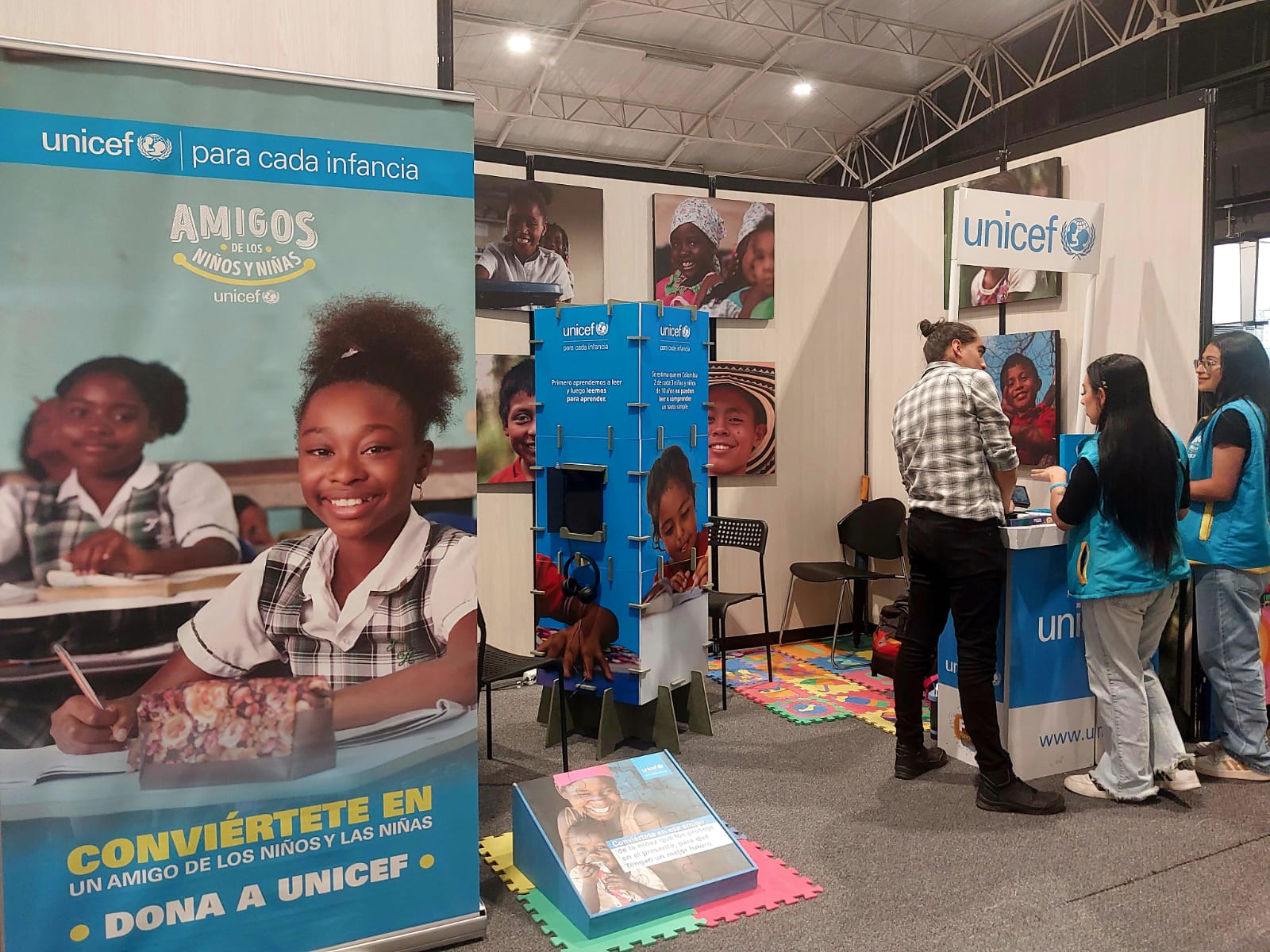
Colombia, one of UNICEF's original Latin American pilot countries for Accessible Digital Textbooks, adapted its first three children's titles with 12 partner institutions and built the region's online course on Universal Design for Learning so teachers can produce audio-narrated,
9.4 %
Access to reading materials among children with disabilities (Colombia)
2 in 3
10-year-olds unable to read a simple text (Colombia)
UNICEF's Accessible Digital Textbook (ADT) initiative, running since 2016-2017, gives children with and without disabilities the same reading materials in accessible formats — audio narration, integrated sign-language video, image audio-descriptions and simplified language — built to Universal Design for Learning (UDL) principles. UNICEF Colombia cites national figures that only 9.4% of children with disabilities in Colombia have access to reading materials, alongside a wider literacy gap in which two of every three 10-year-olds cannot read a simple text.
Activities
Colombia was one of six original Latin America & Caribbean pilot countries. On 23 April 2024, at the Bogotá International Book Fair, Colombia's Ministry of National Education, UNICEF, Fundación Saldarriaga Concha, INCI, INSOR, MinTIC and MinCulturas jointly launched the country's own accessible-digital-book (LDA) programme: 30+ participants from 12 public and private entities adapted a first batch of three children's titles for publication on the Colombia Aprende portal, with gradual library expansion planned from the second half of 2024. Colombia and Paraguay were specifically tasked with developing the region's online course on UDL and ADT production and use.
Results
Regionally, the initiative has trained more than 1,600 ministry staff, teachers and other stakeholders across six Latin American and Caribbean countries, produced 60+ prototype accessible textbooks, and reached over 2,500 students, winning the Zero Project Award 2024 from 523 nominations across 97 countries. Production is increasingly automated through a 2024 UNICEF-OpenAI pipeline that converts existing curriculum materials into accessible HTML in days rather than months, at over 80% accuracy, still requiring human quality assurance.
Conclusions
As of the Ministry's own announcement, Colombia's first three adapted titles were still undergoing usability and accessibility validation with children rather than a published learning-outcome evaluation, and region-wide figures on staff trained and students reached are not broken out by country.
Implementation
Indicative cost
Medium (€50k–€500k)
Time to results
Medium (1–3 years)
Staffing & skills
UNICEF Colombia, Ministerio de Educación Nacional (Colombia), Fundación Saldarriaga Concha, INCI — Instituto Nacional para Ciegos, INSOR — Instituto Nacional para Sordos, MinTIC, MinCulturas
Conditions for success
a cross-sector coalition spanning education, disability-specialist institutes (INCI, INSOR), technology and culture ministries
adherence to Universal Design for Learning (UDL) principles across every adapted title
a shared regional online course on UDL/ADT production so capacity built in one country (Colombia and Paraguay) transfers to others
an AI-assisted production pipeline paired with mandatory human quality assurance before publication
Commonly funded by
Philanthropic / foundation fundingNational / regional programmes
Indicative funding routes for practices of this type — always check each programme's current calls and eligibility rules.
Do you run this practice?
Claim it —
verified implementers get a public contact pathway and can propose corrections.
Data sources
Where this practice's information was retrieved from, and when.
An offline Kolibri learning platform paired with a socio-emotional curriculum reached 714 refugee and host-community children in Palabek, Uganda. Paragraph-reading …
Since December 2022 the Dominican Republic's MINERD and UNICEF have built AI-converted Accessible Digital Textbooks — audio narration, sign language, …