Upstream Thinking — South West Water Catchment Management Programme (UK)
United Kingdom
Since 2010, South West Water has paid 2,000+ Devon and Cornwall farmers to cut diffuse pollution across 144,120 ha, investing …
United Kingdom · Glossop · See the United Kingdom profile
Evidence: Observational / pre–post Top 7% 67/100 · Ask Evidence Copilot about this practice
United Utilities' £22.2M Sustainable Catchment Management Programme (2005-2015) paid tenant farmers across 57,000 hectares of Peak District and Forest of Bowland moorland to restore peat and woodland, lifting SSSI land in favourable condition from 14% to about 99%.
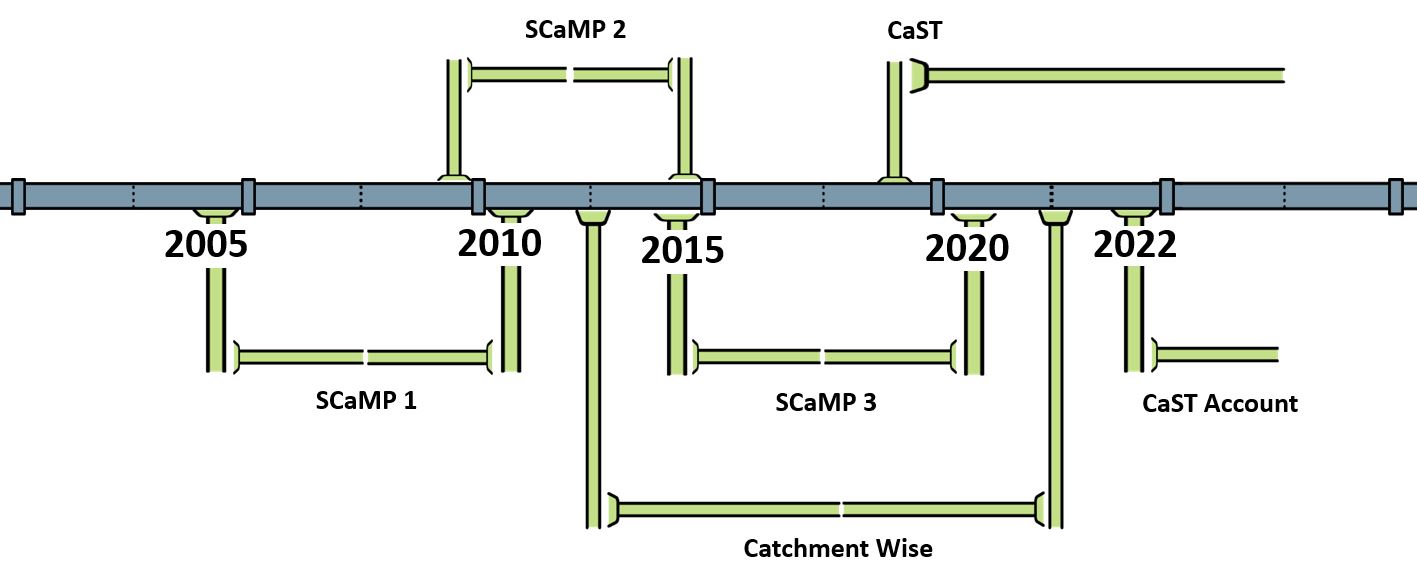
United Utilities, the water and wastewater utility serving North West England, launched the Sustainable Catchment Management Programme (SCaMP) in 2005 to pay tenant farmers on its own upland landholdings to shift from intensive grazing toward peatland and habitat restoration that protects drinking-water sources. SCaMP 1 (2005-2010) covered about 27,000 hectares across the Peak District and Forest of Bowland at a cost of £10.6 million; SCaMP 2 (2010-2015) extended the model to a further 30,000 hectares across 53 tenant farms in Cumbria and South Lancashire, costing £11.6 million from United Utilities plus £2.7 million in grants from Natural England and the Forestry Commission. Delivery partners included the RSPB, with support from regulators Ofwat, the Drinking Water Inspectorate, the Environment Agency and Natural England.
Shift tenant farming away from intensive grazing toward peatland and habitat restoration practices that protect the raw drinking-water sources United Utilities draws from its upland catchments.
Across both phases, SCaMP funded planting of 608 hectares of upland oak woodland (520,000 trees), blocking of 320 km of moorland drainage 'grips' to re-wet peat, re-vegetation of 10,905 hectares of bare peat, 258 km of new fencing and 21 stock buildings.
Natural England's condition assessment found that the proportion of the roughly 17,500 hectares of Site of Special Scientific Interest (SSSI) land in 'favourable' or 'unfavourable recovering' condition rose from just 14% before SCaMP to about 99% (United Utilities cites 99.4% in some materials, 98.6% in others). Independent long-term monitoring by ecological consultancy Penny Anderson Associates, running for at least a decade, tracked water colour, turbidity and peat water-table levels across 12,300 hectares of blanket bog, finding largely stable-to-improving trends outside the most severely degraded areas. Peer-reviewed peatland literature notes that drain-blocking can temporarily increase nutrient and dissolved organic carbon leaching for up to five years before water-colour benefits emerge -- a general caveat for this restoration technique rather than a SCaMP-specific failure.
SCaMP was a time-bound, two-phase programme that formally ran 2005-2015, not an open-ended fund; United Utilities has continued catchment work since under other programme names. Much of the detailed evaluation comes from United Utilities' own materials and a consultancy it contracted directly, so independence is partial, though it is corroborated by RSPB, the IUCN UK Peatland Programme and the Catchment Based Approach partnership network.
Own resources / municipal budget
Indicative funding routes for practices of this type — always check each programme's current calls and eligibility rules.
Do you run this practice? Claim it — verified implementers get a public contact pathway and can propose corrections.
Where this practice's information was retrieved from, and when.
United Kingdom
Since 2010, South West Water has paid 2,000+ Devon and Cornwall farmers to cut diffuse pollution across 144,120 ha, investing …
New Zealand
A 10-year, NZ$20 million partnership (2013-2023) between dairy co-operative Fonterra and New Zealand's Department of Conservation enhanced 5,213 ha across …
Uganda
Since 2019, Nile Breweries and WWF Uganda have restored 80.3 ha and demarcated 270 ha of degraded riverbank along a …
Estonia
Estonia's 2015–2021 LIFE Mires programme restored natural water conditions on nearly 8,000 hectares of drained peatland by closing 317km of …
Open full copilot Grounded in cited practices — always check the sources.