Metro Manila's Urban Greening Initiative — DENR Mini-Forests, Tree Corridors & Green-Space Mapping
Philippines
DENR's Metro Manila office has built mini-forests, linear parks and tree corridors since 2019, lifting the region's green cover from …
Jordan · Amman · See the Jordan profile · See the Amman profile
Evidence: Descriptive / self-reported Top 76% 33/100 · Ask Evidence Copilot about this practice
Amman's municipality and Germany's GIZ adapted the dense Miyawaki afforestation method — first tried in the Middle East here — to plant native, irrigation-free mini-forests up to 250m² in East Amman's poorest districts, under an €8m BMZ-funded programme (2017–2021).
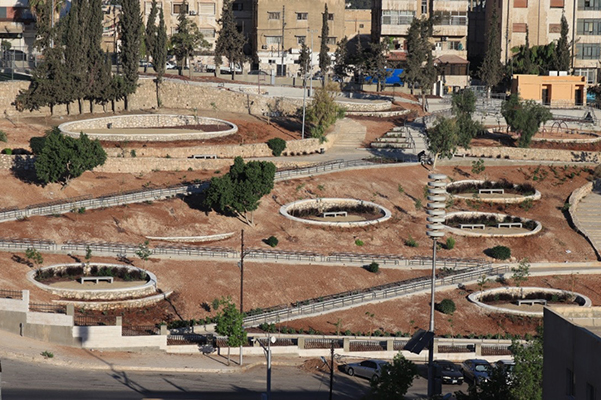
Amman's East district is densely populated, low-income and short on green space in an arid climate, prompting a GIZ/BMZ-funded response with Jordan's Ministry of Environment and Greater Amman Municipality.
The 'Urban Micro-Lungs' initiative adapted the dense, multi-layered Miyawaki afforestation method — for the first time in the Middle East — using around 40 native species (18 used at public sites) planted at about three seedlings/m2 with engineered soil; three sites have been planted since a November 2018 private-garden pilot, including two public parks in November 2020 (largest 250m2), needing irrigation for 2-3 years before self-sustaining.
Reported outcomes are mostly at output level — sites built, funding spent (up to €8m BMZ), a plant-species selection guidebook published for GAM to scale city-wide — plus anecdotal sightings of new birds and insects by gardeners; no quantified biodiversity, carbon or temperature monitoring for the Amman sites has been published.
National / regional programmes
Indicative funding routes for practices of this type — always check each programme's current calls and eligibility rules.
Do you run this practice? Claim it — verified implementers get a public contact pathway and can propose corrections.
Where this practice's information was retrieved from, and when.
Philippines
DENR's Metro Manila office has built mini-forests, linear parks and tree corridors since 2019, lifting the region's green cover from …
Singapore
Singapore's national tree-planting programme, run by NParks under the Green Plan 2030, had planted over 832,000 of a targeted 1 …
Australia
Melbourne's 2012 Urban Forest Strategy set a 20-year target to double tree canopy from 20% to 40% by planting over …
Portugal
An EU LIFE-funded programme (2019-2025) converting irrigated Lisbon parkland into rain-fed meadows and planting over 107,000 trees and shrubs, cutting …
Open full copilot Grounded in cited practices — always check the sources.