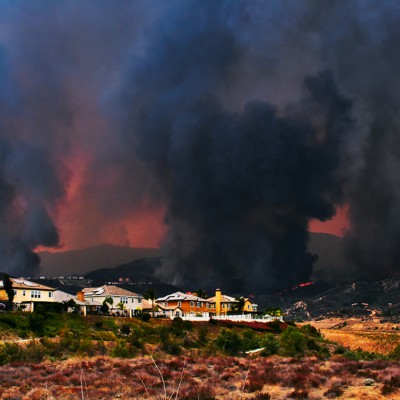
UC San Diego's ALERTCalifornia network of 1,200+ AI-monitored cameras helped CAL FIRE respond to roughly 3,600 wildfire incidents in 2025; in over half of documented dispatches, officials were alerted before any 911 call came in, and six fires were kept under an acre.
1,200+
Cameras in the network
~3,600
Wildfire incidents informed in 2025 (2025)
278
Wildland-fire dispatches examined
190 of 278
Dispatches flagged before or at same time as a 911 call
6
Fires with no 911 call received, kept under one acre
~2 minutes
Camera sweep frequency
60 miles
Daytime camera visibility range
120 miles
Night-time camera visibility range
Details
Maturity
Established
Promoter
CAL FIRE (California Department of Forestry and Fire Protection) with UC San Diego's ALERTCalifornia programme
Period
Camera network built out from 2013 (as ALERTWildfire) and expanded under UC San Diego from 2019; 2025 fire-season results reported July 2026
Keywords
wildfire detection, computer vision, remote sensing, emergency response, public safety
Context
ALERTCalifornia is a University of California San Diego programme, led by Scripps Institution of Oceanography researchers Neal Driscoll and Falko Kuester, that operates a statewide network of more than 1,200 high-definition, pan-tilt-zoom cameras in partnership with CAL FIRE and the US Forest Service.
Activities
The cameras perform a 360-degree sweep roughly every two minutes, use near-infrared sensors for night vision, and can see up to 60 miles by day and 120 miles at night; they are also used after a fire is out to monitor cascading disasters such as the erosion of burned hillsides that have lost their root structure.
Results
In 2025, the platform helped inform CAL FIRE's response to approximately 3,600 wildfire incidents; of 278 wildland-fire dispatches examined, officials were alerted to smoke or fire activity via the camera network before or at the same time as a 911 call in 190 cases, and for at least six fires no 911 call was ever received at all, with early detection keeping every one of those six fires under one acre in size.
Conclusions
Officials describe the value chiefly in terms of speed, since an automated feed flagging a change in smoke colour or density removes the delay otherwise spent verifying a member of the public's 911 report, though neither CAL FIRE nor UC San Diego has published a formal third-party audit of detection accuracy, false-positive rates, or cost-effectiveness relative to the traditional lookout-and-911 model.
Implementation
Indicative cost
High (€500k–€5M)
Time to results
Long (> 3 years)
Staffing & skills
Led by UC San Diego Scripps Institution of Oceanography researchers Neal Driscoll and Falko Kuester, in partnership with CAL FIRE and the US Forest Service.
Conditions for success
Multi-agency partnership between a research university (UC San Diego), the state fire agency (CAL FIRE) and the US Forest Service.
Statewide camera infrastructure built out over more than a decade.
Automated near-infrared night vision reducing reliance on public 911 reporting for verification.
Common failure modes
No published independent audit of detection accuracy, false-positive rates, or cost-effectiveness versus the traditional lookout-and-911 model.
Commonly funded by
National / regional programmes
Indicative funding routes for practices of this type — always check each programme's current calls and eligibility rules.
Do you run this practice?
Claim it —
verified implementers get a public contact pathway and can propose corrections.
Data sources
Where this practice's information was retrieved from, and when.