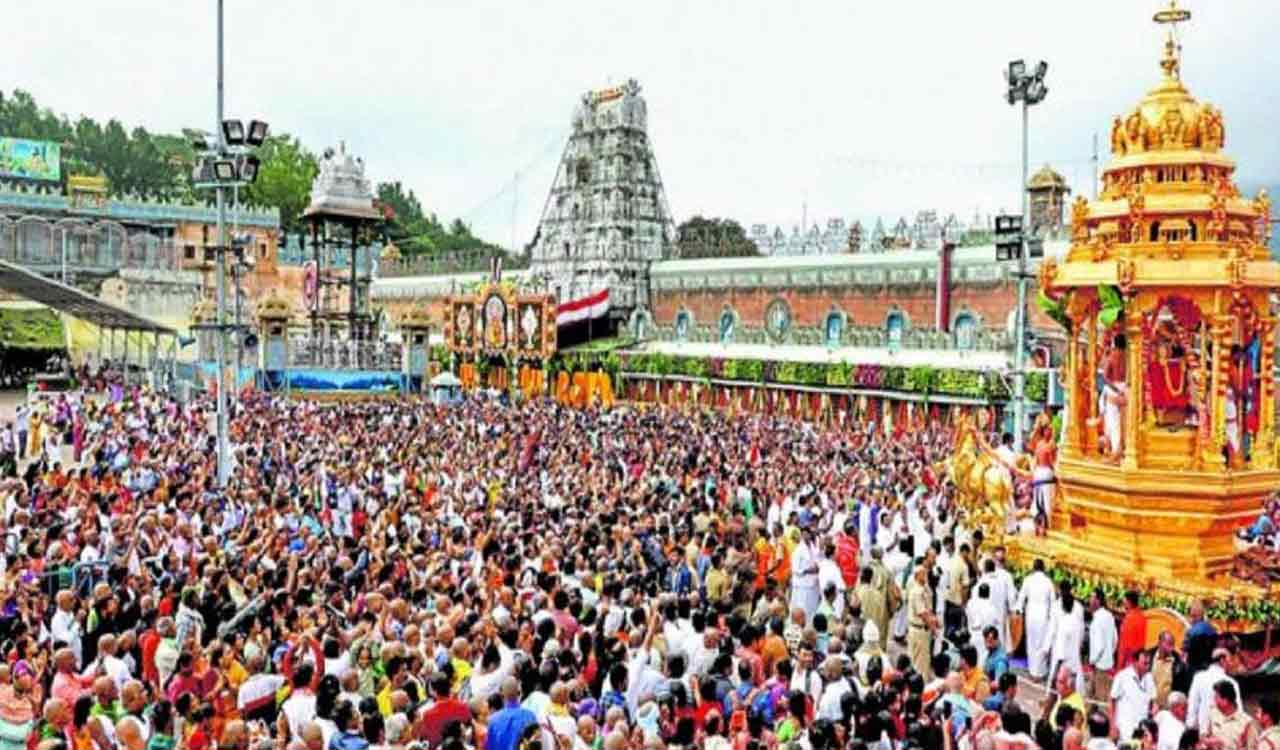
TTD's new Integrated Command Control Centre uses 6,000+ AI cameras to process 518 million events daily, predicting darshan queue times for the world's busiest pilgrimage site — even as TTD says crowd-safety liability sits with local police, not itself.
6,000+
AI-linked cameras deployed
~360,000
Data payloads processed per minute
~518 million
Events processed per day
~2.5 billion
Inferences processed per day
Details
Maturity
Pilot
Promoter
Tirumala Tirupati Devasthanams (TTD)
Period
2026
Keywords
public safety, crowd management, pilgrimage administration, emergency response
Context
In 2026, the Tirumala Tirupati Devasthanams (TTD), the statutory trust that administers the Sri Venkateswara temple in Tirumala, Andhra Pradesh, inaugurated an Integrated Command Control Centre (ICCC) that TTD describes as India's first AI-powered command hub built specifically for a pilgrimage site.
Objectives
Housed at the Vaikuntham Queue Complex–I, the centre combines over 6,000 AI-linked cameras, 3D situational maps and live dashboards to predict 'sarva darshanam' waiting times, visualise congestion in real time, flag red-zone crowding, and coordinate queue compartments and accommodation status across the site, plus facial-recognition-assisted search for missing persons, automated distress alerts and guided evacuation routes.
Activities
TTD reports that the system processes about 360,000 data payloads every minute, amounting to roughly 518 million events and 2.5 billion inferences per day.
Results
TTD states that since the centre opened it has enabled additional darshan hours without added congestion, cut waiting times, and extended camera-based headcounts to children below token age for the first time.
Conclusions
These figures come from TTD's own statements as relayed by Indian media, not from an independently published evaluation. There is also a live accountability question: in a separate legal matter concerning a fatal stampede at a Tirumala event, TTD's own Executive Officer stated that TTD's jurisdiction is limited to Tirumala and that crowd-management responsibility rests with local administration and police — a position that sits uneasily alongside TTD's promotion of the ICCC as a 'reference model' for temple crowd governance. Until an independent body evaluates the centre's actual safety impact and TTD's accountability role is clarified, this practice should be treated as a large-scale, well-resourced pilot rather than a proven safety intervention.
Implementation
Indicative cost
High (€500k–€5M) — Not quantified in sources reviewed.
Time to results
Short (< 1 year) — Inaugurated 2026; described as newly operational at time of reporting.
Staffing & skills
Tirumala Tirupati Devasthanams (TTD), the statutory trust administering the temple
A large integrated camera network (6,000+ AI-linked cameras) with 3D mapping and live dashboards
Common failure modes
Accountability is contested: TTD's own Executive Officer stated in a separate stampede-related legal matter that crowd-management responsibility rests with local administration and police, not TTD, despite TTD promoting the ICCC as a 'reference model' for temple governance
No independent evaluation of the centre's actual safety impact has been published
Where it fits
Governance type
statutory religious trust (TTD) operating alongside local police/administration
Scale
single very-high-footfall pilgrimage site
Do you run this practice?
Claim it —
verified implementers get a public contact pathway and can propose corrections.
Data sources
Where this practice's information was retrieved from, and when.