RESILAND CA+ Tajikistan Resilient Landscape Restoration Project — Vakhsh Catchment
Tajikistan
A $45M World Bank IDA grant, approved Feb 2022, funds forest, pasture and soil-erosion restoration across southern Tajikistan's Vakhsh catchment, …
Algeria · Djelfa · See the Algeria profile
Evidence: Observational / pre–post Top 76% 33/100 · Ask Evidence Copilot about this practice
Algeria's Barrage Vert (1971-) afforestation belt reports conflicting outcomes: FAO cites ~75% survival, an independent study found ~42%, and a Djelfa remote-sensing study showed planted canopy collapsing 43% between 2009 and 2019.
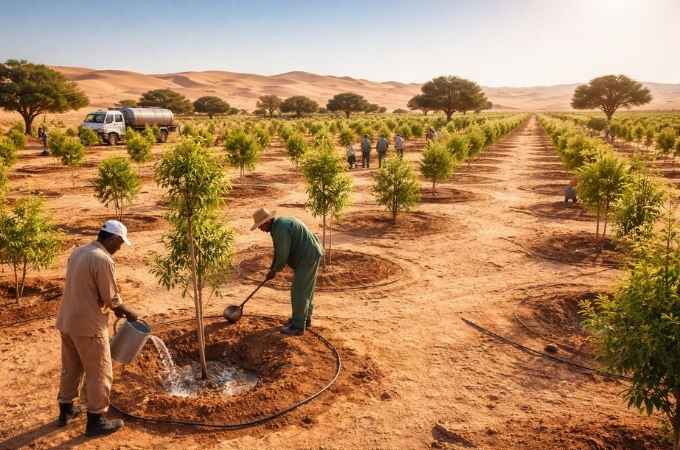
The Barrage Vert (Green Dam) was conceived under President Houari Boumediene and launched around 1970-71, formalised by 1974, as a state afforestation belt intended to run roughly 1,000-1,500 km along Algeria's High Plateaus and steppe zone, about 20 km wide, to hold back desertification from the south. It was carried out by the Direction Generale des Forets (DGF) via military conscripts and later the Office National des Travaux Forestiers, and Algeria folded it into the African Union's Great Green Wall for the Sahara and Sahel Initiative after 2007.
The original programme planted Aleppo pine (Pinus halepensis) at high density on the High Plateaus. A 2023-2030 relaunch framework took effect on 29 October 2023, coordinated under Decree 24-376 (18 November 2024), pivoting away from the original monoculture approach toward agroforestry with native and diverse species (Atlas pistachio, holm oak, acacia, carob, argan, olive, almond) and greater involvement of local pastoralist populations in planning and maintenance.
Reported results diverge sharply by source: an FAO technical note cites about 100,000 ha reforested with a claimed 75% survival rate after ten years, while an independent academic review ('Bilan critique du barrage vert en Algerie') finds only 120,000 of 160,000 ha planned were realised, with roughly 42% survival, failure rates above 40%, and about 20% further loss to pine processionary moth infestation. A peer-reviewed remote-sensing study of the Moudjbara perimeter in Djelfa Province found open-plantation canopy growing from 0 ha in 1972 to 11,074 ha by 2009, then collapsing 43% to 6,303 ha by 2019. As of December 2025, Algeria's DGF reports roughly 26,000 ha reforested since the October 2023 relaunch, against a national forest patrimony of about 4.1 million hectares (some 2% of national land area).
The programme's documented weaknesses are extensive: excessive planting density (over 1,600 stems/ha) on shallow, encrusted soils poorly suited to Aleppo pine; heavy losses to overgrazing, illegal cutting and pest infestation; and FAO describes natural regeneration in stands over 60 years old as 'practically null'. Minimal local and pastoralist involvement in the early decades undermined long-term maintenance — a gap the 2020s relaunch is attempting to correct. Reported survival/canopy figures also diverge sharply between sources, illustrating a persistent reporting-consistency problem.
National / regional programmes
Indicative funding routes for practices of this type — always check each programme's current calls and eligibility rules.
Do you run this practice? Claim it — verified implementers get a public contact pathway and can propose corrections.
Where this practice's information was retrieved from, and when.
Tajikistan
A $45M World Bank IDA grant, approved Feb 2022, funds forest, pasture and soil-erosion restoration across southern Tajikistan's Vakhsh catchment, …
Niger
Niger's 1993 Rural Code, reinforced by a 2004 forestry law and a 2020 presidential decree, gave farmers ownership of on-farm …
China
Since 2011, China's Grassland Ecological Compensation Policy has paid herders 37.5-112.5 yuan/ha to reduce grazing, investing over 150 billion yuan …
Mali
IOC and Tree Aid agroforestry programme across 90 villages in Mali and Senegal targeting 2,120 ha and 200,000 tCO2 via …
Open full copilot Grounded in cited practices — always check the sources.