Fondation des Savanes Ouest-Africaines: A Trust Fund for the W-Arly-Pendjari Complex
Benin
Created in 2012 by Benin's government, IUCN and international donors, FSOA finances ranger patrols and community programmes across the W-Arly-Pendjari …
Kazakhstan · Irgiz · See the Kazakhstan profile
Evidence: Observational / pre–post Top 76% 33/100 · Ask Evidence Copilot about this practice
ACBK and partners (Fauna & Flora, Frankfurt Zoological Society, RSPB) worked with Kazakhstan's government to expand state reserves and curb poaching, helping saiga antelope rebound from ~21,000 in 2003 to ~4.6 million by 2026 — though the boom now drives crop-conflict culls.
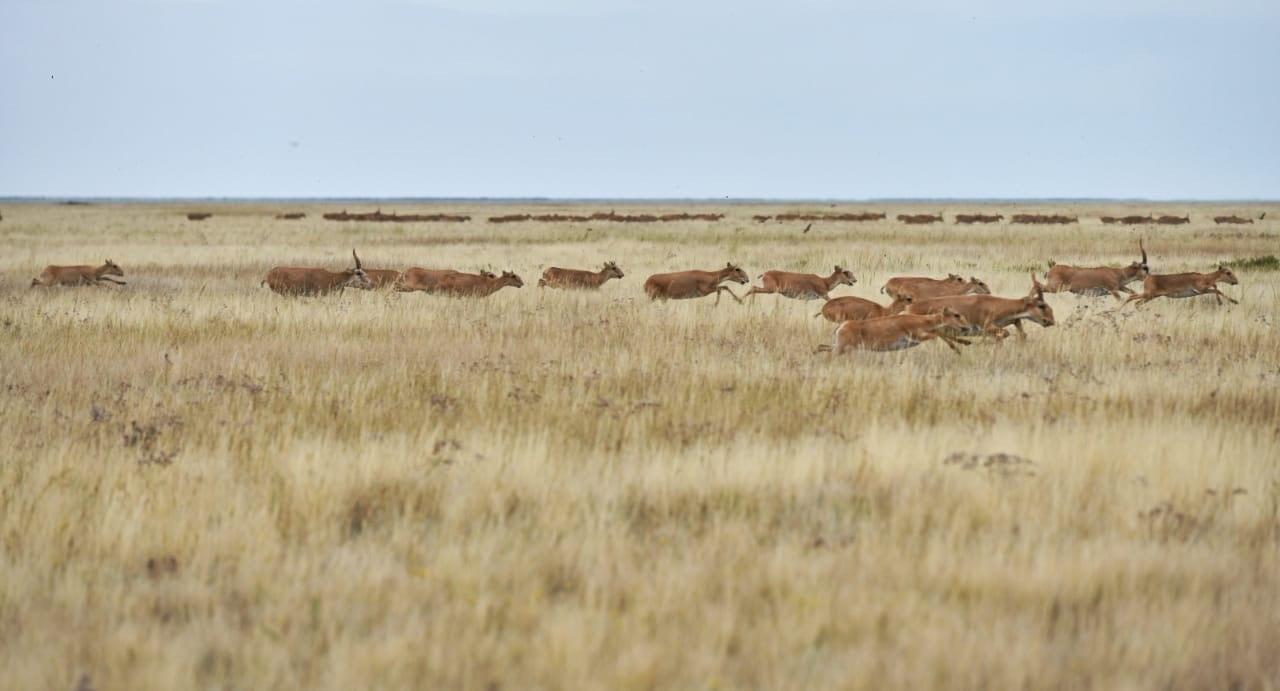
Kazakhstan's saiga antelope population collapsed from roughly 1-2 million in the early 1990s to just ~21,000 by 2003 — one of the fastest large-mammal declines ever recorded — after the collapse of Soviet-era anti-poaching enforcement opened the species to horn poaching and uncontrolled hunting.
In response, the Association for the Conservation of Biodiversity of Kazakhstan (ACBK) partnered with Fauna & Flora, the Frankfurt Zoological Society and the RSPB, together with Kazakhstan's Committee of Forestry and Wildlife, to found the Altyn Dala Conservation Initiative, aiming to curb poaching and restore the saiga population and its steppe habitat.
The initiative expanded a network of state nature reserves (zapovedniks) — including Altyn Dala (489,766 ha, established 2012), Irgiz-Turgai (763,549 ha, established 2007, later expanded to roughly 1.2 million ha) and a 2 million ha ecological corridor linking them — and trained over 250 community rangers to curb poaching. It also reintroduced kulan (Asiatic wild ass) from 2017 and Przewalski's horse from 2024.
The recovery has been dramatic and well documented: Kazakhstan's saiga population reached 334,400 by 2019, 842,000 by 2021, and an estimated 4.6 million by spring 2026 (regional aerial census using two AN-2 aircraft over 215 flight hours), prompting the IUCN to downlist the species from Critically Endangered to Near Threatened in December 2023. The initiative won the 2024 Earthshot Prize for 'Protect and Restore Nature'.
The population remains vulnerable to sudden collapse: a 2015 outbreak of haemorrhagic septicaemia killed roughly 200,000 saiga — over two-thirds of the local Betpak-Dala population — within three weeks. More recently, the recovery's very success has created a new problem: rapid population growth has driven crop damage and conflict with livestock herders in western Kazakhstan, leading the government to plan a contested cull of around 800,000 animals (roughly 20% of the population) in 2025. Saiga populations in neighbouring Russia (~38,000) and Mongolia (~15,500) remain far smaller and more fragile, underscoring that the recovery is concentrated in, and dependent on, Kazakhstan's specific conservation model.
Philanthropic / foundation funding
Indicative funding routes for practices of this type — always check each programme's current calls and eligibility rules.
Do you run this practice? Claim it — verified implementers get a public contact pathway and can propose corrections.
Where this practice's information was retrieved from, and when.
Benin
Created in 2012 by Benin's government, IUCN and international donors, FSOA finances ranger patrols and community programmes across the W-Arly-Pendjari …
Central African Republic
A trilateral conservation trust fund finances anti-poaching and protected-area management across 4.4 million hectares of Congo Basin rainforest shared by …
Georgia
German-seeded conservation trust fund financing protected-area staff and operations across Armenia, Azerbaijan and Georgia; EUR58.7M endowed since 2008 plus a …
Bhutan
Asia's first 'Project Finance for Permanence' secures 1.1 M ha of protected Himalayan forest in Bhutan via a USD 118 …
Open full copilot Grounded in cited practices — always check the sources.