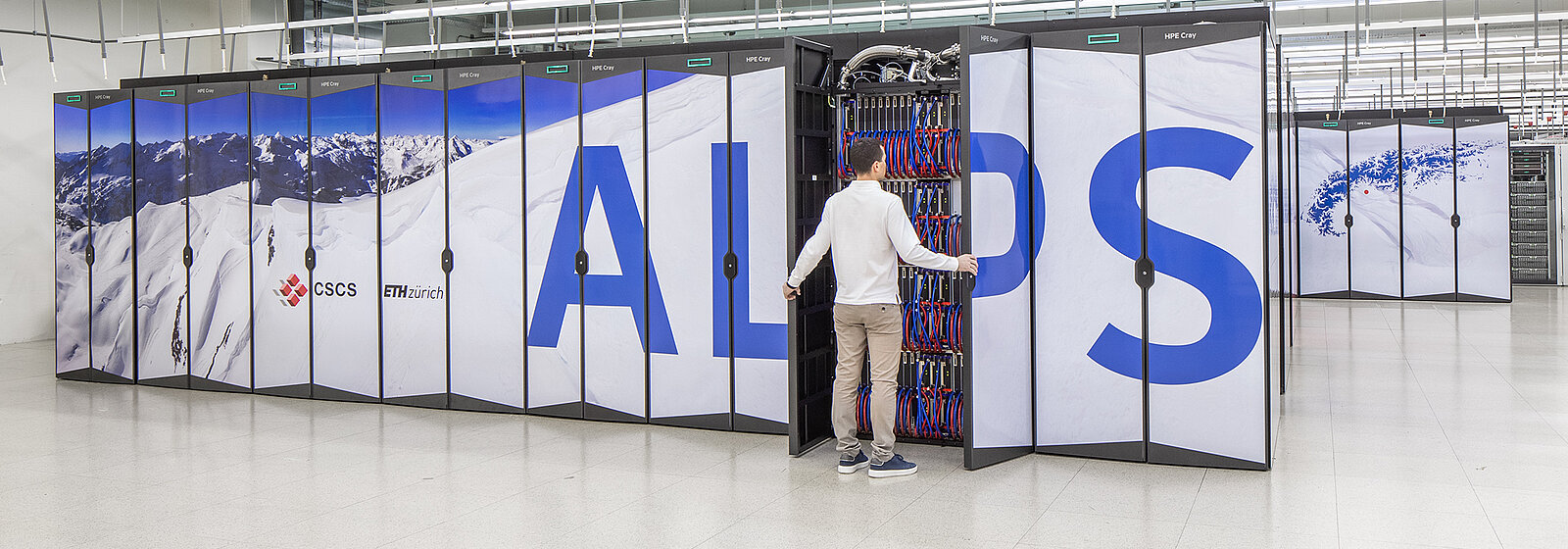
Switzerland's Canton of Ticino began testing a locally hosted, fine-tuned version of the national Apertus open-source language model in March 2026, letting around 100 cantonal staff translate sensitive documents across six languages without any data leaving cantonal servers.
94%
Internal translation-quality benchmark score after fine-tuning (March 2026)
90%
Internal translation-quality benchmark score before fine-tuning (baseline) (prior to March 2026)
~100
Cantonal staff using the tool (March 2026 pilot)
Details
Maturity
Pilot
Promoter
Centro Sistemi Informativi (CSI), Department of Finance and Economy, Canton of Ticino, with Artificialy and CSCS
Period
March 2026 (pilot testing phase)
Region (NUTS)
CH07
Keywords
digital government, language technology, generative AI, data sovereignty
Context
The Centro Sistemi Informativi (CSI), the IT department of Ticino's Department of Finance and Economy, worked with AI vendor Artificialy and the Swiss National Supercomputing Centre (CSCS) to fine-tune Apertus-8B — Switzerland's publicly funded, open-source large language model released in 2025 — into an in-house translation tool for cantonal administration.
Objectives
To provide sovereign, on-premise AI translation for cantonal staff handling potentially sensitive government documents, as an alternative to sending confidential text through commercial cloud AI services.
Activities
The tool runs entirely on CSI's own on-premise GPU infrastructure, translating between Italian, German, French, Spanish, Romanian and Ukrainian for roughly 100 employees who need daily translation of government documents.
Results
CSI's own reported benchmark shows the fine-tuned Apertus-8B scoring 94% on its internal translation-quality benchmark, up from a 90% baseline before fine-tuning.
Conclusions
No independent, citizen-facing outcome data (time saved, translation volume, error rates in production) had been published as of the most recent reporting, and the tool was entering its testing phase with a small user group, not yet a canton-wide rollout — a concrete, real deployment of a sovereign open-source model with one honest technical metric and clearly labelled pilot status.
Implementation
Indicative cost
Medium (€50k–€500k) — No public budget figures; involves on-premise GPU infrastructure plus vendor/CSCS fine-tuning collaboration.
Time to results
Short (< 1 year) — Apertus-8B released 2025; fine-tuning and pilot testing reported mid-March 2026; not yet canton-wide.
Staffing & skills
Centro Sistemi Informativi (CSI) staff, Artificialy (AI vendor), Swiss National Supercomputing Centre (CSCS) / EPFL technical support
Conditions for success
on-premise GPU infrastructure to keep data sovereign
fine-tuning an existing open-source national model (Apertus-8B) rather than building from scratch
Common failure modes
no independent or citizen-facing outcome data published as of the pilot stage
Where it fits
Governance type
sub-national (cantonal) government IT department
Scale
~100 employees, single-canton pilot
Income level
high-income (Switzerland)
Commonly funded by
National / regional programmes
Indicative funding routes for practices of this type — always check each programme's current calls and eligibility rules.
Do you run this practice?
Claim it —
verified implementers get a public contact pathway and can propose corrections.
Data sources
Where this practice's information was retrieved from, and when.
Baden-Württemberg built F13, the first AI assistant in productive use across a full German state administration, running on sovereign infrastructure; …