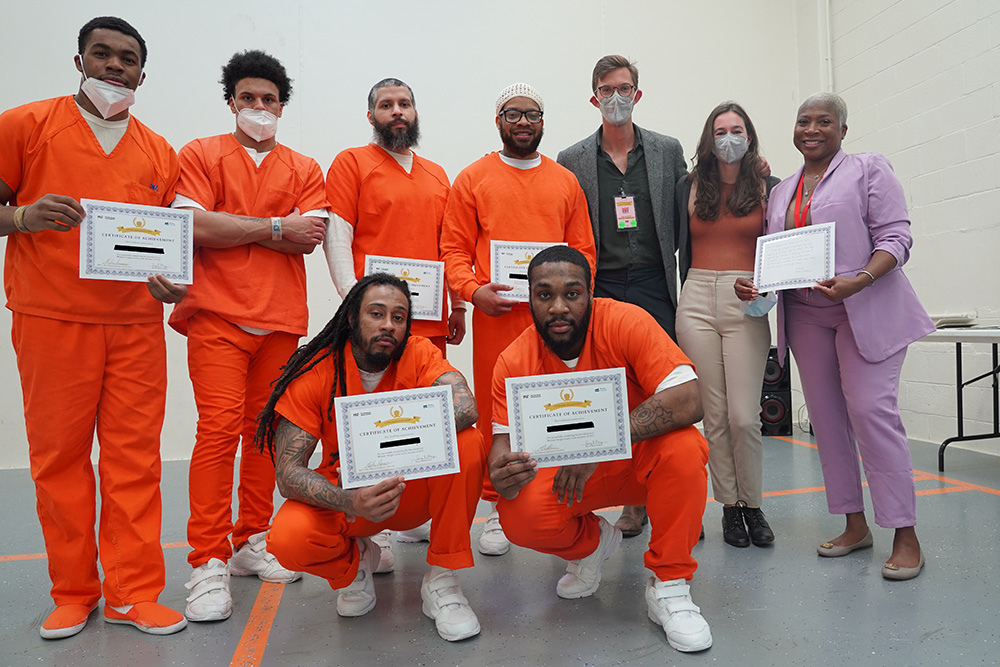
A 12-week MIT-led virtual course teaches HTML, CSS and JavaScript to incarcerated students across five US prisons. A 2024 MIT/UMass Lowell study found strong qualitative confidence gains, but a 37-person quantitative pilot found no statistically significant self-efficacy change.
30 women
Participants in the original 2020 pilot (2020)
4
Correctional facilities in original pilot (2020)
5
Correctional facilities currently covered
34
Students in the 2022 qualitative study (2022)
37
Participants in the 2023-24 quantitative self-efficacy study (2023-24)
Details
Maturity
Scaling
Promoter
MIT Educational Justice Institute (TEJI) & Brave Initiatives
Period
2020-present
Keywords
corrections education, digital literacy, web development, reentry
Context
Brave Behind Bars is a virtual web-design and career-readiness course for incarcerated students, launched in 2020 by MIT PhD candidates Martin Nisser and Marisa Gaetz together with the nonprofit Brave Initiatives. What began as a pilot with 30 women across four New England correctional facilities has grown into a 12-week, college-accredited curriculum delivered synchronously online across five US correctional facilities, run in partnership with MIT's Educational Justice Institute (TEJI) and MIT CSAIL, with credit offered through Georgetown University, the Benjamin Franklin Institute of Technology and Washington County Community College.
Objectives
The course aims to build technical web-development skills and career-readiness alongside self-confidence for incarcerated students.
Activities
Students learn HTML, CSS and JavaScript, build a capstone website on a social issue they care about, and receive coaching on CVs and public speaking.
Results
A 2022 qualitative study of 34 students found consistent themes of increased self-confidence and motivation. A follow-up 2023–24 quantitative study of 37 participants, published as 'From Prisons to Programming: Fostering Self-Efficacy via Virtual Web Design Curricula in Prisons and Jails', used validated self-efficacy scales before and after the course; mean scores rose, but the change was not statistically significant.
Conclusions
The programme illustrates both the promise and the evidentiary limits of small-scale correctional digital-skills programmes: strong self-reported impact, but not yet large enough or long enough to demonstrate a statistically robust effect.
Implementation
Indicative cost
Medium (€50k–€500k) — No budget figures are disclosed; conservatively banded medium given synchronous multi-facility technology delivery and college-credit administration despite small student numbers.
Time to results
Long (> 3 years) — Running continuously since the 2020 pilot, expanded from four to five facilities over roughly four years — ongoing as of 2024 reporting.
Staffing & skills
MIT PhD candidate founders (Martin Nisser, Marisa Gaetz), Brave Initiatives (nonprofit partner), MIT Educational Justice Institute (TEJI) and MIT CSAIL, Credit-granting institutions: Georgetown University, Benjamin Franklin Institute of Technology, Washington County Community College
Conditions for success
Synchronous live delivery across multiple correctional facilities
College-credit accreditation for completed coursework
Capstone project tied to a social issue plus CV and public-speaking coaching alongside technical skills
Common failure modes
The 2023-24 quantitative self-efficacy gains were not statistically significant at the current sample size (37 participants)
Small study samples (30-37 participants) limit generalisability of findings
BancoSol's AppSol added GanaSol, a gamified points-and-prizes layer, to nudge low-literacy microfinance clients into digital banking. Three years after its …