Kazakhstan National AI in Education Standards 2025–2029
Kazakhstan
Kazakhstan approved joint ministerial AI-in-education standards (2025–2029) on ethics, data protection and academic integrity for 4.1 million pupils; AI entered …
Burundi · Bujumbura · See the Burundi profile · See the Bujumbura profile
Evidence: Descriptive / self-reported Top 89% 27/100 · Ask Evidence Copilot about this practice
Burundi's Ministry of Finance and UNDP validated a National AI Strategy in April 2026 with six pillars — including AI in education — targeting 1,000+ trained public agents, ~15 pilot projects, and explicit focus on youth and women, though implementation has not yet begun.
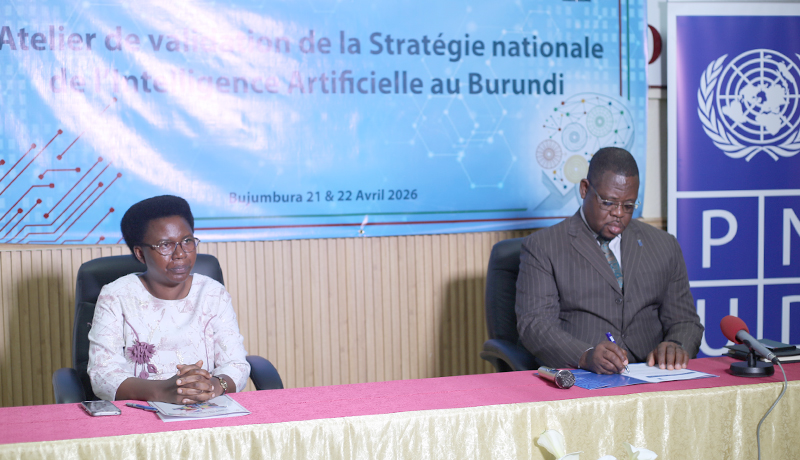
Burundi's Stratégie Nationale d'Intelligence Artificielle (SNIA, 2025-2030) was validated at a national workshop in Bujumbura on 21-22 April 2026, led by the Ministry of Finance, Budget and Digital Economy with UNDP support. The strategy rests on six pillars — governance; infrastructure; human capital development; innovation and entrepreneurship; inclusion, transparency and sustainability; and sector applications — with 'AI in education' named as one of six priority workstreams.
Concrete commitments include training more than 1,000 public agents in AI-related competencies, roughly 15 pilot projects (initially targeting healthcare and agriculture), and adapting university curricula to AI-related professions, with explicit 'particular attention' to youth and women in talent development. Following validation, Burundi aims to join Rwanda, Senegal, Morocco and Benin among Africa's AI-strategy leaders.
This is a governance milestone, not an implementation record: no independent evaluation, pilot results, or teacher/student reach numbers exist yet, and separate donor-funded digital-pedagogy programmes running in Burundi since 2019 remain distinct from — and not yet specific to — AI.
National / regional programmes
Indicative funding routes for practices of this type — always check each programme's current calls and eligibility rules.
Do you run this practice? Claim it — verified implementers get a public contact pathway and can propose corrections.
Where this practice's information was retrieved from, and when.
Kazakhstan
Kazakhstan approved joint ministerial AI-in-education standards (2025–2029) on ethics, data protection and academic integrity for 4.1 million pupils; AI entered …
Portugal
Portugal's National Education Council published Recommendation 4/2026 in May 2026, mandating AI literacy from primary school, an independent education AI …
New Zealand
New Zealand's Ministry of Education published national guidance on generative AI for schools in November 2024, setting principles on teacher …
Denmark
Denmark's Ministry of Education issued seven AI-in-schools recommendations in June 2025, complemented by Datatilsynet's 2023 GDPR guidance, forming a dual-layer …
Open full copilot Grounded in cited practices — always check the sources.