Redonda Ecosystem Reserve — Rat and Goat Eradication (Antigua and Barbuda)
Antigua and Barbuda
Goat and rat eradication (2016–2018) on the barren islet of Redonda triggered a peer-reviewed sixfold+ rebound in an endemic ground …
British Indian Ocean Territory · Peros Banhos · See the British Indian Ocean Territory profile
Evidence: Quasi-experimental Top 76% 33/100 · Ask Evidence Copilot about this practice
A 2014 rat eradication on Ile Vache Marine and two Salomon Atoll islets, confirmed rat-free in 2017, let seabirds recover — and a peer-reviewed Nature study found seabird-driven nutrient subsidies boosted nearby coral reef fish biomass by roughly half.
Rats introduced via historic shipping and coconut plantations are present on 26 of the Chagos Archipelago's islands. In 2014, the Chagos Conservation Trust (CCT), the BIOT Administration, RSPB, the Royal Botanic Gardens Kew and Biodiversity Restoration Specialists Ltd, with logistical support from British Forces on Diego Garcia and funding from the UK's Darwin Plus Initiative, eradicated rats from Ile Vache Marine (Peros Banhos Atoll) and the islets of Île Sel and Île Jacobin (Salomon Atoll) — confirmed successful in 2017, the first completed eradication in the territory.
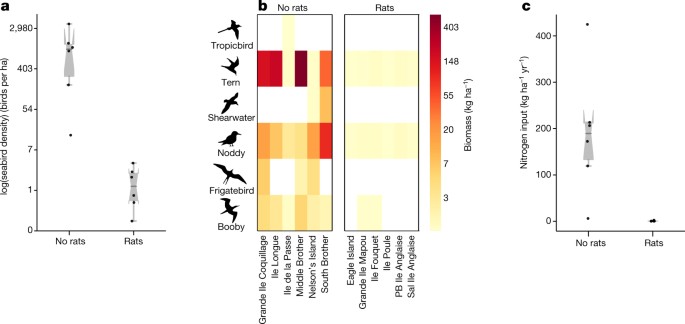
A peer-reviewed Nature study (Graham et al., 2018) analysed a natural experiment across 12 islands (6 rat-free, 6 rat-infested) to measure the ecological effects of rat eradication. A follow-on study in Current Biology (Benkwitt et al., 2021) examined recovery trajectories at other regional eradication sites, including Tromelin Island (rats removed 2005) and Île du Lys (rats removed 2003).
Graham et al. (2018) found seabird densities 760x higher, nitrogen deposition rates 251x higher, and reef fish community biomass roughly 50% larger on or near rat-free islands, with herbivory/bioerosion rates over 3x higher near large seabird colonies. Benkwitt et al. (2021) found seabirds increased roughly 8-fold at Tromelin Island (with 6 species resuming breeding) and roughly 10-fold at Île du Lys, with the seabird-derived nitrogen signal reaching reef fish within about 16 years, though fish growth rates had not measurably improved over that period.
Territory-wide eradication — potentially covering up to about 1,400 hectares of rat-affected islands — remains an ongoing priority rather than a completed task; funding for scale-up is not secured, and reinvasion risk requires continued biosecurity. The wider political context — BIOT's creation through the forced depopulation of Chagossians in the 1960s-70s to establish the Diego Garcia military base, and ongoing UK-Mauritius sovereignty/resettlement negotiations — is a separate but relevant governance backdrop to the conservation programme.
Philanthropic / foundation funding
Indicative funding routes for practices of this type — always check each programme's current calls and eligibility rules.
Do you run this practice? Claim it — verified implementers get a public contact pathway and can propose corrections.
Where this practice's information was retrieved from, and when.
Antigua and Barbuda
Goat and rat eradication (2016–2018) on the barren islet of Redonda triggered a peer-reviewed sixfold+ rebound in an endemic ground …
Mexico
Since the late 1990s, Mexican NGO GECI has removed 60 populations of 13 invasive mammal species from 39 Pacific islands, …
South Georgia and the South Sandwich Islands
Three helicopter-baiting phases (2011-2015) cleared invasive rats and mice from 108,723 ha of sub-Antarctic South Georgia, the world's largest rodent …
South Georgia and the South Sandwich Islands
The world's largest rodent-eradication project cleared brown rats and mice from over 100,000 ha of sub-Antarctic South Georgia between 2011 …
Open full copilot Grounded in cited practices — always check the sources.