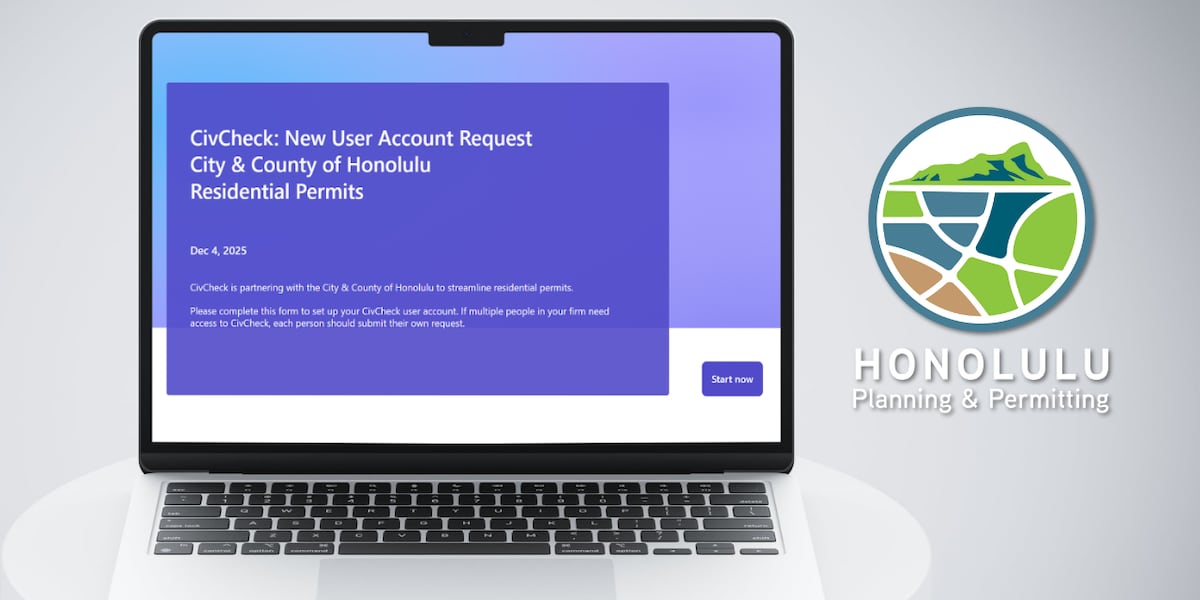
Honolulu's Department of Planning and Permitting built CivCheck, an AI pre-screener for residential permits. DPP data show review times fell from 73 to 32.5 days and corrections per permit dropped 67%; the tool won a 2026 AI 50 Award and became mandatory in August 2026.
73 → 32.5 days
Average permit decision time
3.4 → 1.4 rounds
Plan-review cycles (average)
-67%
Corrections per permit
40.5 days
Average time saved vs. non-CivCheck submissions
174 projects
Prescreen-status backlog cleared
~40 applications
Reported cohort size
Details
Maturity
Scaling
Promoter
Honolulu Department of Planning and Permitting (DPP)
Period
2025-2026
Keywords
urban planning, permitting, digital government, civic tech
Context
Honolulu's Department of Planning and Permitting (DPP) launched CivCheck, built with vendor Clariti, in December 2025 to pre-screen residential building-permit applications before they enter the city's formal review queue, checking submissions for completeness and common code errors.
Activities
CivCheck pre-screens residential permit applications for completeness and common code errors before formal review. DPP is explicit that the tool 'does not replace the DPP's official review, nor does it guarantee permit approval' — it is a pre-check, not a decision-maker. In August 2026, DPP began requiring applicants to use the tool for residential project permit submissions.
Results
According to DPP's own published figures, average permit decision times fell from 73 days to 32.5 days, plan-review cycles dropped from 3.4 to 1.4 rounds on average, corrections per permit fell by 67%, and applicants saved an average of 40.5 days compared with non-CivCheck submissions; a backlog of 174 projects in prescreen status cleared within weeks of launch. The initiative won a 2026 AI 50 Award.
Conclusions
The reported results are drawn from an early cohort of roughly 40 applications. The August 2026 mandatory-use policy has drawn questions from local commentators about accessibility for applicants without reliable digital access or technical fluency.
Implementation
Indicative cost
Medium (€50k–€500k) — Vendor product (Clariti); no public cost figures disclosed.
Time to results
Short (< 1 year) — Launched December 2025; became mandatory for residential permit submissions from August 2026, roughly eight months later.
Staffing & skills
Honolulu Department of Planning and Permitting (DPP) staff, Vendor Clariti (software provider)
Conditions for success
Human sign-off retained as the final decision authority — the tool doesn't replace official review
Clear applicant disclaimer that pre-screening doesn't guarantee approval
Common failure modes
Mandatory-use policy from August 2026 raised accessibility questions for applicants without reliable digital access or technical fluency
Reported metrics come from an early ~40-application cohort and the implementing agency itself, not an independent audit
Underlying Clariti scoring logic is proprietary and not independently published
Commonly funded by
National / regional programmes
Indicative funding routes for practices of this type — always check each programme's current calls and eligibility rules.
Do you run this practice?
Claim it —
verified implementers get a public contact pathway and can propose corrections.
Data sources
Where this practice's information was retrieved from, and when.
Montevideo built a generative-AI assistant, with Microsoft's AI Co-Innovation Lab, that answers architects' questions on the city's 4,000+-article construction-permit code …