Can't Wait to Learn — adaptive tablet game for out-of-school children in Sudan
Sudan
A solar-powered tablet game teaches literacy and numeracy to out-of-school children in conflict-affected Sudan. A 2020 peer-reviewed study found significantly …
Jordan · Azraq · See the Jordan profile · See the Azraq profile
Top 14% 67/100 · Ask Evidence Copilot about this practice
Two competition-winning mobile games — Antura and the Letters and Feed the Monster — delivered a 27-hour literacy programme to Syrian refugee children in Jordan's Azraq camp, producing large reading gains over a matched control group across both genders and age groups.
The EduApp4Syria competition, funded by Norad and run by All Children Reading: A Grand Challenge for Development (USAID, World Vision Norway and the Australian government), was created to develop literacy apps for the millions of displaced Syrian children whose schooling had been interrupted.
Antura and the Letters (Cologne Game Lab, Germany) and Feed the Monster (Apps Factory, Romania) were the two prize-winning games — both offline, Arabic-language mobile games combining an engaging game loop with practice of foundational reading skills (letters, syllables, fluency).
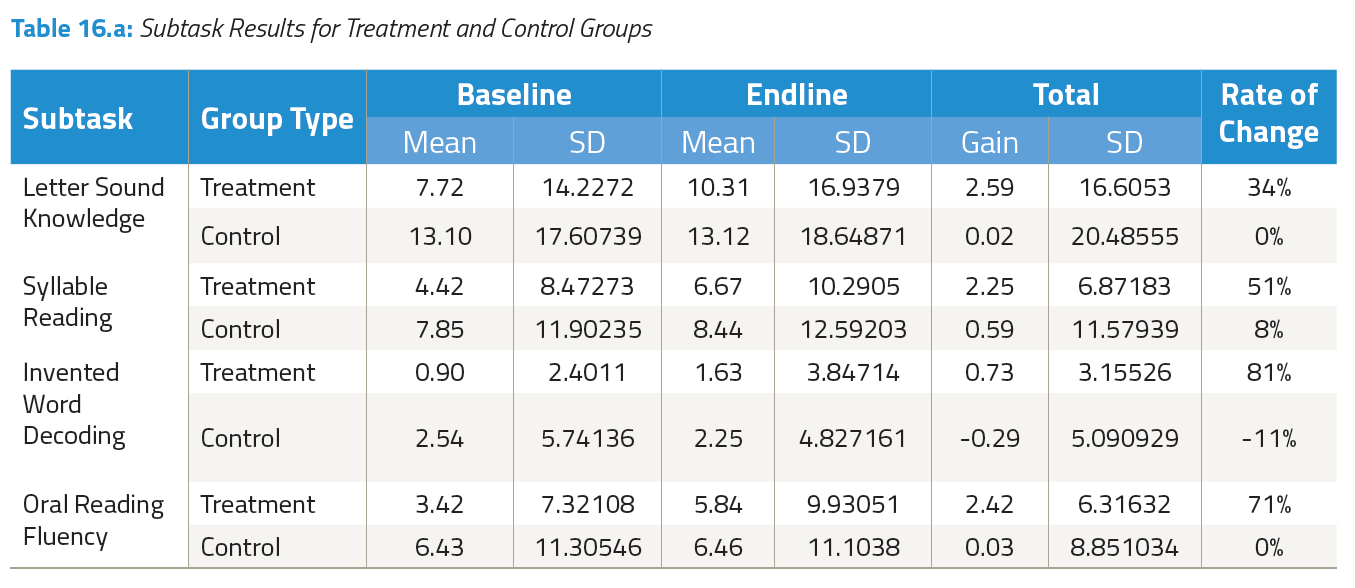
A 2018 quasi-experimental evaluation in Jordan's Azraq refugee camp, led by INTEGRATED in collaboration with NYU's CREATE, tested the games with roughly 300 children aged 5–10 with little or no prior schooling. After a 27-hour play period, decoding of rare words improved 81% versus -11% for the control group, oral reading fluency rose 71% versus 0%, syllable reading 51% versus 8%, and letter-sound knowledge 34% versus 0%. Gains held across both genders and all tested age groups, though effects were concentrated in foundational decoding rather than comprehension.
Because the evaluation used a quasi-experimental (non-randomised) design in a single camp, and gains were strongest on foundational decoding rather than comprehension, the results should be read as promising but not conclusive evidence of generalisable literacy recovery.
Read the full analysis: https://colognegamelab.de/research/research-projects/the-antura-initiative/impact-evaluation/
Implementation detail (cost, timeline, staffing, conditions for success) is not yet available for this practice.
Do you run this practice? Claim it — verified implementers get a public contact pathway and can propose corrections.
Where this practice's information was retrieved from, and when.
Sudan
A solar-powered tablet game teaches literacy and numeracy to out-of-school children in conflict-affected Sudan. A 2020 peer-reviewed study found significantly …
Congo (the Democratic Republic of the)
Vodafone Foundation and UNHCR's solar-powered 'school in a box' brings offline digital classrooms and local-language content to refugee children in …
Mozambique
Since 2021, Instant Network Schools has expanded from one refugee settlement to 15+ Kolibri-powered offline learning centres across Nampula Province, …
United States of America
Free AI literacy tools in Microsoft Teams that give students personalised reading practice and teachers fluency data; a trial showed …
Open full copilot Grounded in cited practices — always check the sources.