National AI Campaign — Mongolia's Nationwide AI Teacher-Training Drive Across All 21 Provinces
Mongolia
AI Academy Asia's five-year National AI Campaign, backed by UNICEF Mongolia, M Bank and Golomt Bank, has trained 1,000 teachers …
Uzbekistan · Tashkent · See the Uzbekistan profile
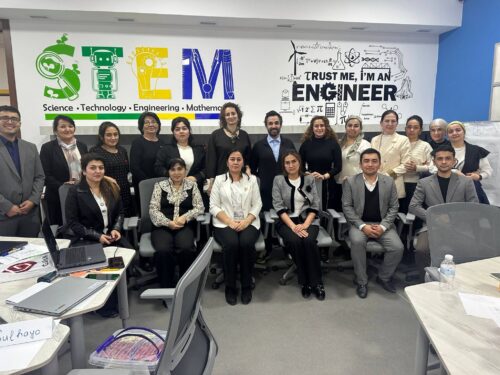
UNICEF, Arm, the Raspberry Pi Foundation and Micro:bit Educational Foundation brought the Experience AI curriculum to Uzbekistan's 50 government STEM Labs from January 2026, extending a 2024 Honduras-Maldives-Montenegro-Vietnam pilot with a stronger AI-literacy focus.
Tinkering with Tech launched in 2024 as a UNICEF Global Learning and Innovation Hub initiative with Arm and Finland's Ministry for Foreign Affairs, piloted in Honduras, the Maldives, Montenegro and Viet Nam to build children's coding, computational-thinking and problem-solving skills. At a partnership workshop in Helsinki on 28–29 January 2026, UNICEF and Arm, together with the Micro:bit Educational Foundation and the Raspberry Pi Foundation, announced "Tinkering with Tech and AI," expanding the programme to Lao PDR, Ukraine and Uzbekistan with the Raspberry Pi Foundation's Experience AI curriculum specifically added to build AI literacy.
In Uzbekistan, under the government's Ishonch 2030 education project, UNICEF and the Ministry of Preschool and School Education have already equipped Innovative STEM Labs in 50 schools nationwide with smartboards, laptops, 3D printers, Arduino kits and micro:bits; Tinkering with Tech, and now Experience AI, is being rolled out across these labs, with UNICEF and the Ministry's stated long-term goal of embedding the programme in the national curriculum. The national civil-society organisation Tech4Impact supports local delivery.
As of the sources reviewed, published material describes programme design, infrastructure investment and a single trainer's qualitative reflection ("I have changed my mind about AI and now I have a better understanding of it") rather than measured student learning outcomes. The Raspberry Pi Foundation's own account is candid about the challenge ahead: some Uzbekistani classrooms have laptops and interactive whiteboards, while others operate with limited electricity, lower digital literacy and devices shared among many students — an acknowledged, unresolved gap rather than a solved problem.
Read the full analysis: https://www.raspberrypi.org/blog/why-localisation-matters-for-ai-literacy-lessons-from-uzbekistan/
Implementation detail (cost, timeline, staffing, conditions for success) is not yet available for this practice.
Where this practice's information was retrieved from, and when.
Mongolia
AI Academy Asia's five-year National AI Campaign, backed by UNICEF Mongolia, M Bank and Golomt Bank, has trained 1,000 teachers …
Panama
Panama's Ministry of Education, UNESCO and Huawei trained 1,550 lead teachers who cascade-trained ~52,000 in-service teachers across 16 regions in …
Tajikistan
Tajikistan's AI Council, UNICEF and zypl.ai launched Project Soro in Oct 2025 to make 'Intro to AI' mandatory in all …
Namibia
UNESCO and CODEMAO's Africa-Asia Youth Coding Initiative entered Phase II in Namibia in August 2025, building on Phase I's 3,000+ …
Open full copilot Grounded in cited practices — always check the sources.