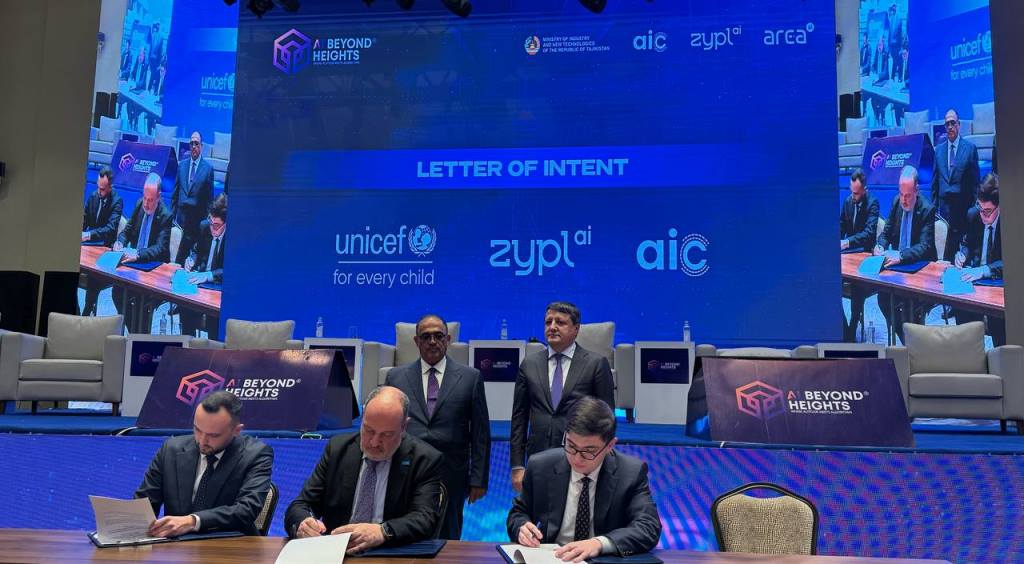
Tajikistan's AI Council, UNICEF and zypl.ai launched Project Soro in Oct 2025 to make 'Intro to AI' mandatory in all schools by 2027, deploying the Tajik-language SoroLLM chatbot; a pilot reached 30 Dushanbe schools (770 teachers, 2,000+ students) before scaling to 100 schools.
30
Schools in initial Dushanbe pilot
770
Teachers reached in pilot
2,000+
Students reached in pilot
100
Schools reached at time of reporting
4,000 schools / 2 million students
National rollout target by 2027 (by 2027)
Details
Maturity
Pilot
Promoter
AI Council of Tajikistan / UNICEF Tajikistan / zypl.ai
Period
Launched Oct 2025; mandatory subject and full national rollout targeted for 2027
Keywords
AI literacy, K-12 curriculum, Tajik-language LLM, teacher training, inclusive education
Context
Project Soro is a joint initiative of Tajikistan's Artificial Intelligence Council, UNICEF Tajikistan and the Tajik AI startup zypl.ai, launched in Dushanbe in October 2025 to integrate AI into the national school system, with a mandatory 'Introduction to Artificial Intelligence' subject planned for all of Tajikistan's roughly 4,000 schools by 2027.
Objectives
The plan aims to reach an estimated 2 million students nationwide and train up to 2,000 AI specialists, with government and partner projections putting the initiative's economic value at around $150 million.
Activities
The technical core is SoroLLM, a family of lightweight Tajik-language conversational models built through continual pretraining on a curated 1.9-billion-token Tajik corpus, designed to run under the country's compute and connectivity constraints and integrated into the existing maktabmobile.tj and eDonish school platforms. Roles are split explicitly: the AI Council coordinates and sets standards, zypl.ai builds and deploys SoroLLM, and UNICEF Tajikistan is responsible for ethical compliance and child-rights safeguards.
Results
An initial pilot in around 30 schools near Dushanbe reached 770 teachers and just over 2,000 students; by the time of reporting the model was being piloted in 100 schools nationwide, still well short of the 4,000-school, 2-million-student target for 2027. No independent learning-outcome evaluation has been published.
Implementation
Indicative cost
High (€500k–€5M)
Time to results
Long (> 3 years)
Staffing & skills
AI Council of Tajikistan coordinates and sets standards, zypl.ai builds and deploys the SoroLLM models, UNICEF Tajikistan is named as responsible for ethical compliance and child-rights safeguards
Conditions for success
SoroLLM designed as a lightweight model to run under tight national compute and connectivity constraints
Integration into existing maktabmobile.tj and eDonish school platforms rather than a standalone system
Common failure modes
Scale-up from around 100 to 4,000 schools remains almost entirely ahead and unproven
No independent learning-outcome evaluation published to date
Where it fits
Governance type
national government with multi-partner (UN/startup) delivery
Scale
national
Income level
low-income
Commonly funded by
National / regional programmes
Indicative funding routes for practices of this type — always check each programme's current calls and eligibility rules.
Do you run this practice?
Claim it —
verified implementers get a public contact pathway and can propose corrections.
Data sources
Where this practice's information was retrieved from, and when.
A 5-week AI-literacy module for pre-service physics teachers across nine Kazakhstani universities, led by Zhetysu University, raised literacy scores far …