Seeing AI — Microsoft's Real-Time AI Visual Assistant for Blind and Low-Vision Users
United States of America
Microsoft's free Seeing AI app narrates text, currency, people, barcodes and scenes in real time through a phone camera for …
United States of America · Louisville · See the United States of America profile
Evidence: Observational / pre–post Top 10% 96/100 · Ask Evidence Copilot about this practice
Spun off in 2019 from the American Printing House for the Blind, GoodMaps replaces beacons and GPS with camera-based computer vision for indoor directions for blind and low-vision travelers, now live at 35+ airports in 8 countries and validated in four peer-reviewed studies.
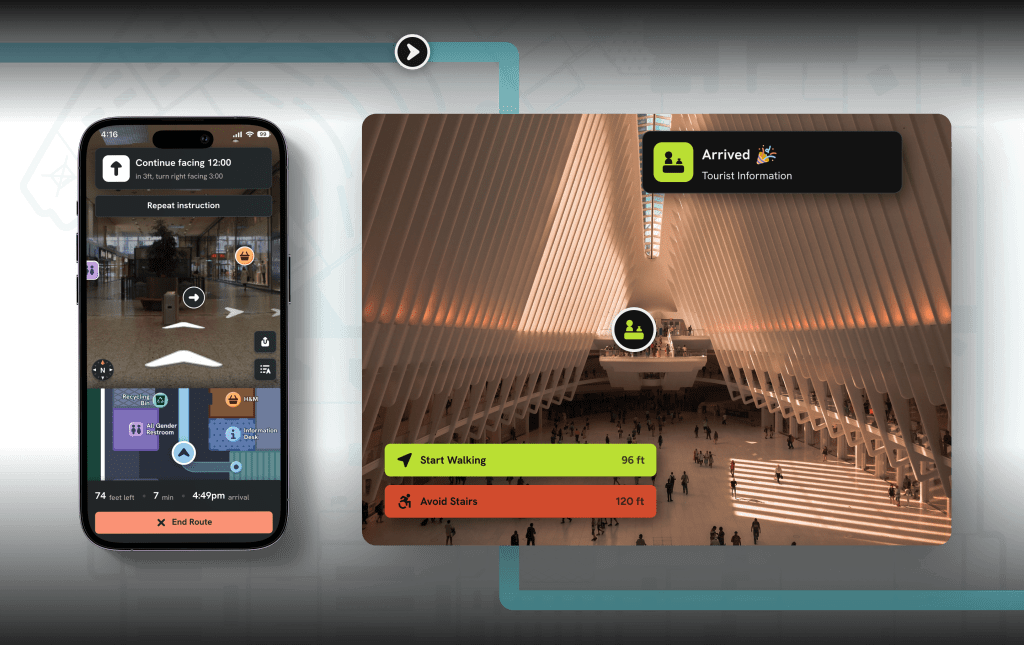
GoodMaps was founded in 2019 as a standalone spinoff of the American Printing House for the Blind (APH), the Louisville, Kentucky nonprofit founded in 1858 that has long produced materials for blind and low-vision people. Instead of Bluetooth beacons or GPS, which perform poorly indoors, GoodMaps uses camera-based computer-vision positioning, developed in partnership with Intel, to deliver turn-by-turn voice directions through a smartphone app across airports, transit stations, campuses, schools and museums.
Between January 2023 and its most recent research cycle, GoodMaps tested its app with nearly 200 users across five North American cities — Seattle, Louisville, New York City, Austin and Ottawa — including 75 people who are blind or have low vision, 8 who are D/deaf or hard of hearing, 10 wheelchair users, 5 with reduced mobility and 14 neurodiverse participants. Findings have been published across four peer-reviewed venues: HCII 2023, AHFE 2024, HCII 2025 and EdMedia+ 2025.
Deployment has quadrupled since January 2025: by 2025-2026 the platform was live at more than 35 airports across 8 countries and 15 US states, including the Gerald R. Ford International Airport and the USD 1 billion Louisville Muhammad Ali International Airport modernisation.
As a still-growing deployment, long-term outcome data — such as changes in independent-travel frequency over years — is not yet available; the published studies to date focus on usability and short-term wayfinding performance rather than longitudinal life-outcome evidence.
Own resources / municipal budget
Indicative funding routes for practices of this type — always check each programme's current calls and eligibility rules.
Reusable artefacts from this practice — as published by their sources.
Do you run this practice? Claim it — verified implementers get a public contact pathway and can propose corrections.
Where this practice's information was retrieved from, and when.
United States of America
Microsoft's free Seeing AI app narrates text, currency, people, barcodes and scenes in real time through a phone camera for …
Brazil
Brazil's federal government embeds a free, open-source 3D avatar that machine-translates Portuguese text into Libras (Brazilian Sign Language) across public …
Czechia
BlindShell Classic is a tactile-button feature phone developed by Prague-based Matapo with EU Horizon 2020 funding, offering voice menus, OCR …
United States of America
Microsoft's free Immersive Reader applies specific, peer-reviewed reading-science findings — on font spacing, syllable breaks, line length and text-to-speech — …
Open full copilot Grounded in cited practices — always check the sources.