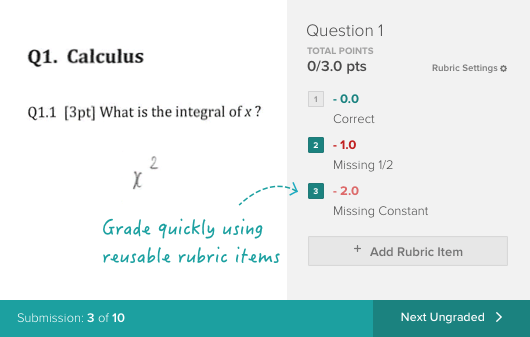
AI platform grouping similar student responses for batch grading; 3.2M students at 2,600+ universities. A peer-reviewed ACM 2017 study found 67% of instructors save ≥30% grading time; a 2024 Indiana University case study linked adoption to lower DFW rates and higher grades.
67%
Instructors saving ≥30% grading time
79.7%
Users agreeing anonymous grading reduces bias
3.2M
Active students (2025) (2025)
2,600+
Institutions served (2025)
Details
Maturity
Established
Promoter
Gradescope
Period
2014–present
Keywords
higher education, assessment, ed-tech, AI
Context
Gradescope, launched commercially in 2014 from a UC Berkeley prototype, clusters visually similar handwritten student responses so instructors can apply one rubric decision to an entire group. Turnitin acquired it in 2018; it now covers typed, code and bubble-sheet assignments.
Results
A peer-reviewed ACM Learning @ Scale 2017 paper found 67% of surveyed instructors saved at least 30% of grading time, and 79.7% of users agreed anonymous grading reduced assessor bias. A 2024 Indiana University case study (Journal of Teaching and Learning with Technology) documented lower DFW rates and higher average grades in a large lecture course after adoption, though the authors note concurrent instructional changes also contributed.
Conclusions
As of 2025 the platform serves 3.2 million students at 2,600+ institutions across 100+ countries. Data-privacy conditions changed under Turnitin ownership, drawing scrutiny from European data-protection advocates.
Implementation
Implementation detail (cost, timeline, staffing, conditions for success) is not yet available for this practice.
Commonly funded by
Own resources / municipal budget
Indicative funding routes for practices of this type — always check each programme's current calls and eligibility rules.
Do you run this practice?
Claim it —
verified implementers get a public contact pathway and can propose corrections.
Data sources
Where this practice's information was retrieved from, and when.
An RCT across four political science courses at Houston and partner universities found GPT-4-assisted grading of short-answer questions, using instructor …
TU/e researchers analysed 1,450 annotated student–chatbot interactions from 70 graded STEM essays and found a strong positive correlation between interaction …