Jordan revived the ancient Hima communal rangeland system at Bani Hashem in the Zarqa River Basin, using rotational grazing exclusion to nearly triple forage biomass — a pilot that fed into a 2015 Prime Ministerial declaration and a national rangeland strategy.
40 kg/ha
Dry forage biomass before grazing exclusion (start of the pilot's grazing exclusion)
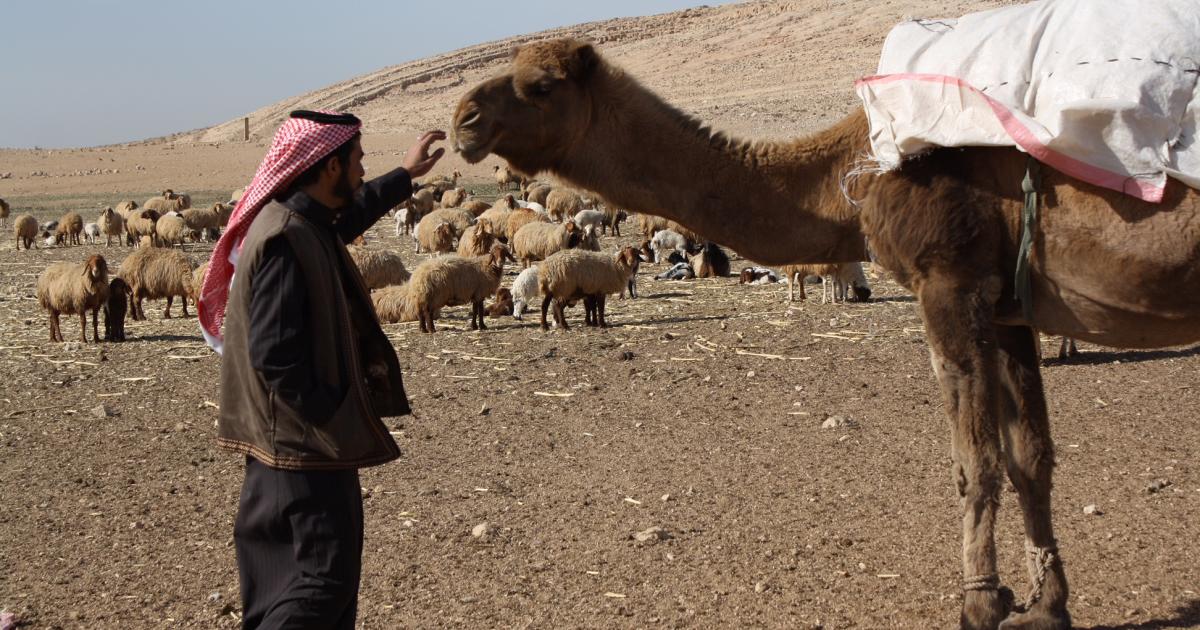
Since 2010, Jordan's Ministry of Agriculture has partnered with IUCN, the Arab Women's Organization and EU funding to revive Hima, a centuries-old Bedouin system of communal rangeland protection, piloting it at four sites in the Zarqa River Basin's eastern desert, including Bani Hashem. At Bani Hashem, 100 hectares of public rangeland were placed under community-managed rotational grazing, with grazing excluded from three enclosures for the pilot's first two years. This is a communal land-management revival in which communities self-regulate grazing, rather than a direct cash-payment scheme to individual landowners.
Objectives
The pilot aimed to test whether reviving the traditional Hima communal grazing system could restore degraded rangeland vegetation at a small scale and generate credible evidence to inform Jordan's national rangeland policy.
Activities
Community-managed rotational grazing was introduced on the 100-hectare Bani Hashem site, with all grazing excluded from three enclosures for the pilot's first two years to let vegetation recover. The model relies on communities self-regulating grazing rather than receiving per-hectare payments, and was implemented jointly by the Ministry of Agriculture, IUCN and the Arab Women's Organization with EU funding.
Results
The two-year grazing exclusion nearly tripled dry forage biomass, from 40 kg/ha to 113 kg/ha, and restored the quality, quantity and diversity of native forage and floral species at the site. A 2015 IUCN economic assessment projected the value of scaled-up sustainable rangeland management at roughly US$10 million over 25 years for the four Zarqa Basin communities, though this is a modelled projection rather than money already disbursed. The pilot's credibility helped drive the 2015 Amman Declaration on Innovating Hima, endorsed at Prime Ministerial level, and informed Jordan's updated national Rangeland Strategy.
Conclusions
The Bani Hashem pilot itself covers just 100 hectares against Jordan's roughly 8 million hectares of rangeland, so nationwide replication remains limited to date. Independent commentary on the programme cautions that Al Hima is not a panacea, even as its results have helped shape national-level policy.
Implementation
Indicative cost
Medium (€50k–€500k)
Time to results
Long (> 3 years) — Piloted from 2010; the two-year grazing exclusion phase produced the reported biomass results, feeding into the 2015 Amman Declaration and Jordan's updated national Rangeland Strategy; described as ongoing (2010–present) in the source material.
Staffing & skills
Ministry of Agriculture, Government of Jordan — lead government implementing partner, IUCN — technical/conservation implementing partner, Arab Women's Organization — community-facing implementing partner, EU funding — financing partner
Conditions for success
Community agreement to self-regulate grazing rather than receive individual cash payments
Sustained multi-year grazing exclusion enforced across enclosures to allow vegetation recovery
Coordinated partnership between national government, an international conservation body and a local community organization
Credible pilot-level results to build political support for the 2015 Amman Declaration and national Rangeland Strategy
Common failure modes
Reported economic benefits (~US$10 million over 25 years) are modelled projections for a hypothetical basin-wide scale-up, not funds already disbursed, which could undermine community buy-in if not realised
The pilot's 100-hectare footprint is small relative to Jordan's roughly 8 million hectares of rangeland, and independent commentary notes nationwide replication remains limited to date
Where it fits
Governance type
national government-led pilot delivered through a government-NGO-community partnership
Scale
local pilot (100 ha at Bani Hashem, part of 4 sites in the Zarqa River Basin)
Income level
upper-middle-income country (Jordan)
Commonly funded by
National / regional programmes
Indicative funding routes for practices of this type — always check each programme's current calls and eligibility rules.
Do you run this practice?
Claim it —
verified implementers get a public contact pathway and can propose corrections.
Data sources
Where this practice's information was retrieved from, and when.
Namibia's government and GIZ (BMZ-funded, EUR 4m, 2014-2017) back national bush-thinning to restore rangeland and groundwater recharge on land encroached …
Since 2019, Japan distributes ¥40–62 billion/year to municipalities and prefectures for managing private plantation forests; from April 2024 funded by …