SIYB Business Training for Women Entrepreneurs — Colombo & Kandy's Two-Track Randomised Trial
Sri Lanka
A randomised trial delivered ILO's SIYB training to 1,256 women across 10 divisions of greater Colombo and Kandy. Training alone …
Kenya · Meru · See the Kenya profile
Evidence: Observational / pre–post Top 50% 67/100 · Ask Evidence Copilot about this practice
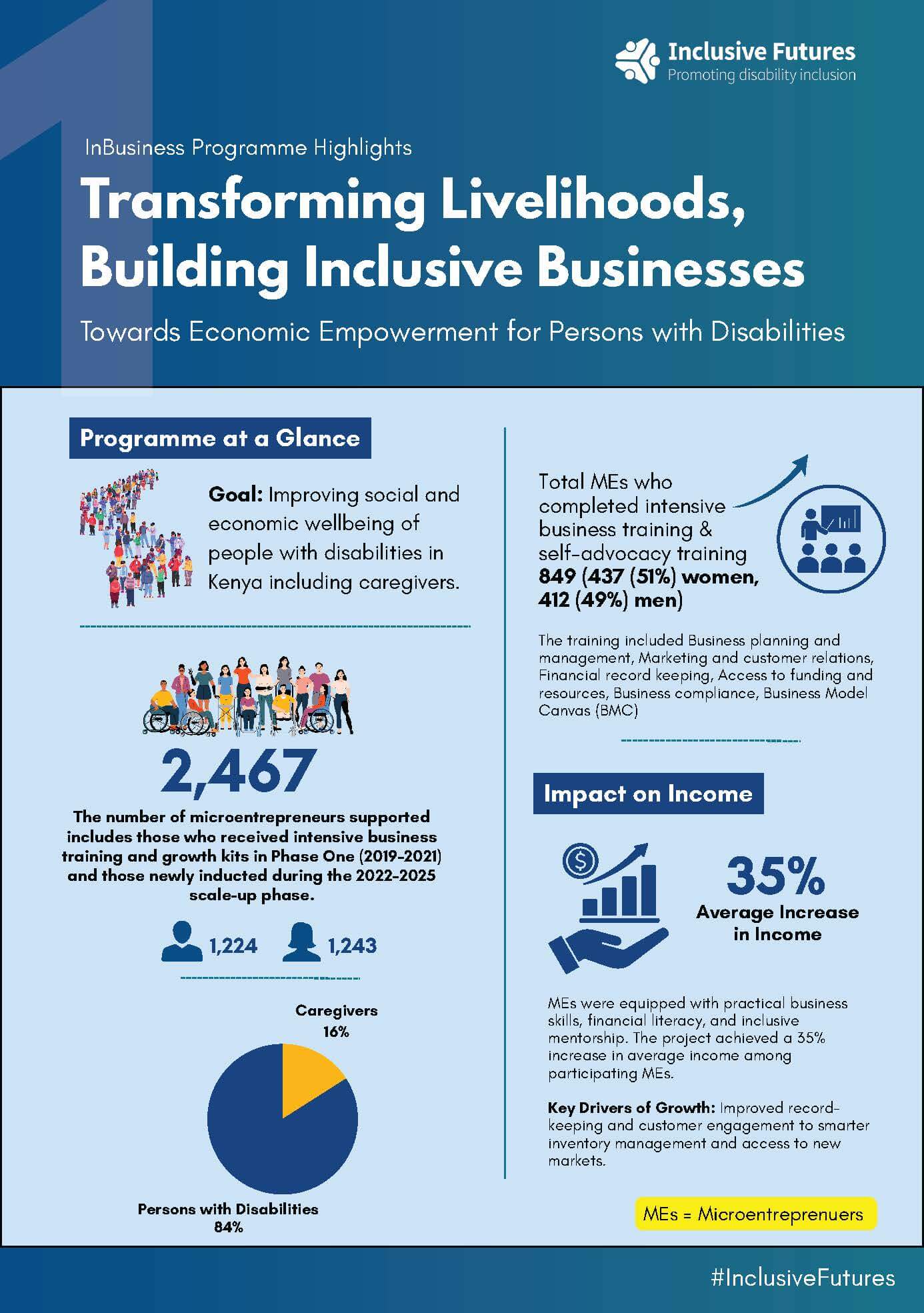
A three-NGO consortium trains and mentors microentrepreneurs with disabilities, backed by an in-kind growth-kit and procurement links. 2,467 reached (84% disabled), self-reported income +35%; an LSHTM/KEMRI randomised trial is testing the causal effect.
Microentrepreneurs with disabilities in Kenyan counties including Meru face compounded barriers to running viable businesses, from limited access to tailored equipment to exclusion from buyer-side procurement processes.
InBusiness, led by Light for the World with Humanity & Inclusion and Sense International, aims to build the business skills, assets and market access of microentrepreneurs with disabilities and their caregivers through a ten-month bundled support model.
The model combines classroom business-skills training, one-to-one mentorship, an in-kind business growth kit of tailored equipment, disability-inclusion training for the public and private institutions the entrepreneurs sell to, and direct links into procurement opportunities.
Across its 2019-2025 phases, InBusiness reached 2,467 microentrepreneurs and caregivers, 84% of them people with disabilities, of whom 849 completed the intensive business-skills track; participants recorded an average 35% increase in income, 42% went on to pursue supply opportunities with private or public institutions and 18% won a contract.
These are the implementer's own July 2026 monitoring figures rather than an independently verified causal estimate; a cluster-randomised controlled trial run by LSHTM and KEMRI, with baseline data collected in March 2023, is testing the model's causal effect on household consumption and economic empowerment against a waitlist control group, with its endline results still unpublished as of this review.
Philanthropic / foundation funding
Indicative funding routes for practices of this type — always check each programme's current calls and eligibility rules.
Do you run this practice? Claim it — verified implementers get a public contact pathway and can propose corrections.
Where this practice's information was retrieved from, and when.
Sri Lanka
A randomised trial delivered ILO's SIYB training to 1,256 women across 10 divisions of greater Colombo and Kandy. Training alone …
Peru
FINCA Perú added 22 short entrepreneurship-training sessions to routine village-bank meetings for 4,591 mostly female microfinance clients in Ica and …
Togo
A psychology-based 'personal initiative' training for 1,500 Lomé microentrepreneurs raised monthly profits 30% within 2.5 years and USD 91 (52%) …
Ethiopia
A World Bank/ACDI-VOCA RCT trained 197 experienced Ethiopian businesswomen who then mentored 1,128 less-experienced peers. Over three years, mentor training …
Open full copilot Grounded in cited practices — always check the sources.