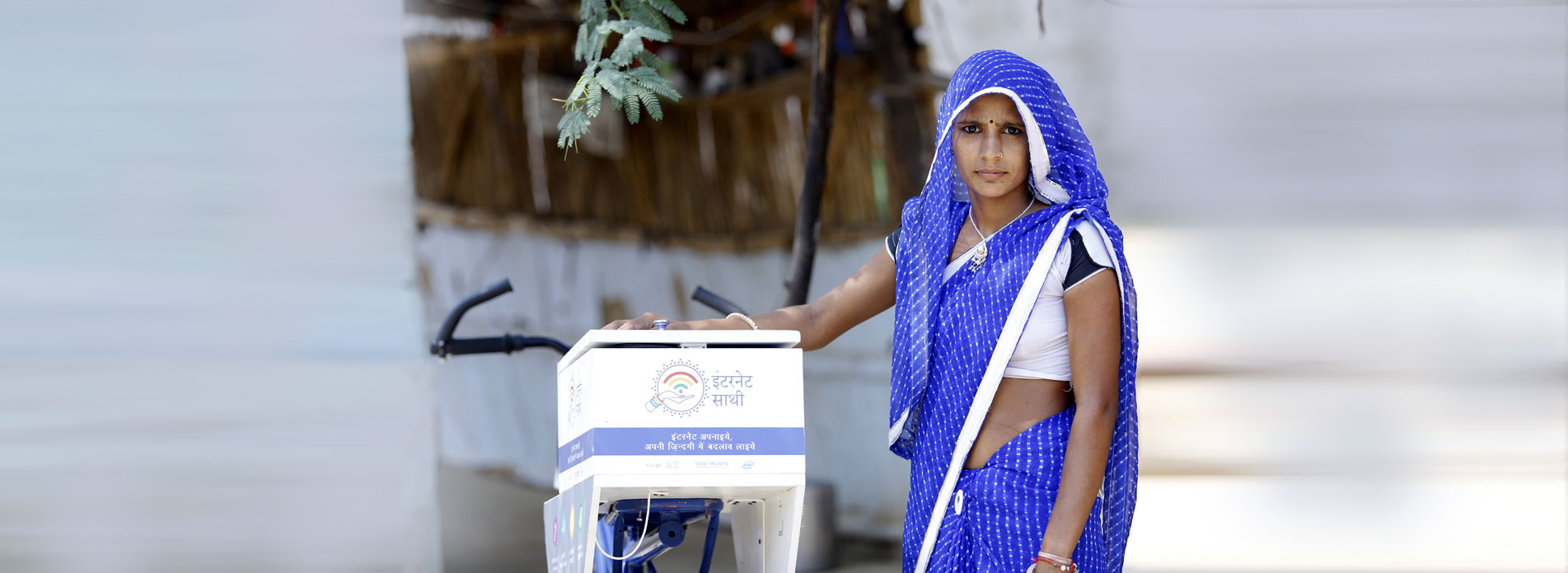
Google India, Intel and Tata Trusts trained rural women as 'Saathis' who taught fellow villagers to use the internet, reaching an estimated 20-26 million women across roughly 200,000 villages before the programme was archived as complete.
5,000 villages
Villages reached at initial pilot
200,000 villages
Peak villages reached (self-reported) (by 2019)
20-26 million women
Women reached (self-reported) (by 2019)
up to 20
Indian states covered
Details
Maturity
Discontinued
Promoter
Google India, Intel and Tata Trusts
Period
2015-2019
Keywords
digital literacy, gender equality, rural development, women's empowerment
Context
Internet Saathi ('internet friend') was launched on 3 July 2015 in villages across Gujarat, Rajasthan and Jharkhand to bring digital literacy to rural Indian women, many in villages without connectivity.
Activities
Rural women were trained as local 'Saathis' who taught other women in their communities, in some regions using internet-enabled bicycle carts to reach unconnected villages. It was a joint initiative of Google India, Intel and the Tata Trusts.
Results
Reach grew from an initial pilot of about 5,000 villages to a self-reported peak of roughly 200,000 villages and 20-26 million women across up to 20 states by 2019. Impact studies commissioned by Google (via Kantar TNS and Ipsos, summarised in a 2020 IFC/World Bank Group case study) reported most Saathis were seen as trusted village information sources, and that some beneficiaries started small internet-enabled businesses. Two small independent academic studies (2023, West Bengal; 2025, tribal Gujarat) offer smaller-scale corroboration, though no large independent impact evaluation exists. The programme is now marked 'archived post completion', with its final phase transitioning into a separate livelihoods initiative, the Foundation for Rural Entrepreneurship Development (FREND).
Conclusions
The Bridgespan Group's case study documents real limitations: women often forgot skills without continued access to a personal smartphone, some Saathis faced family resistance to travelling between villages, and a 'one-size-fits-all' curriculum did not suit all literacy levels — factors that contributed to the pivot away from the original model.
Implementation
Implementation detail (cost, timeline, staffing, conditions for success) is not yet available for this practice.
Data sources
Where this practice's information was retrieved from, and when.
D.Net's Infolady model trains rural Bangladeshi women as bicycle-riding info-entrepreneurs delivering health, agriculture and e-government services door-to-door; it reached roughly …
Taiwan's Ministry of Education has built 300 Digital Opportunity Centers in 168 remote/indigenous villages since 2005 (NT$6.8bn/US$212m in phase one), …