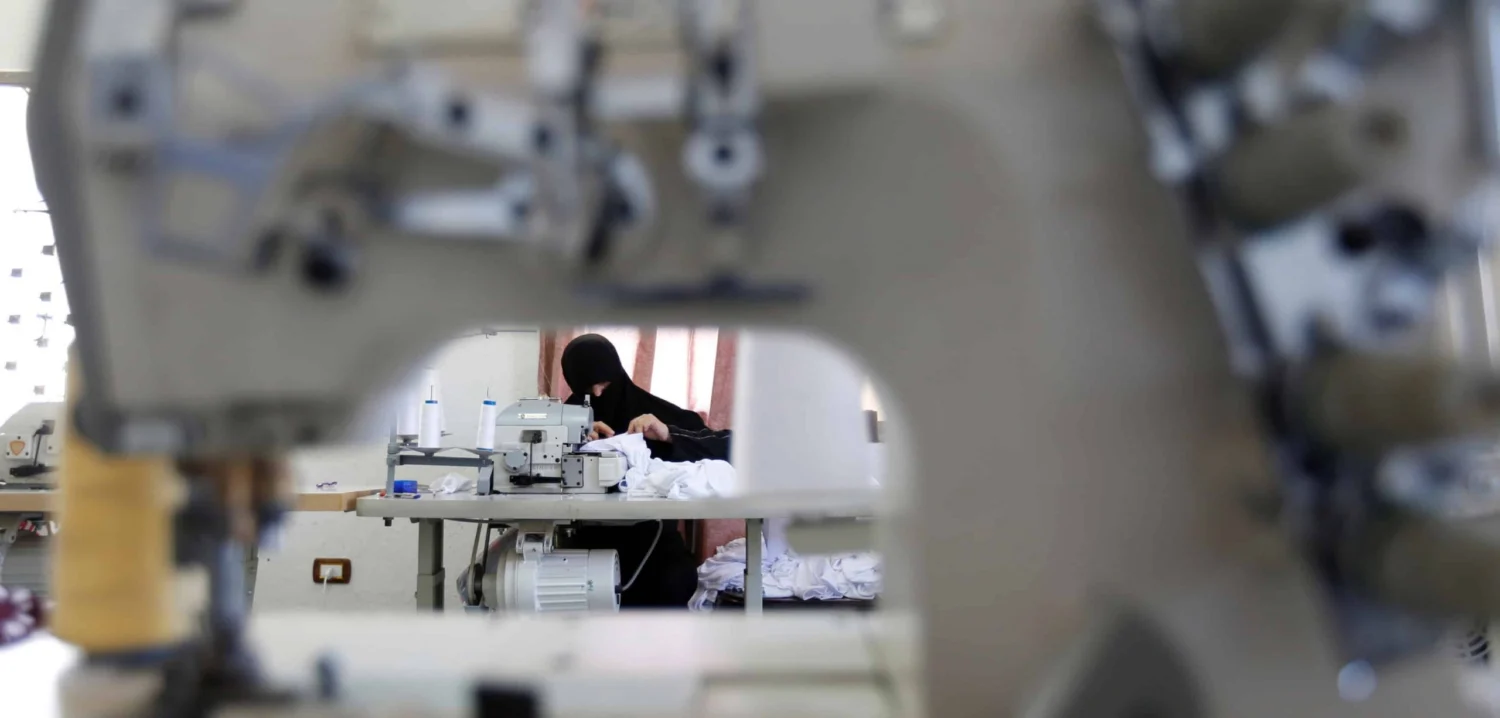
The 2016 Jordan Compact was a trade-for-jobs deal between the EU and Jordan: donors pledged $1.7 billion in financing in exchange for 200,000 jobs for Syrian refugees, with garment factories granted tariff-free EU market access if at least 15% of their workforce was Syrian. Garment factories, which employ large numbers of women, were positioned as a key channel for recruiting Syrian women.
Early results exposed a gender gap the Compact's design had not addressed. By the end of 2016 the flagship pilot had recruited only 30 Syrians; Jerash Garments, an early adopter, employed just 22 Syrian workers among 2,800 total staff. Critically, only 5% of the work permits issued under the Compact went to women, even though women were the intended recruitment target in garment factories. Surveys found 57% of Syrian refugee women wanted work but were not seeking it, citing long commutes to isolated desert industrial zones, safety and harassment concerns, husbands' disapproval, wages of about 190 Jordanian dinars a month, and a lack of childcare.
The International Labour Organization's Better Work Jordan programme responded by addressing the mobility barrier directly: providing transport from Zaatari refugee camp to factory buses helped place 165 women from the camp among 347 Syrian refugees hired, contributing to roughly 1,800 garment-sector placements within 2,300 total placements achieved across sectors through eleven ILO employment service centres.
In July 2025, the ILO, the Jordan Garments and Textiles Exporters Association (JGATE) and Jordan's Ministry of Social Development, with European Union funding under a programme titled "Towards an inclusive national social protection system and accelerating decent job opportunities for Syrians and vulnerable Jordanians," renovated and expanded a nursery in the Al-Dhulayl Industrial Zone, raising its capacity from 32 to 184 children of garment workers.
The case is an honest illustration that trade-linked job quotas alone do not guarantee gender-equal outcomes: it took years of added, targeted childcare and transport investment to begin correcting a gap that the original Compact design left largely unaddressed, and national data on women's share of work permits suggests the gap is only partially closed.
Read the full analysis: https://www.thecairoreview.com/essays/a-compact-for-syrian-refugee-women/
Where this practice's information was retrieved from, and when.