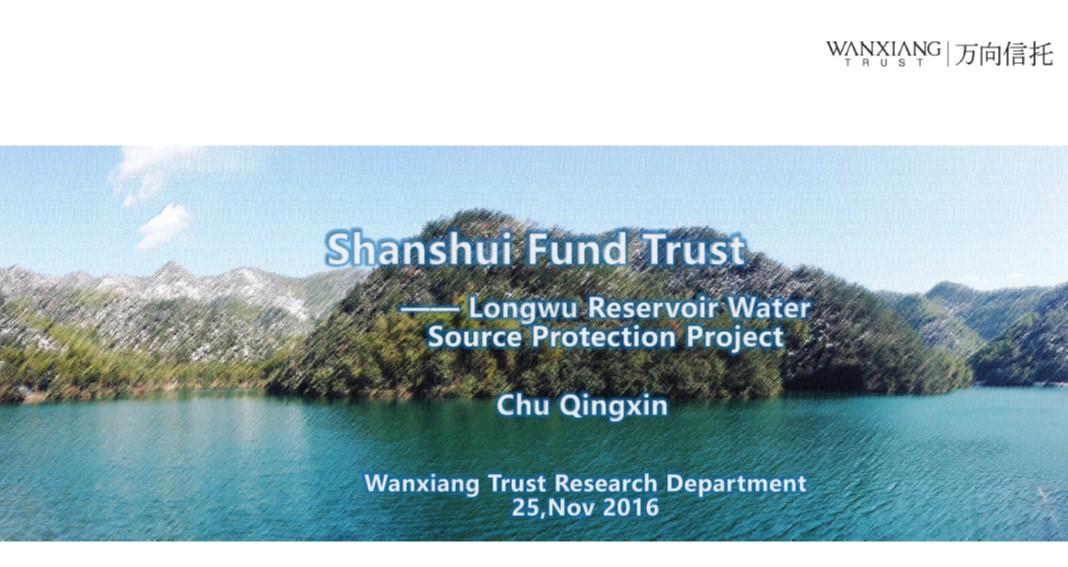
China's first water trust fund: TNC, Alibaba Foundation and Wanxiang Trust seeded the Longwu Water Fund with 330,000 CNY in 2015 to cut fertiliser runoff from bamboo plantations above a village reservoir, lifting water quality to Class I drinking standard by 2018.
330,000 CNY
Initial fund grant (2015) (2015)
rose to Class I (China's highest drinking-water grade)
Reservoir water quality classification (by 2018)
4.02 million CNY
Qiandao Lake Water Fund follow-on investment
3,000+
People trained by Qiandao Lake Water Fund
Details
Maturity
Established
Promoter
The Nature Conservancy / Alibaba Foundation / Wanxiang Trust
Period
2015-present
Keywords
water trust fund, watershed protection, bamboo forestry, drinking water quality
Context
Longwu Reservoir, built in 1981, supplies drinking water to roughly 3,000-4,000 residents of Qingshan Village and neighbouring hamlets in Yuhang District, on the edge of the Hangzhou metropolitan area, Zhejiang Province. Its upstream catchment (about 173 hectares, of which some 107 hectares are moso bamboo plantations) had suffered rising nitrogen and phosphorus levels since the 1980s from heavy fertiliser and pesticide use to boost bamboo shoot yields.
Objectives
In 2015 The Nature Conservancy, the Alibaba Foundation and Wanxiang Trust jointly established the Longwu Water Fund (also known as the Shanshui Water Fund) with an initial grant of 330,000 CNY — China's first water trust fund. Wanxiang Trust acts as legal trustee, working with upstream bamboo farmers, local public-interest groups, NGOs and agricultural supply-chain partners to shift toward reduced-fertiliser, reduced-pesticide plantation management.
Results
By 2018 the reservoir's water quality had risen from a grade usable only for industrial purposes to China's highest drinking-water classification (Class I), with total phosphorus and dissolved oxygen meeting national standards, and participating farmers reported higher incomes. The approach directly informed the follow-on Qiandao Lake Water Fund — China's first large-scale urban water fund — which channelled a further 4.02 million yuan into watershed protection and has trained more than 3,000 government officials, farmers and students.
Conclusions
Both funds remain modest relative to China's national watershed eco-compensation schemes and depend on renewed philanthropic and corporate grants rather than a large recurring payment stream, and detailed public accounting of total funds disbursed since the initial grants is limited.
Implementation
Indicative cost
Medium (€50k–€500k) — Only the initial 330,000 CNY (2015) grant is publicly disclosed; because the fund depends on renewed grants, total cumulative cost since 2015 is not documented, so a conservative medium estimate is used.
Time to results
Long (> 3 years) — Fund established 2015 and reported as ongoing; the follow-on Qiandao Lake Water Fund built directly on the model, indicating a multi-year trajectory.
Staffing & skills
The Nature Conservancy (TNC), Alibaba Foundation, Wanxiang Trust (legal trustee), local NGOs and agricultural supply-chain partners, upstream bamboo farmers
Conditions for success
formal legal trust structure with a named legal trustee
multi-stakeholder funding combining a corporate foundation, a financial trust and an environmental NGO
direct engagement with upstream farmers to change fertiliser/pesticide practices
Common failure modes
the fund depends on renewed philanthropic and corporate grants rather than a stable recurring payment mechanism
detailed public accounting of total funds disbursed since the initial grant is limited
Where it fits
Governance type
NGO/corporate-funded legal trust
Scale
single small watershed (~173 hectares)
Income level
upper-middle income (China)
Commonly funded by
Philanthropic / foundation funding
Indicative funding routes for practices of this type — always check each programme's current calls and eligibility rules.
Do you run this practice?
Claim it —
verified implementers get a public contact pathway and can propose corrections.
Data sources
Where this practice's information was retrieved from, and when.
United Utilities' £22.2M Sustainable Catchment Management Programme (2005-2015) paid tenant farmers across 57,000 hectares of Peak District and Forest of …