Presupuesto Participativo — Peru's National Participatory Budgeting Law
Peru
Peru's 2003 Ley Marco del Presupuesto Participativo made it one of the few countries mandating participatory budgeting nationwide. In its …
Kenya · Wote · See the Kenya profile
Evidence: Observational / pre–post Top 74% 57/100 · Ask Evidence Copilot about this practice
After Kenya's 2010 devolution, Makueni County built a six-tier participatory budgeting process from village to county level. By FY2016/17, World Bank data show 32% of its development budget (Kshs 823 million) was allocated through forums reaching over 350,000 people.
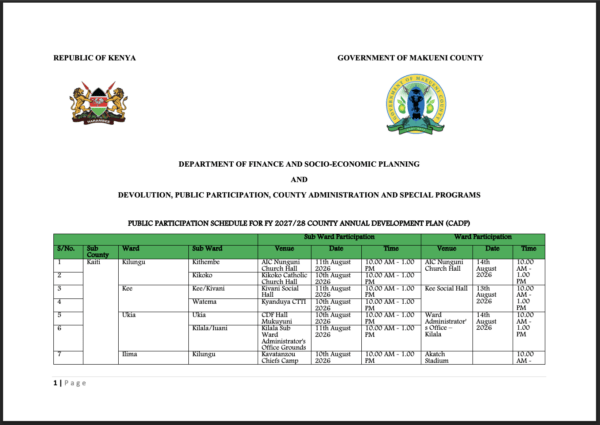
Kenya's 2010 constitution devolved budgeting to 47 new counties and required public participation under the 2012 Public Finance Management Act. After early consultations under Makueni's first governor, Kivutha Kibwana (elected 2013), suffered from elite capture and low turnout, the county redesigned its process from FY2015/16 with support from the World Bank's Kenya Accountable Devolution Program.
To build a structured, non-hierarchical, multi-tier participatory budgeting process to allocate development budget in line with citizen priorities, avoiding elite capture experienced in the initial consultations.
A six-tier cascade: Village Peoples' Forums (over 3,000, each with an 11-member committee), Village Clusters, Sub-Wards, Wards, Sub-Counties, and a final County Forum of around 1,000 delegates.
World Bank data for FY2016/17 record 3,867 participatory meetings, over 350,000 participants engaged, and 32% of the county's development budget (Kshs 823 million) allocated through the process, funding projects such as 84 medium-size earth dams built without land-purchase disputes. Makueni's own-source revenue grew from KSh 189 million in FY2013/14 to KSh 1.291 billion in FY2024/25, which the county attributes in part to trust built through citizen engagement. In August 2018 the Council of Governors, with World Bank, UKAID and USAID support, brought all 47 county governors to Makueni to study the model.
The World Bank's own working paper cautions that Makueni's results 'should not be considered a best practice that can be readily replicated,' given how much depended on sustained political commitment from a single reformist governor who faced an impeachment attempt. Citizens systematically prioritise visible, immediate needs over longer-term strategic investment, rural participants often had limited feedback on which prioritised projects were funded, and reported figures have varied by year and source.
National / regional programmes
Indicative funding routes for practices of this type — always check each programme's current calls and eligibility rules.
Do you run this practice? Claim it — verified implementers get a public contact pathway and can propose corrections.
Where this practice's information was retrieved from, and when.
Peru
Peru's 2003 Ley Marco del Presupuesto Participativo made it one of the few countries mandating participatory budgeting nationwide. In its …
Dominican Republic
Since Ley 170-07 (2007), Dominican municipalities must decide part of their capital-investment budget through open community assemblies. Adoption spread from …
Belgium
City-wide non-profit (founded 2013) steering Leuven toward climate neutrality via a quadruple-helix model of government, knowledge institutions, companies and citizens. …
Brazil
Porto Alegre's 1989 invention of neighbourhood budget assemblies raised sewer/water coverage from 75% to 98% of households by 1997 and …
Open full copilot Grounded in cited practices — always check the sources.