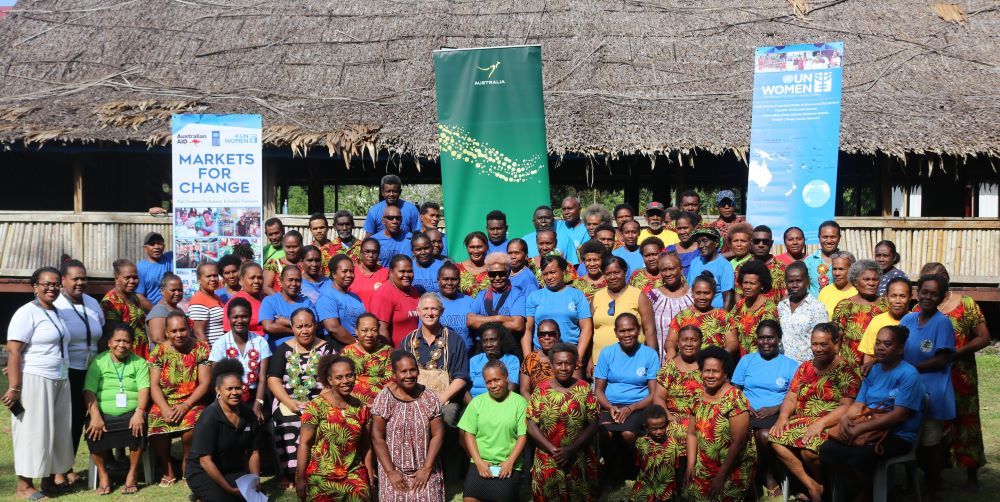
Markets for Change: UN Women/UNDP/DFAT programme (2014–ongoing) building women's leadership, safety and infrastructure in Solomon Islands' marketplaces — Honiara, Auki, Gizo, Munda and Buala — where up to 90% of vendors are women.
75-90 %
Share of marketplace vendors who are women (Pacific)
250-300
Auki market vendors, ordinary trading day
450-500
Auki market vendors, peak trading day
~1 million AUD
Australian supplementary funding, Solomon Islands component (2017-2019)
Vendors surveyed by ANU (Keen & Ride, 2018), Honiara unregulated markets
10-16 million USD/year
Estimated annual value of Honiara unregulated community markets
~90 %
Share of that market value earned by women
Details
Maturity
Scaling
Promoter
UN Women / UNDP, with Government of Australia (DFAT), Canada and New Zealand
Period
2014–ongoing
Keywords
informal markets, women vendors, marketplace governance, economic empowerment, Pacific
Context
Markets for Change (M4C) is a multi-country programme implemented by UN Women with UNDP, funded principally by the Government of Australia (DFAT) with additional support from Canada and New Zealand, operating in Fiji, Vanuatu and Solomon Islands since 2014 (Samoa added later). In Solomon Islands it works in Honiara Central Market, Auki Market (Malaita Province), and sites in Gizo, Munda and Buala, where roughly 75-90% of vendors are women; before M4C, no formal Market Vendors Associations (MVAs) existed in the country.
Objectives
To build women vendors' leadership, safety and market infrastructure, shifting market governance from largely male-dominated decision-making toward women-led Market Vendors Associations.
Activities
Combines physical infrastructure upgrades — such as the March 2021 Auki market renovation adding concrete slabbing, drainage, expanded vendor space and a security fence — with governance and skills training: a 32-vendor food-safety and hygiene course in Auki (2017), leadership/financial-literacy workshops for 60+ vendors in Honiara, a five-province Market Vendors Forum in Honiara (June 2024, 80+ representatives), and a value-adding training of trainers for 20 vendor representatives across Munda, Gizo, Auki and Honiara (July 2025).
Results
The Australian Government committed roughly AUD 1 million in supplementary funding for the Solomon Islands component (2017-2019), part of a six-year regional initiative whose combined Fiji/Solomon Islands/Vanuatu budget exceeded US$11 million. Independent ANU research (Keen & Ride, 2018) surveyed 189 vendors (84% women) at Honiara's unregulated community markets and found these sites remain largely outside the reach of M4C's infrastructure and governance improvements, despite generating an estimated US$10-16 million a year in value with women earning roughly 90% of that income.
Conclusions
Most published M4C outcome statistics are aggregated across Fiji, Solomon Islands and Vanuatu rather than broken out by country, and no independent Solomon-Islands-specific impact evaluation was found publicly; achievements should be read as programme-reported, alongside credible but limited independent academic corroboration.
Implementation
Implementation detail (cost, timeline, staffing, conditions for success) is not yet available for this practice.
Do you run this practice?
Claim it —
verified implementers get a public contact pathway and can propose corrections.
Data sources
Where this practice's information was retrieved from, and when.
Pakistan’s BISP pays quarterly grants to >6.1 million female household heads across 149 districts. Oxford Policy Management’s evaluation (2010–2017) found …