Banff National Park Wildlife Crossings — Trans-Canada Highway Mitigation Programme
Canada
Parks Canada's 44 wildlife crossings along Banff's Trans-Canada Highway recorded 200,000+ animal crossings since 1996, cut collisions ~80% (96% for …
Netherlands · Hilversum · See the Netherlands profile
Evidence: Quasi-experimental Top 58% 40/100 · Ask Evidence Copilot about this practice
The Netherlands' MJPO programme resolved 166 of 176 ecological barriers by 2018, building a network of 2,100+ road and rail wildlife crossings; an independent study found ecoducts reach 62% target-species use and cut roadkill 83% where fenced.
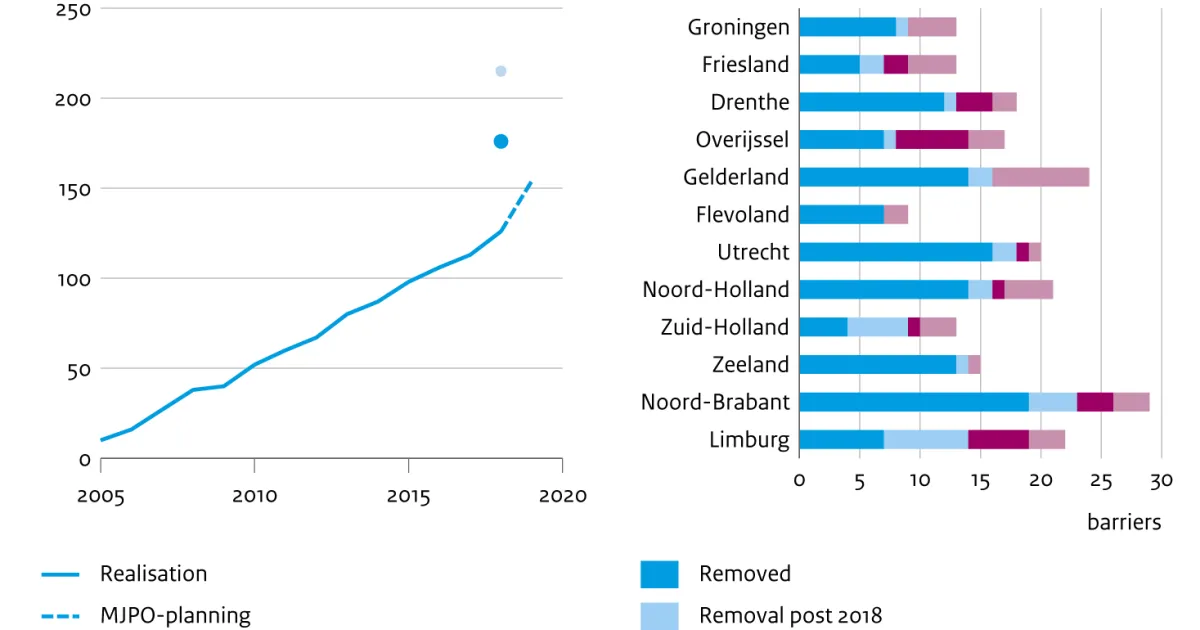
Starting with badger tunnels built in 1974 and the first large green bridges over the A50 motorway in 1988, the Netherlands built one of the world's most extensive wildlife-crossing networks under Rijkswaterstaat and ProRail, the national roads and rail agencies. The Multi-Year Programme for Defragmentation (MJPO), run 2005-2018, targeted 176 official ecological barriers where roads, railways and waterways cut through the National Ecological Network.
The programme built ecoducts, eco-culverts, wildlife underpasses, tree-crown-level overpasses and adapted bridges across the national road, rail and waterway network.
By the end of 2018, 126 barriers were fully removed and 40 more partially addressed; the country's road network now carries more than 2,100 dedicated wildlife crossings. A peer-reviewed evaluation (van der Grift et al., Landscape Ecology, 2020) found that about 62% of target species use ecoducts as intended and that fenced crossing structures cut large-mammal roadkill by roughly 83%. The programme raised an estimated 1,734 T-EQA of threat-weighted ecological quality at a total cost of about EUR 283 million.
The same study found ecoducts to be the most expensive mitigation type per unit of ecological gain - large fauna tunnels and shared-use viaducts were more cost-effective, and buying and restoring agricultural land outperformed building new crossings on pure cost-effectiveness grounds. Researchers and the Dutch government treat this as an argument for mixing cheaper measures with ecoducts rather than a case against the network, which remains a reference model cited across Europe.
National / regional programmes LIFE Programme
Indicative funding routes for practices of this type — always check each programme's current calls and eligibility rules.
Do you run this practice? Claim it — verified implementers get a public contact pathway and can propose corrections.
Where this practice's information was retrieved from, and when.
Canada
Parks Canada's 44 wildlife crossings along Banff's Trans-Canada Highway recorded 200,000+ animal crossings since 1996, cut collisions ~80% (96% for …
Kenya
Kenya's Mombasa–Nairobi railway crosses unfenced Tsavo on an embankment with 141 crossing structures; a 2022 peer-reviewed study found real but …
Costa Rica
After a University of Costa Rica primatologist found a howler monkey electrocuted crossing a canopy gap, her team strung rope …
Slovenia
On two hotspots on the Ljubljana–Kočevje road, roadside sensors detect approaching bears and trigger dynamic 'animal on the road' warning …
Open full copilot Grounded in cited practices — always check the sources.