Lao PDR's Ethics-Guided National AI Literacy & TVET Instructor Programme
Laos
Guided by UNESCO's AI Readiness Assessment, Lao PDR's Ministry of Education and Sports and UNESCO issued national ICT-AI Competency Standards …
Nicaragua · Managua · See the Nicaragua profile · See the Managua profile
Evidence: Descriptive / self-reported Top 80% 33/100 · Ask Evidence Copilot about this practice
Nicaragua's Ministry of Education, INATEC, SETEC and the National Engineering University launched three national guides on responsible, ethical AI use for educators, students and parents, reaching about 2,380 people in person and online on 19 March 2026.
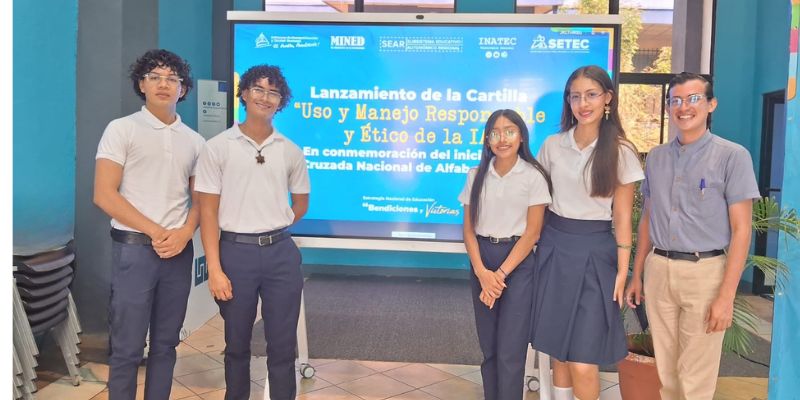
On 19 March 2026, Nicaragua's Ministry of Education (MINED), together with the technical-education institute INATEC, SETEC and the Universidad Nacional de Ingeniería, launched three 'cartillas' — short guidance booklets — on the responsible and ethical use of artificial intelligence in education, one each for teachers, students and parents or guardians, as part of the government's 2024–2026 National Education Strategy.
Guide responsible and ethical AI use in education around three stated principles — security, privacy and critical thinking — tailored separately for teachers, students and families.
The teachers' edition offers pedagogical tools for classroom use, the students' edition focuses on ethical and innovative learning practices, and the parents' edition covers safe digital supervision at home. The launch event took place at the Universidad Nacional de Ingeniería in Managua, with programme coordinator David Armengol describing the initiative as a response to the need to 'accompany' everyday technology use in classrooms.
The launch drew about 200 people in person, with more than 2,180 additional educators, students and family members connecting virtually from across the country.
As a newly launched policy document rather than a classroom intervention with follow-up data, its evidence base at this stage is descriptive: reach and content are documented, but no measurement of resulting changes in AI use, safety incidents or learning outcomes has yet been reported.
National / regional programmes
Indicative funding routes for practices of this type — always check each programme's current calls and eligibility rules.
Do you run this practice? Claim it — verified implementers get a public contact pathway and can propose corrections.
Where this practice's information was retrieved from, and when.
Laos
Guided by UNESCO's AI Readiness Assessment, Lao PDR's Ministry of Education and Sports and UNESCO issued national ICT-AI Competency Standards …
Costa Rica
Costa Rica's Ministry of Public Education, with the UN, UNESCO and ULACIT, launched an ethics-and-safety guide for AI in classrooms …
Germany
On 10 October 2024, Germany's Kultusministerkonferenz — all 16 state education ministries — adopted a joint framework for AI in …
Bulgaria
Survey of 10,038 pupils, 1,767 teachers and 210 principals in 63 schools: 94.7% of pupils use AI, but only 6.5% …
Open full copilot Grounded in cited practices — always check the sources.