Czech State Environmental Fund's Anti-Drought Landscape Water Retention Programme
Czechia
Since 2014, the Czech State Environmental Fund has backed ~18,000 projects with CZK 13bn (~EUR 520m) to slow water loss …
United States of America · Okeechobee · See the United States of America profile
Florida's SFWMD pays ranchers near Lake Okeechobee, under 10-year contracts, per acre-foot of water retained and pound of phosphorus kept from the Everglades. Grown from an 8-ranch 2005-2011 pilot, its first nine projects retained ~6,700 acre-feet; a 2014 deal added 95,812 more.
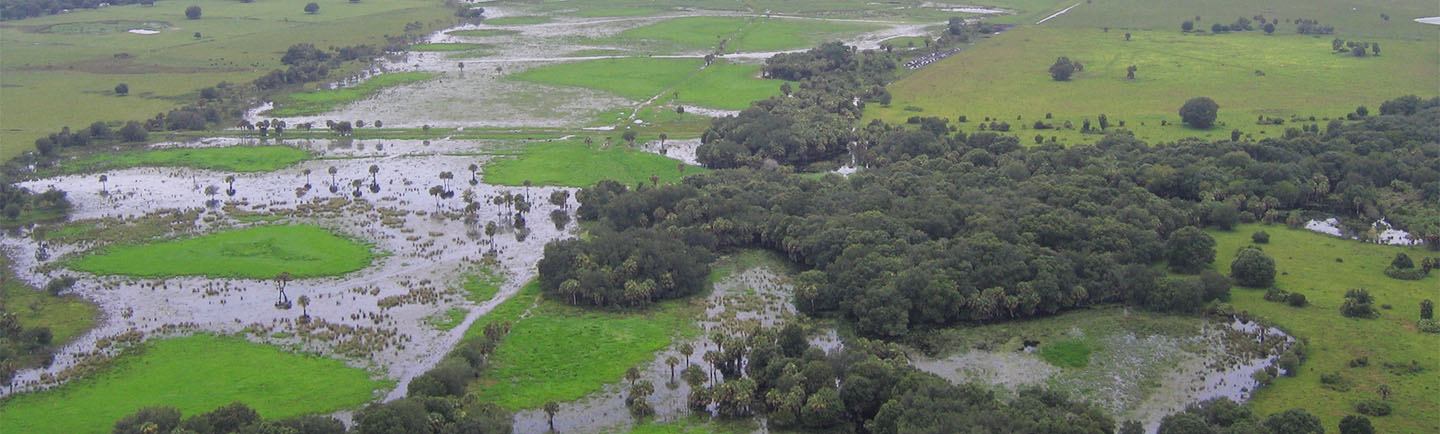
The Northern Everglades Payment for Environmental Services (NE-PES) program, run by the South Florida Water Management District (SFWMD), pays cattle ranchers in the Lake Okeechobee watershed (Highlands, Okeechobee and Glades counties) to retrofit ditches and culverts so pastureland retains water and filters phosphorus and nitrogen before it reaches the lake and, downstream, the Everglades. It grew out of the Florida Ranchlands Environmental Services Project (FRESP), a 2005-2011 pilot on eight ranches led by a coalition of SFWMD, the Florida Department of Agriculture and Consumer Services, the Florida Department of Environmental Protection, USDA NRCS, the University of Florida, World Wildlife Fund and Archbold Biological Station. SFWMD launched the follow-on NE-PES program with its first solicitation in January 2011 (14 proposals submitted, 8 approved). Under 10-year contracts, ranchers are paid per acre-foot of water retained and/or per pound of phosphorus and nitrogen removed at contracted (average-year) performance levels, verified by monitoring, plus reimbursement for design, permitting and construction and an annual operations-and-maintenance payment.
SFWMD's own water-storage-strategy reporting shows the first nine NE-PES projects, built by around 2014, collectively retaining approximately 6,700 acre-feet of water. In December 2014 SFWMD's Governing Board approved six additional contracts adding 95,812 acre-feet of storage capacity, funded by a Florida Legislature appropriation of $5 million one-time plus $5 million recurring. The design and monitoring approach has been documented in peer-reviewed literature: Bohlen et al. (2009, Frontiers in Ecology and the Environment) describe the pilot's payment-for-environmental-services design, and Boughton et al. (2019, Ecosphere) analyse trade-offs and synergies among ecosystem services across four participating ranches.
The program has real continuity and scaling limits. The Florida Bar Journal, reporting on the broader dispersed-water-management effort NE-PES sits within, notes the Legislature itself flagged that 'a continuing source of funding is needed to effectively implement the program', and that by Water Year 2016 the umbrella program had 40 operational projects but a further 10 stuck in planning and 7 still in design or permitting — evidence of slower-than-intended scale-up. Total lifetime program budget and aggregate phosphorus-load-reduction figures were not found in publicly accessible form.
Read the full analysis: https://www.sfwmd.gov/our-work/water-storage-strategies
Implementation detail (cost, timeline, staffing, conditions for success) is not yet available for this practice.
Where this practice's information was retrieved from, and when.
Czechia
Since 2014, the Czech State Environmental Fund has backed ~18,000 projects with CZK 13bn (~EUR 520m) to slow water loss …
United States of America
Since 1986 Minnesota has paid landowners a one-time fee for easements retiring marginal cropland, wetlands and prairie. State agency BWSR …
New Zealand
National programme paying contractors to eliminate invasive wilding conifers from ~180,000 ha/year; wilding conifers remove up to 40% of catchment …
United States of America
After 1996 and 2002 wildfires choked Denver's reservoirs with sediment, Denver Water and the US Forest Service treated 120,000+ acres …
Open full copilot Grounded in cited practices — always check the sources.