Kushiro River Meander Restoration — Kushiro Wetland, Japan
Japan
A 2006-2011 project reconnected 2.4km of the Kushiro River's original meander in Japan's largest peatland; a 2025 peer-reviewed study found …
United States of America · Columbia · See the United States of America profile
Evidence: Descriptive / self-reported Top 14% 60/100 · Ask Evidence Copilot about this practice
The Nature Conservancy has rewetted 37,000+ acres of pocosin peatland at Pocosin Lakes NWR, NC, and with TerraCarbon built the first ACR-approved peatland carbon methodology for the Southeast coastal plain, backed by a $67.8M EPA grant to restore 33,000 more acres.
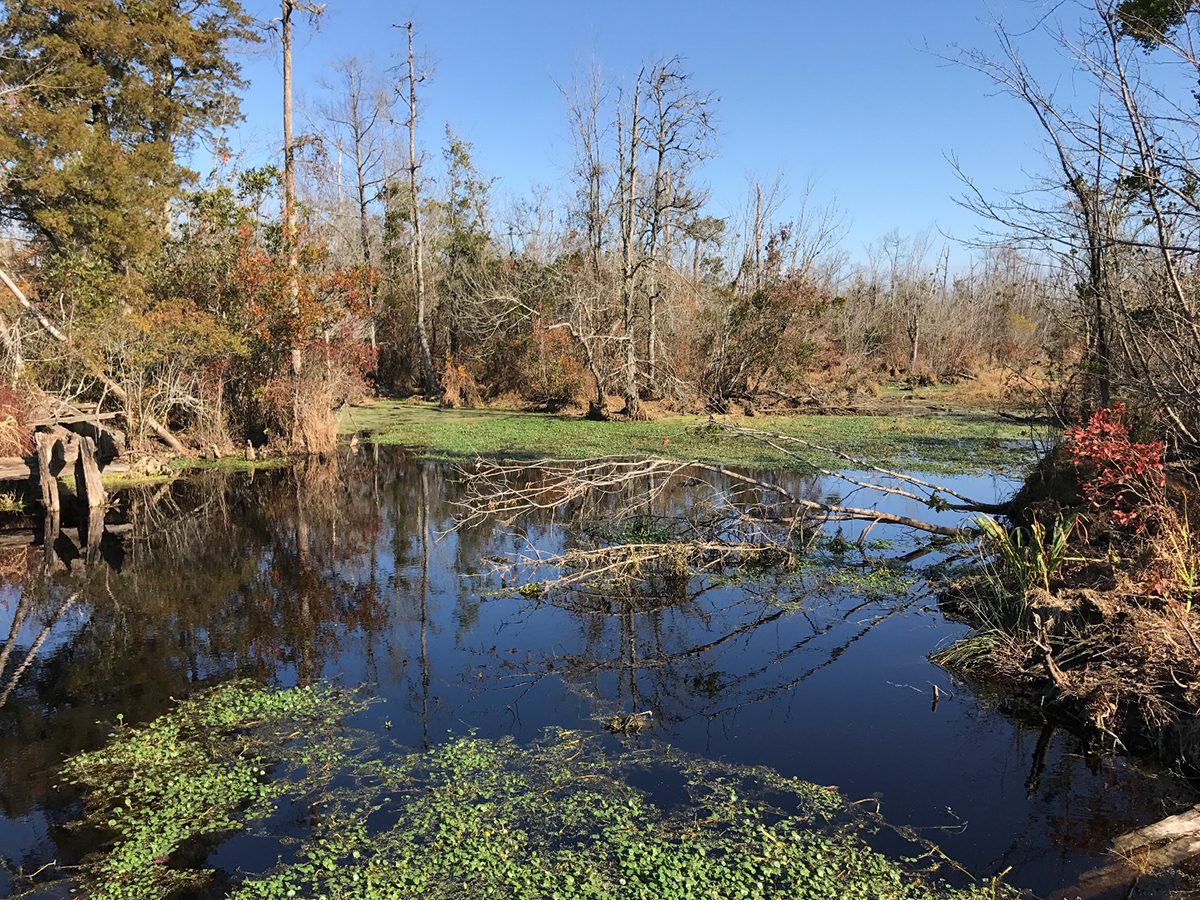
Pocosin Lakes National Wildlife Refuge in eastern North Carolina protects one of the largest remaining pocosin peat-wetland complexes in the United States. Decades of agricultural and forestry drainage before the refuge's 1990 creation left much of its roughly 101,600 acres of peat soil oxidizing and emitting carbon, and prone to catastrophic peat fires -- most notably the 2008 Evans Road Wildfire, which burned 41,534 acres of the refuge for three months and required 450 firefighters to contain.
Rewet drained pocosin peat to reduce ongoing carbon emissions and wildfire risk, and establish a carbon-accounting methodology that lets landowners fund further restoration through voluntary carbon credit sales.
Since the 1990s the U.S. Fish & Wildlife Service and The Nature Conservancy have installed water-control structures to rewet drained pocosin, restoring more than 37,000 acres. TNC and carbon-project developer TerraCarbon built the first peatland carbon-accounting methodology (Version 1.0) approved by the American Carbon Registry, applicable to any peat-restoration project across the Southeast coastal plain. In July 2024 the EPA awarded TNC's North Carolina chapter $67.8 million -- part of a $421 million regional Climate Pollution Reduction Grant -- to restore a further 33,000 acres and protect 10,500 acres of peatland across North Carolina and Virginia.
As of 2023 reporting, no peatland carbon credits under this methodology had yet been sold commercially: enrollment requires third-party audits and site-specific baselines that reporters describe as far more complex than trading conventional securities.
Experts caution that the wider, largely unregulated voluntary carbon market carries a real risk of greenwashing without strong integrity standards -- a caution relevant to this methodology's future credit sales even though the underlying restoration work itself is well documented.
Philanthropic / foundation funding National / regional programmes
Indicative funding routes for practices of this type — always check each programme's current calls and eligibility rules.
Do you run this practice? Claim it — verified implementers get a public contact pathway and can propose corrections.
Where this practice's information was retrieved from, and when.
Japan
A 2006-2011 project reconnected 2.4km of the Kushiro River's original meander in Japan's largest peatland; a 2025 peer-reviewed study found …
Estonia
Estonia's 2015–2021 LIFE Mires programme restored natural water conditions on nearly 8,000 hectares of drained peatland by closing 317km of …
Czechia
The EU LIFE for MIRES project (2018–2024, €5.85M) rewetted ~2,200 ha of bogs and fens across Czechia's Šumava and Germany's …
Estonia
EU LIFE-funded programme (2015-2021, EUR 2.8M) rewetted 7,900 ha of degraded Estonian mires — beating its 5,800 ha target — …
Open full copilot Grounded in cited practices — always check the sources.