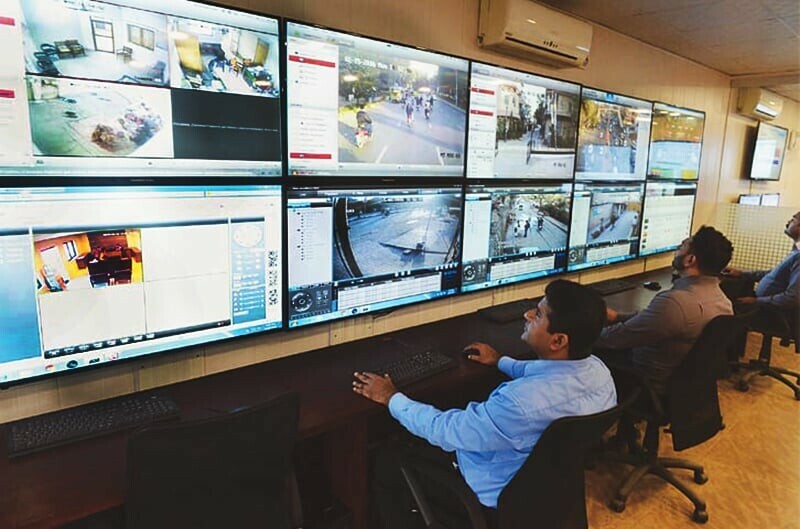
Punjab Police's AI Face Trace System matches CCTV images against an 18M-record biometric database from driving licences, crime files and prison photos. PSCA cites falling Lahore crime, but reporters found a third of cameras broken and the drop confounded with a policing surge.
39 %
Reduction in heinous crimes in Lahore (2022-23 to 2023-24)
36 %
Reduction in robbery/snatching (2022-23 to 2023-24)
45 %
Reduction in vehicle-theft calls (2022-23 to 2023-24)
18 million records
Biometric records in merged Face Trace database (as of 2023 launch)
8,000+ cameras
Facial-recognition-capable cameras in Lahore (as of August 2025)
~33 % of 7,678 cameras
Non-functional cameras in Lahore (2022)
51.7 USD million (Rs 12 billion)
Initial Safe Cities rollout cost (2016) (2016)
Details
Maturity
Scaling
Promoter
Punjab Safe Cities Authority, Punjab Police IT Wing & Punjab Information Technology Board
Period
Launched July 2023, expanded through 2025
Keywords
public safety, policing, surveillance, biometrics
Context
The Punjab Safe Cities Authority (PSCA) operates a province-wide CCTV and analytics network across Lahore, Rawalpindi, Faisalabad and Gujranwala, expanded from an initial 2016 rollout that cost roughly Rs 12 billion (about US$51.7 million).
Objectives
In July 2023, Punjab Police's IT Wing and the Punjab Information Technology Board (PITB) launched the 'Face Trace System' (FTS), an AI facial-recognition tool letting officers match a CCTV or photo capture against a merged biometric database of more than 18 million records (driving-licence photos, Crime Record Branch entries, citizen-service-centre visit photos and prison intake photos).
Activities
PSCA has since expanded facial-recognition-capable cameras in Lahore to more than 8,000 by August 2025 and received an international certification for its AI/analytics management system, alongside a parallel expansion of 'Dolphin' rapid-response police units from 110 to 266.
Results
PSCA's own year-on-year statistics, reported by Dawn, show heinous crimes in Lahore falling from 97,565 cases (2022-23) to 65,712 (2023-24) — a reported 39% reduction — alongside a 36% drop in robbery/snatching and a 45% drop in vehicle-theft calls.
Conclusions
PSCA itself attributes much of the crime decline to the parallel Dolphin unit expansion, so the drop cannot be isolated as an AI effect. Specialist reporting found that around a third of Lahore's cameras — and nearly all roughly 1,000 dedicated facial-recognition cameras — were non-functional in 2022 due to contractor non-compliance. No public methodology, accuracy testing, or independent oversight body for the facial-recognition matching has been published, and reusing driving-licence and citizen-service-centre photos for police biometric search raises unresolved consent and function-creep concerns that have not been publicly addressed.
Implementation
Indicative cost
Very high (> €5M) — Initial 2016 Safe Cities rollout cost roughly Rs 12 billion (~US$51.7 million); no separate published cost figure exists specifically for the 2023 Face Trace System AI layer.
Time to results
Long (> 3 years) — Safe Cities network launched 2016; Face Trace System (AI facial-recognition layer) launched July 2023 and expanded through August 2025.
Staffing & skills
Punjab Safe Cities Authority (PSCA) operating the province-wide CCTV/analytics network, Punjab Police IT Wing and Punjab Information Technology Board (PITB) building and launching the Face Trace System, Dolphin rapid-response police units expanded from 110 to 266 alongside the AI rollout
Conditions for success
Merged biometric database combining driving-licence, crime-record, citizen-service-centre and prison photos
International certification received for the AI/analytics management system
Parallel expansion of rapid-response policing capacity (Dolphin units)
Common failure modes
About a third of Lahore's cameras (and nearly all ~1,000 dedicated facial-recognition cameras) were reported non-functional in 2022 due to contractor non-compliance
No public methodology, accuracy testing or independent oversight body published for the facial-recognition matching
Reuse of driving-licence and citizen-service-centre photos (collected for unrelated purposes) for police biometric search raises unresolved consent/function-creep concerns
Crime decline cannot be isolated as an AI effect since PSCA attributes much of it to the parallel Dolphin unit expansion
Where it fits
Governance type
provincial government agency + police IT wing
Scale
provincial (Punjab, Pakistan — multiple cities)
Income level
lower-middle-income
Commonly funded by
National / regional programmes
Indicative funding routes for practices of this type — always check each programme's current calls and eligibility rules.
Do you run this practice?
Claim it —
verified implementers get a public contact pathway and can propose corrections.
Data sources
Where this practice's information was retrieved from, and when.
Cameroon's police run a Huawei-built 'Intelligent Cities' facial-recognition network, launched in Yaoundé (2019), expanded to Douala (2023). Phase one installed …
Mauritius built a nationwide facial-recognition and licence-plate camera network for policing, but an undisclosed contract, a national-security data exemption, and …