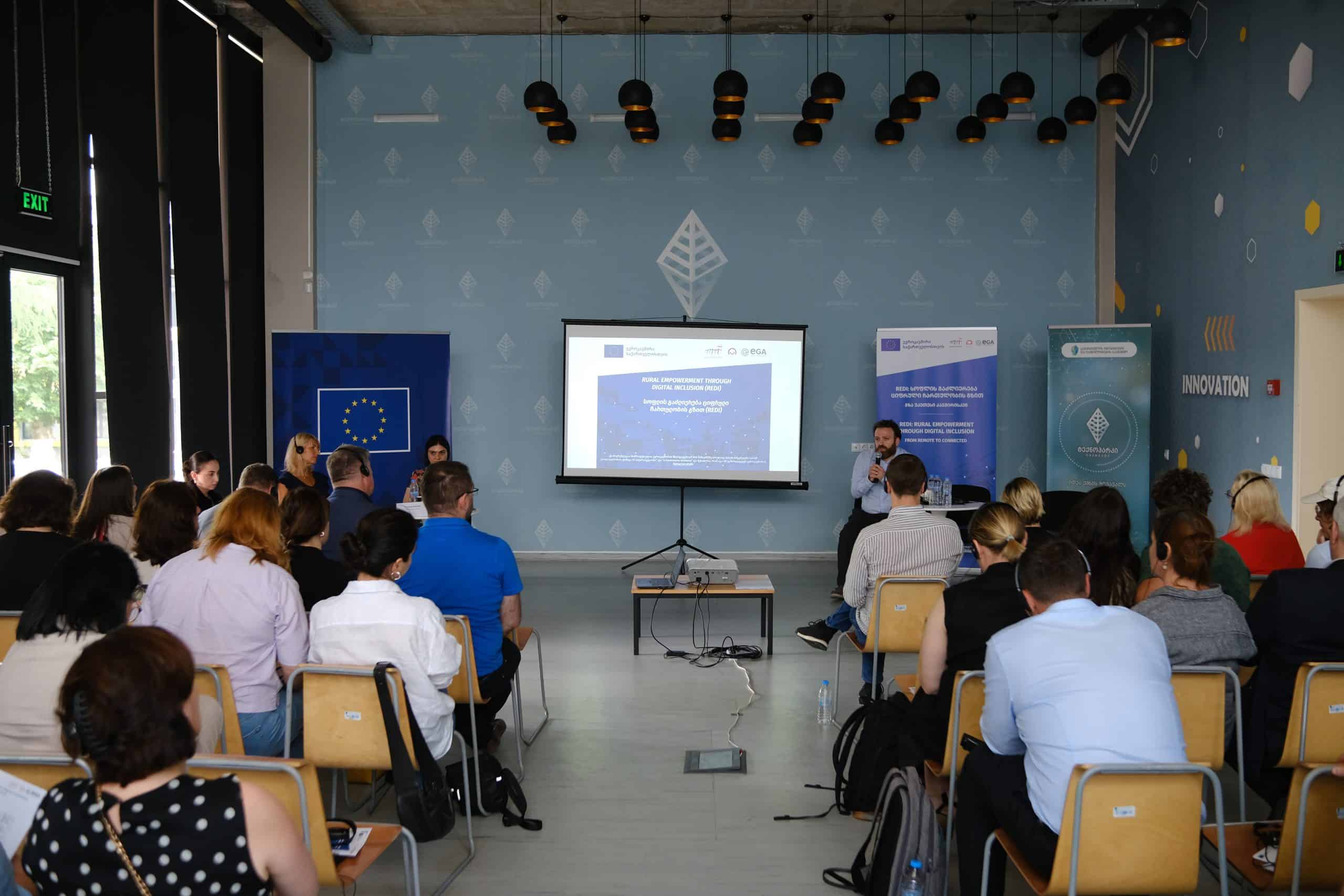
An EU-funded project led by Estonia's eGovernance Academy and Poland's Solidarity Fund PL is building public internet access points and rural digital hubs, and training digital-skills trainers, across 200 villages in four of Georgia's least-connected regions.
roughly 200 villages
Villages targeted for digital hubs and skills activities (2024-ongoing)
11 trainers
Georgian digital-skills trainers trained via Estonia study visit (February 2025)
Details
Maturity
Pilot
Promoter
eGovernance Academy (Estonia) & Solidarity Fund PL (Poland)
Period
2024-ongoing
Keywords
rural connectivity, digital literacy, public internet access points, EU cross-border cooperation
Context
REDI (Rural Empowerment through Digital Inclusion) is an EU-funded, cross-border project launched on 1 July 2024 with a kick-off event at Tech Park Ozurgeti. It is implemented by Estonia's eGovernance Academy (eGA) and Poland's Solidarity Fund PL (SFPL) under the Team Europe Initiative for Balanced Territorial Development, targeting citizens, vulnerable groups and small businesses in the Georgian regions of Guria, Racha-Lechkhumi and Kvemo Svaneti, Imereti and Kakheti — areas with sparse rural connectivity.
Activities
Activities include establishing public internet access points and digital rural hubs and advancing digital skills across roughly 200 villages, alongside a train-the-trainer strand: in February 2025, eleven Georgian digital-skills trainers completed a study visit to Estonia to learn from its e-governance and digital-education ecosystem. The project also works with local self-governments to design and test digital-engagement and inclusion guidelines intended to outlast the project itself.
Results
The project is still in its early implementation phase; public sources describe planned reach and training activity rather than measured changes in participants' digital skills or usage, and no impact evaluation has yet been published.
Implementation
Indicative cost
Medium (€50k–€500k) — EU-funded under the Team Europe Initiative for Balanced Territorial Development; specific budget not stated in source.
Time to results
Medium (1–3 years) — Launched 1 July 2024; train-the-trainer study visit completed February 2025; still in early implementation phase as of source publication.
Staffing & skills
Estonia's eGovernance Academy (eGA) - implementing partner, Poland's Solidarity Fund PL (SFPL) - implementing partner, Local self-governments in the targeted Georgian regions - guideline co-design partners
Conditions for success
Train-the-trainer approach: Georgian digital-skills trainers completed a study visit to Estonia to learn from its e-governance and digital-education ecosystem
Co-design of digital-engagement and inclusion guidelines with local self-governments, intended to outlast the project itself
Where it fits
Governance type
EU-funded cross-border project via national implementing agencies (Team Europe Initiative for Balanced Territorial Development)
Scale
regional/rural (5 Georgian regions, roughly 200 villages)
Income level
upper-middle-income (Georgia)
Do you run this practice?
Claim it —
verified implementers get a public contact pathway and can propose corrections.
Data sources
Where this practice's information was retrieved from, and when.
Farmerline's voice-first Mergdata platform delivers weather, market-price and agronomic advice plus digital credit to over 2 million smallholder farmers in …
ITU-led Smart Island programme brought VSAT/solar-powered connectivity and digital-skills training to six villages on Vanuatu's Malekula island, training over 1,000 …