Google Flood Hub — Bangladesh Water Development Board's AI-Powered River Flood Alert System
Bangladesh
Since 2020, Google Research's machine-learning flood model — which forecasts river levels even in ungauged basins — has combined with …
Kenya · Kisumu · See the Kenya profile
Underwater sensors and AI models built by Kenya's KMFRI and Nairobi's ShoShin Innovation Hub flagged a dissolved-oxygen crash at Dunga Beach, Kisumu in February 2026; over 300 farmers moved 450+ tilapia cages by SMS alert, averting a repeat of $1m in 2024-25 losses.
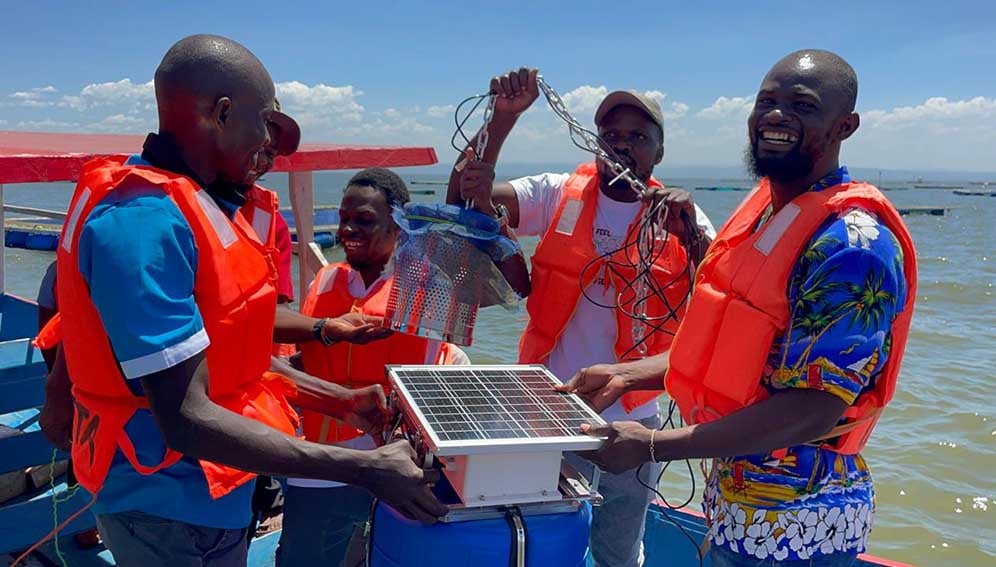
In February 2026, underwater sensors deployed by Kenya's Marine and Fisheries Research Institute (KMFRI) and the Nairobi-based ShoShin Innovation Hub detected a dangerous drop in dissolved oxygen — below the 2.0 mg/L threshold associated with fish kills — in the waters off Dunga Beach, Kisumu, on Lake Victoria. Cloud-hosted AI models, trained on KMFRI's historical fish-kill research combined with live sensor readings, flagged the pattern and triggered SMS alerts with simple, actionable guidance ('slow feeding', 'move cages') to feature phones belonging to more than 300 tilapia farmers.
Within hours, farmers coordinated by phone and relocated more than 450 cages of tilapia to safer water. The mass die-off that had come to define cage farming on this stretch of the lake did not happen: between 2024 and 2025, similar oxygen crashes had destroyed roughly US$1 million in fish stock at Dunga Beach alone, part of a pattern in which a 2022 KMFRI survey found more than three-quarters of Kenyan fish farmers had experienced mortalities. Since the February 2026 alert, Dunga Beach has recorded no further mass fish deaths.
The Kenyan government currently covers the platform's data and dissemination costs, with a low-cost subscription model under consideration as the network scales; the initiative is framed as aligning with Kenya's National Digital Masterplan (2022–2032). KMFRI has identified 15 additional high-risk hotspots along the Kenyan shoreline of Lake Victoria for possible expansion, with two further sites expected to go live in the second half of 2026, and the NGO WorldFish is adapting a similar sensor-and-AI approach (E-Samaki) for coastal mariculture sites in Kilifi and Kwale counties.
Researchers and reporters covering the rollout have been candid about its limits: the system can buy farmers the hours between an oxygen crash and a total loss, but it cannot reverse the underlying pollution — untreated urban waste and agricultural runoff feeding the algal blooms that drive oxygen depletion — nor regulate the weather. Rural connectivity gaps, the sustainability of long-term funding once government support tapers off, and unresolved questions about who controls farmers' sensor data over time were all raised as open concerns by the people building and reporting on the system.
Read the full analysis: https://www.scidev.net/global/scidev-net-investigates/can-ai-stop-mass-fish-deaths-on-lake-victoria/
Implementation detail (cost, timeline, staffing, conditions for success) is not yet available for this practice.
Where this practice's information was retrieved from, and when.
Bangladesh
Since 2020, Google Research's machine-learning flood model — which forecasts river levels even in ungauged basins — has combined with …
Iraq
Iraq's Prime Ministerial AI Advisor announced a small-scale AI trial at the Kufa and Al-Abbasiya water regulators near Najaf to …
Switzerland
SPSP integrates AI-powered genomic analysis to detect pathogen variants across Switzerland. Mandated by the Federal Office of Public Health since …
Singapore
Singapore's National Environment Agency runs a peer-reviewed machine-learning system that forecasts dengue cases up to three months ahead. In the …
Open full copilot Grounded in cited practices — always check the sources.