DFROG — De Nederlandsche Bank's Machine-Learning-Tested Nowcasting Model for GDP Growth
Netherlands
DNB's DFROG nowcasting model has tracked Dutch GDP growth in real time since 2024, publishing monthly estimates; a decade-long evaluation …
Italy · Rome · See the Italy profile
The Italian Senate uses Similis, an NLP tool built with CNR, to automatically cluster near-identical amendments filed en masse during filibusters. Presented in a peer-reviewed 2022 paper and released as open source, it keeps final voting-order authority with the Speaker.
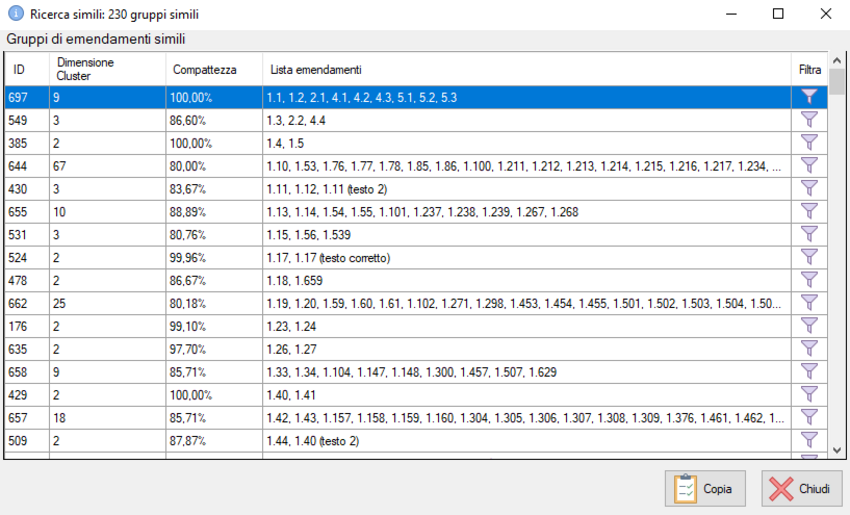
Similis is an AI/NLP text-clustering tool used by the Italian Senate (Senato della Repubblica) to detect groups of near-identical or heavily overlapping amendments submitted to bills, addressing 'filibustering' tactics where opposition parties file thousands of amendments differing by only a few words to delay a vote. It was built by the Senate's Information Systems Development Office with CNR-IGSG and is embedded in the Senate's GEM (Gestore Emendamenti) amendment-management suite.
The tool and its methodology were presented in a peer-reviewed paper at the ParlaCLARIN III workshop (LREC 2022), and its code is published as open source on GitHub (SenatoDellaRepubblica/Similis), offering a REST/Flask API and a command-line interface. Similis is positioned as assistive rather than autonomous: clustering is described as 'almost instant', but a human reviews, approves, modifies and integrates the results, with the Speaker retaining full authority over the final voting order.
The Senate's own dossier states the tool 'significantly reduced processing times' for what was previously a heavily manual triage task, and the Inter-Parliamentary Union published an independent case study on how it addresses mass near-duplicate amendment filing.
Precise quantitative figures on hours saved, amendment volumes processed, or clustering precision/recall were not independently verifiable with hard numbers, so time-savings claims should be read as Senate self-reported; no adversarial audit or public criticism of the tool's accuracy was found.
Implementation detail (cost, timeline, staffing, conditions for success) is not yet available for this practice.
Where this practice's information was retrieved from, and when.
Netherlands
DNB's DFROG nowcasting model has tracked Dutch GDP growth in real time since 2024, publishing monthly estimates; a decade-long evaluation …
United Kingdom
Consult, built by the UK's i.AI unit with the Alan Turing Institute, uses generative AI to analyse tens of thousands …
Taiwan
AI-assisted civic deliberation platform run by Taiwan's PDIS, using open-source Polis AI to map consensus on ~30 policy issues since …
United Kingdom
The UK's ATRS is a public register documenting how government algorithmic tools work and affect people. World-first when launched in …
Open full copilot Grounded in cited practices — always check the sources.