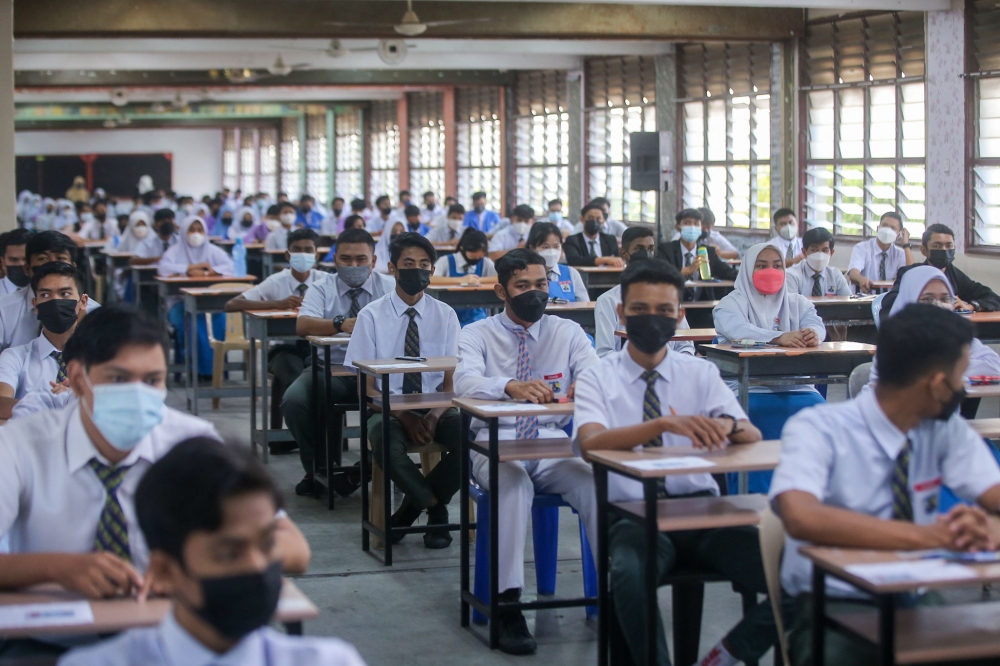
Malaysia's Ministry of Education added AI risk-screening to its student-tracking system, SiPKPM. In 2025 it helped over 9,000 at-risk students, including 3,287 girls, return to school, while national exam-day absenteeism fell from over 10,000 to about 8,000.
7 indicators
Risk indicators screened per student
9,000+ students
At-risk students helped to return to school (2025)
3,287 students
Girls among students helped to return to school (2025)
10,160
SPM exam-day absentees (2023)
8,164
SPM exam-day absentees (2024)
Details
Maturity
Established
Promoter
Ministry of Education Malaysia (KPM), with UNICEF Malaysia
Malaysia's Ministry of Education (KPM) operates Sistem Pengesanan Murid KPM (SiPKPM), a national student-tracking platform covering primary and secondary schools, which the ministry strengthened with AI in mid-2024 to screen students for dropout risk.
Objectives
The AI layer screens each student against seven risk indicators — attendance, academic achievement, disciplinary record, disability or learning-support needs, household income, distance from school, and parents' marital status — and sends automatic alerts so at-risk students can be identified early.
Activities
Alerts generated by the system route to teachers, counsellors and district officials for follow-up with flagged students and their families, and the system's development was supported by UNICEF Malaysia.
Results
UNICEF Malaysia reports that more than 9,000 flagged students, including 3,287 girls, returned to school in 2025, while SPM exam-day absenteeism fell from 10,160 no-shows in 2023 to 8,164 in 2024, according to Malay Mail, with BERNAMA separately describing the reduction to just over 8,000.
Conclusions
The system relies on sensitive personal data, including household income, disability status and parental marital status, and no published source describes an independent evaluation, a data-protection impact assessment, or a documented consent framework for families, so the reported figures should be read as self-reported ministry and partner statistics rather than independently audited outcomes.
Implementation
Indicative cost
Medium (€50k–€500k) — No public budget figure is available; the AI layer extends the ministry's existing national tracking platform rather than building new infrastructure, implying moderate incremental cost.
Time to results
Long (> 3 years) — SiPKPM has operated as a national tracking system since 2019, with AI risk-screening added in mid-2024 and outcome reporting continuing into 2025.
Staffing & skills
Ministry of Education Malaysia (KPM) teachers, counsellors and district officials, UNICEF Malaysia (technical support for system development)
Conditions for success
integration into an existing national student-tracking platform already covering all schools
automatic alert routing to teachers, counsellors and district officials for timely follow-up
technical support from UNICEF Malaysia
Common failure modes
reliance on sensitive personal data, including household income, disability status and parental marital status, without a published data-protection impact assessment or documented consent framework
reported outcome figures are self-reported by the ministry and its partners rather than independently audited
Commonly funded by
National / regional programmes
Indicative funding routes for practices of this type — always check each programme's current calls and eligibility rules.
Do you run this practice?
Claim it —
verified implementers get a public contact pathway and can propose corrections.
Data sources
Where this practice's information was retrieved from, and when.