Alerta Escuela — Peru's National ML-Based School Dropout Early-Warning System
Peru
Peru's Ministry of Education, with the World Bank, built a national ML platform estimating each student's dropout risk. A rigorous …
Argentina · Mendoza · See the Argentina profile
Mendoza and Entre Ríos, Argentina, built AI early-warning systems — with UBA's AI Lab, CIPPEC and CAF — flagging dropout-risk students from attendance, grades and family data. In year one, 4,300 Mendoza and 650 Entre Ríos students identified as high-risk stayed enrolled.
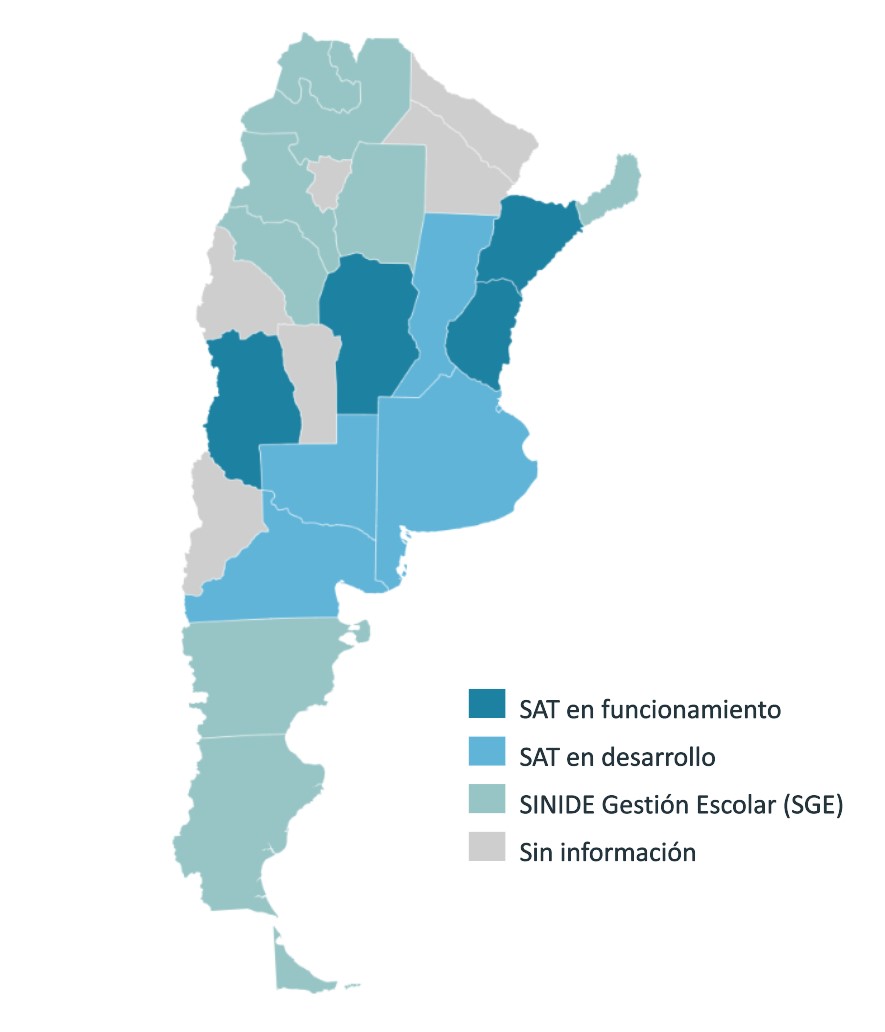
Argentina has one of Latin America's more persistent secondary-dropout problems, with around 30% of 20–22 year-olds not having completed secondary school and only 53 of 100 students reaching their final year on schedule. Starting in 2022–2023, the provinces of Mendoza and Entre Ríos built AI-based early-warning systems (Sistemas de Alerta Temprana, SAT) to identify students at risk of dropping out before it happens. The systems were developed with the Universidad de Buenos Aires's Artificial Intelligence Laboratory, the public-policy think tank CIPPEC, and financing and technical support from the regional development bank CAF.
The programs aim to identify secondary students at risk of dropping out early enough for schools to intervene, using AI models built on school-management data rather than relying only on informal teacher judgment.
Both systems mine school-management data — attendance, grades (especially in Language and Mathematics), parental education level, and age-grade discrepancy — to assign each student a risk level. Mendoza's model, trained on historical student trajectories, uses a “traffic light” (green/amber/red) classification and was rolled out to all secondary schools in the province in 2023. Entre Ríos ran a parallel pilot in 80 secondary schools using a high/medium/low risk ranking. CIPPEC directly accompanied schools in designing the follow-up intervention side of the system alongside the detection model.
In their first reported year, 4,300 students in Mendoza and 650 in Entre Ríos who were flagged as high-risk remained enrolled rather than dropping out, according to CIPPEC and Infobae reporting on provincial education-ministry data. These figures describe students retained after being flagged, not a comparison against a control group of similar students who were not exposed to the system.
The programs' own architects and evaluators are candid about their limits: Mendoza's success rested on the province having built a solid, individually-identified (“nominalized”) student database since 2018, infrastructure most of Argentina's other provinces still lack, since the country has no single national student-information system. CIPPEC's own assessment called the first year of implementation a learning process, flagging the need for better data quality and coverage, stronger technical capacity to run the systems, and better coordination between the detection algorithm and the follow-up interventions meant to keep flagged students in school.
Where this practice's information was retrieved from, and when.
Peru
Peru's Ministry of Education, with the World Bank, built a national ML platform estimating each student's dropout risk. A rigorous …
United Kingdom
The UK's Open University has run OU Analyse, a machine-learning early-warning system flagging at-risk distance learners weekly, in production since …
India
Gujarat's Vidya Samiksha Kendra uses AI analytics on attendance and assessment data to flag dropout risk for 11.5 million students …
Uruguay
A peer-reviewed Uruguayan study tracked 15,529 children into grades 1–3, building ML models that predicted grade repetition with 80% accuracy …
Open full copilot Grounded in cited practices — always check the sources.