Digital Analytics of Judicial Practice — Kazakhstan's AI Case-Outcome Tool, Scaled to Every Court
Kazakhstan
Kazakhstan's Supreme Court scaled an AI analytics tool, piloted for 1.5 years in four regions, to every court nationwide in …
Kenya · Nairobi · See the Kenya profile · See the Nairobi profile
Top 44% 60/100 · Ask Evidence Copilot about this practice
A World Bank and Kenyan Judiciary algorithm learns each mediator's value added and assigns incoming cases under capacity limits. On 30,633 cases from 2016-2025 it raised simulated agreement rates from 0.569 to 0.617; nothing is deployed yet and a randomised trial is pending.
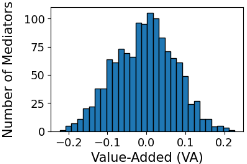
Kenya's Court-Annexed Mediation (CAM) programme diverts civil cases to accredited mediators before trial, aiming to resolve them inside a 70-day window and relieve a backlog of hundreds of thousands of pending cases. Mediators are accredited for particular court stations and case types, and the CAM secretariat prefers to keep each mediator to about three concurrent cases. Assigning each incoming case is therefore a constrained matching problem that has until now been done by hand. Analysing ten years of the Judiciary's own administrative data, a team from the World Bank and the Kenyan Judiciary found that manual assignment barely outperformed round-robin allocation and distributed work unequally across mediators.
SMaRT, published at IJCAI-26 in the AI and Social Good track, is their proposed replacement. It estimates each mediator's 'value added' — the percentage-point increase in the probability that a case is resolved — using a shrinkage model, keeps Gaussian beliefs over those estimates and updates them as outcomes arrive, recalibrating weekly. When a case arrives it solves a quadratic program with soft capacity constraints, penalising mediator overload and sampling likely future arrivals, then assigns the case to the mediator with the highest allocation. A parameter controls how strictly capacity is enforced, letting administrators trade resolution rates against workload equity. Notably, the authors deliberately model mediator quality as idiosyncratic rather than predicted from observable characteristics, treating that as an ethical requirement as much as a modelling choice.
The evidence so far is simulation on real data, not field results. Using 30,633 cases from 2016 to 2025, around 2,100 mediators, 87 court stations and a dozen case types, the full-information variant raised the simulated agreement rate from 0.569 under a greedy benchmark to 0.617, against an upper bound of 0.659 — roughly an 8% relative gain. When quality has to be learned from scratch the gain shrinks (0.518 versus 0.489), and in the warm-start setting the sampling variant reaches 0.495 versus 0.489 for Thompson sampling and 0.473 for greedy, while also cutting the overload measure sharply. Gains at the loosest capacity setting come with far higher mediator overload; tightening the penalty improves overload and the Gini index of workload at the cost of agreement rate.
Nothing is in production. SMaRT is queued to sit behind the 'smart assignment' feature of Cadaster, the Judiciary's World Bank-supported digital mediation platform, where it would propose mediators for a CAM officer to approve rather than assign cases itself, and it has ethics approval for a year-long randomised controlled trial, with the control group to be switched over only if the trial shows real improvement. Independent commentary on the paper makes the same point: the projected gains need a trial before wider adoption. The practice is listed here for the discipline of its approach — published method, real administrative data, human officer in the loop, equity explicitly measured, and a registered trial before deployment — not for proven impact, which does not yet exist.
Read the full analysis: https://ijcai.org/proceedings/2026/794
Implementation detail (cost, timeline, staffing, conditions for success) is not yet available for this practice.
Do you run this practice? Claim it — verified implementers get a public contact pathway and can propose corrections.
Where this practice's information was retrieved from, and when.
Kazakhstan
Kazakhstan's Supreme Court scaled an AI analytics tool, piloted for 1.5 years in four regions, to every court nationwide in …
France
Decree 2020-356 (27 March 2020) let France's Justice Ministry build DataJust, an algorithm mining court rulings to produce a bodily-injury …
Slovakia
Slovakia's justice ministry runs a hybrid named-entity-recognition service that pre-anonymises court decisions for mandatory online publication (~28,000 a month). It …
Vietnam
Launched in April 2022 by Vietnam's Supreme People's Court with Viettel Group, the judges' AI virtual assistant has fielded nearly …
Open full copilot Grounded in cited practices — always check the sources.