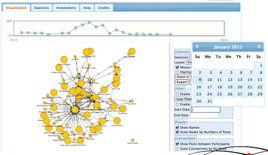
SNAPP, a free browser tool built at the University of Wollongong, turns Moodle and Blackboard discussion-forum activity into real-time social-network diagrams so instructors can spot isolated students and reflect on their own facilitation style.
Details
Maturity
Discontinued
Promoter
University of Wollongong
Period
2010–2014 (active development & evaluation; tool remained freely available afterwards)
Keywords
higher education, learning analytics, social network analysis
Context
SNAPP (Social Networks Adapting Pedagogical Practice) is a free, open-source browser scriptlet developed by Shane Dawson, Aneesha Bakharia and Elizabeth Heathcote at the University of Wollongong, Australia, first presented at the ACM Learning Analytics and Knowledge (LAK) conference in 2011.
Objectives
To let instructors see in real time which students are central to a discussion-forum conversation and which are isolated or peripheral, by turning Moodle and Blackboard forum activity into social-network diagrams.
Activities
SNAPP scrapes discussion-forum pages from Moodle and Blackboard and renders them as social-network graphs. Because the underlying network-analysis method is fully visible rather than a black-box model, teachers could inspect exactly why a student was flagged, using the diagrams for both real-time outreach and, more commonly, post-course reflection on their own moderation style.
Results
Published documentation of SNAPP's impact is mostly descriptive and qualitative - case studies of how staff used it and what they noticed - rather than a controlled study measuring learning-outcome gains.
Conclusions
SNAPP was distributed free of charge and worked across several major learning-management systems, letting it spread beyond Wollongong, but by the mid-2010s independent maintenance had slowed as forum-scraping approaches became harder to sustain against changing LMS interfaces.
Implementation
Indicative cost
Low (< €50k) — Free and open-source; no licensing cost.
Time to results
Short (< 1 year) — Active development and evaluation ran 2010-2014; the tool remained freely available afterwards but maintenance slowed.
Staffing & skills
existing course instructors self-serving the tool; no dedicated specialist staff required
Conditions for success
use of a supported LMS with discussion forums (Moodle, Blackboard, Desire2Learn)
instructor willingness to interpret network diagrams and reflect on their own facilitation style
Common failure modes
reliance on browser-based forum scraping became harder to sustain as LMS interfaces changed
no controlled evaluation of learning-outcome impact was published
Where it fits
Governance type
university research tool
Scale
higher education institutions using Moodle, Blackboard or Desire2Learn