Skjern River Restoration — Denmark's Largest River Re-Meandering & Floodplain Rewetting
Denmark
Denmark re-meandered the channelised Skjern River from 19 to 26 km across 875 ha of rewetted floodplain (2001-2004), an EU …
Switzerland · Niederneunforn · See the Switzerland profile
Evidence: Observational / pre–post Top 27% 53/100 · Ask Evidence Copilot about this practice
In 2002 Swiss authorities removed about 1 km of embankments on the Thur River near Niederneunforn, letting the channel widen naturally; peer-reviewed monitoring documents recovering gravel-bar dynamics under a national law mandating 4,000 km of river restoration by 2090.
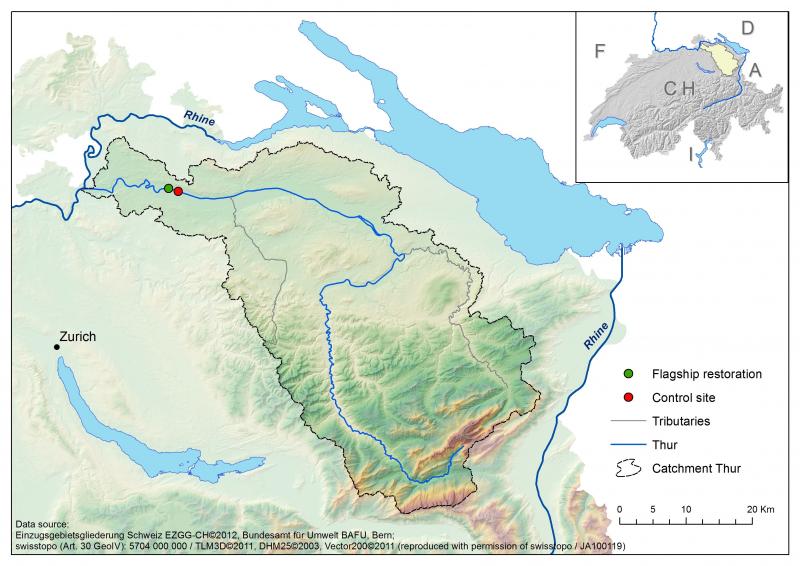
CH05The Thur, a 127 km Rhine tributary, was progressively straightened and leveed for flood control and farmland, losing natural erosion-deposition dynamics.
In the 1990s lateral rip-rap was first removed to let gravel bars re-form; in 2002 a roughly 1 km stretch of embankment near Niederneunforn and Altikon was removed on both banks, with wood structures added to encourage braiding.
Peer-reviewed monitoring published in Water (MDPI, 2018) documents renewed gravel-bar formation, secondary-channel development, and greater instream and terrestrial habitat diversity at the restored reach.
Switzerland's 2011 Water Protection Act revision made ecological river restoration a legal obligation nationwide (target: 4,000 km restored by 2090); unlike more intensively monitored sites, published Thur results emphasise morphological and habitat proxies rather than long-run species-count time series, and no site-specific cost figure was found.
National / regional programmes
Indicative funding routes for practices of this type — always check each programme's current calls and eligibility rules.
Do you run this practice? Claim it — verified implementers get a public contact pathway and can propose corrections.
Where this practice's information was retrieved from, and when.
Denmark
Denmark re-meandered the channelised Skjern River from 19 to 26 km across 875 ha of rewetted floodplain (2001-2004), an EU …
United States of America
A 50/50 USACE-SFWMD project backfilled 22 miles of the C-38 flood-control canal and re-carved 44 miles of the Kissimmee River's …
United Kingdom
A decade-plus monitored NFM experiment across 24 farms: 300,000+ native trees, ~40 leaky ponds and ~136 flow restrictors; reported ~30% …
Sri Lanka
Colombo's remaining marshes, about 17% of the city area, are managed as flood infrastructure holding close to 40% of annual …
Open full copilot Grounded in cited practices — always check the sources.