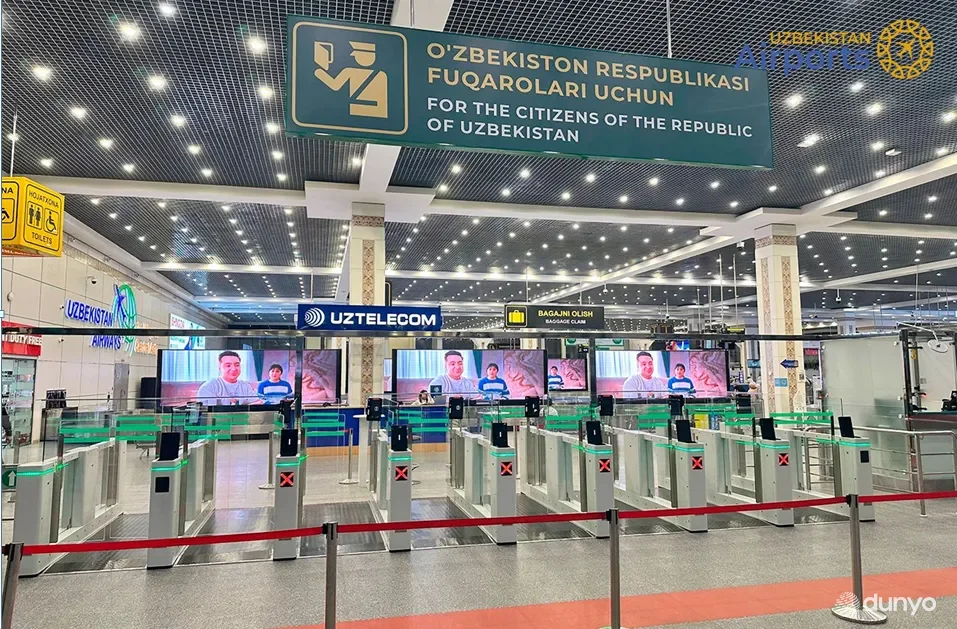
Uzbekistan has built out biometric E-Gate passport control at Samarkand (State Security Service, since August 2022) and Tashkent, where a citizens-only network grew to 20 automated gates, clearing passengers in 15-20 seconds after an 8-gate arrivals expansion in November 2025.
20 gates
Automated gates at Tashkent (total after Nov 2025 expansion) (12 November 2025)
8 gates
Additional gates added in arrivals expansion (12 November 2025)
15-20 seconds per passenger
Passenger processing time (2025)
Details
Maturity
Scaling
Promoter
Uzbekistan Airports / State Security Service of Uzbekistan
Period
2022-2025
Keywords
aviation, border management, digital identity, public administration
Context
Uzbekistan has rolled out automated, biometric E-Gate passport control at its two main international gateways using two different implementing authorities.
Objectives
At Samarkand International Airport, the Border Control Unit of Uzbekistan's State Security Service switched on a locally built system on 30 August 2022 that combines document readers with facial-recognition cameras, matching each traveller's face against their passport, and adds algorithmic checks against unauthorised or duplicate passage and unattended luggage.
Activities
At Tashkent International Airport, state operator Uzbekistan Airports first deployed E-Gates in the departures hall in 2023, then expanded the system into arrivals on 12 November 2025 with eight additional gates, bringing the airport to 20 automated gates in total; the gates are restricted to Uzbek citizens holding biometric passports.
Results
The gates process each passenger in roughly 15-20 seconds by scanning the passport and running facial recognition against it.
Conclusions
Neither airport's announcement includes an independently measured before/after baseline, error-rate data, or passenger-satisfaction figures — both frame the benefit qualitatively, as reduced processing time and higher checkpoint throughput; the approach is nonetheless being extended regionally, with Uzbekistan and Azerbaijan discussing mutual recognition of their biometric national ID systems to streamline cross-border travel.
Implementation
Indicative cost
Medium (€50k–€500k) — No public cost figures were found; conservatively banded medium for biometric e-gate hardware and integration across two airports.
Time to results
Medium (1–3 years) — Rolled out in stages from August 2022 (Samarkand) through the November 2025 Tashkent arrivals expansion; banded medium given the multi-year build-out.
Staffing & skills
State Security Service Border Control Unit (Samarkand), Uzbekistan Airports state operator (Tashkent)
Conditions for success
Biometric passport prerequisite for citizens using the gates
Two independent institutional deployments (Samarkand since 2022, Tashkent since 2023/2025) building parallel operational experience
Common failure modes
No public data on false-match rates, complaint handling, or independent audit was found for either deployment
Restricted to citizens with biometric passports only, so benefits for foreign travellers are untested
Discussed mutual biometric-ID recognition with Azerbaijan raises cross-border data-sharing questions not yet addressed in public sources
Where it fits
Governance type
state security service and state-owned airport operator (two separate authorities)
Scale
two international airports (Samarkand, Tashkent)
Income level
lower-middle-income
Commonly funded by
National / regional programmes
Indicative funding routes for practices of this type — always check each programme's current calls and eligibility rules.
Do you run this practice?
Claim it —
verified implementers get a public contact pathway and can propose corrections.
Data sources
Where this practice's information was retrieved from, and when.
Papua New Guinea's DICT unveiled SevisPass on 27 November 2025: a TECH5-built biometric digital identity and SevisWallet, Oceania's first decentralised …