M-Pesa – Mobile Money as Financial and Digital Inclusion Infrastructure
Kenya
Safaricom's M-Pesa turned basic phones into bank accounts across Kenya. A landmark Science study found it lifted 194,000 households out …
Jordan · Azraq · See the Jordan profile · See the Azraq profile
Evidence: Observational / pre–post Top 10% 96/100 · Ask Evidence Copilot about this practice
Since 2017, WFP's Building Blocks has let Syrian refugees in Jordan's Azraq camp pay for food with an iris scan instead of a card or PIN, cutting bank transaction fees by 98%; by 2025 the blockchain system had moved over $760 million to six million people worldwide.
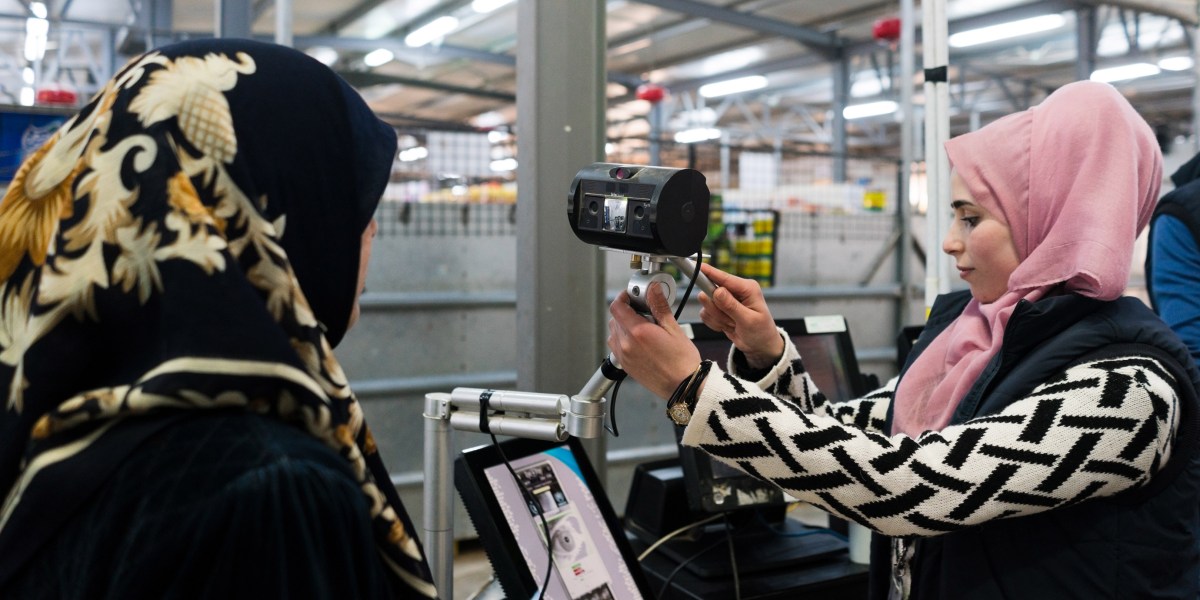
Syrian refugees resettled in Jordan's Azraq camp lacked bank accounts, smartphones or physical ID cards, making conventional cash-assistance payment methods difficult to deliver securely at scale.
Enable refugees without a bank account, smartphone or ID card to receive and spend cash assistance securely, while cutting the transaction fees WFP pays to banks.
Piloted from May 2017, the World Food Programme's Building Blocks links each family's cash-assistance entitlement to a blockchain ledger and authenticates purchases with an iris scan at the till, letting refugees pay for food using only their eyes as credential. The system scaled from Azraq to Zaatari and King Abdullah Park camps by 2018, and by 2025 covered crisis-affected populations across Jordan, Bangladesh, Lebanon, Syria, Palestine, Pakistan and Ukraine.
Within its first months the pilot moved over $1.4 million in food vouchers to roughly 10,500 refugees; by 2018 it had disbursed $37 million and cut WFP's bank transaction fees by 98%. By 2025 the platform had transferred more than $760 million across over 40 million redemption transactions to around six million people, with an estimated $3.5 million saved in bank fees by 2023 and over one million refugees in Jordan and Bangladesh using it actively every month.
Independent researcher Zara Rahman (The Engine Room) has warned that bulk biometric collection carries serious risk if control of the data shifts, citing historical misuse of population registries against displaced people. MIT Technology Review also noted that as of 2018 the iris-scan system worked at only two officially sanctioned stores, leaving informal vendors unintegrated -- a reminder that biometric convenience alone does not guarantee full financial inclusion.
Do you run this practice? Claim it — verified implementers get a public contact pathway and can propose corrections.
Where this practice's information was retrieved from, and when.
Kenya
Safaricom's M-Pesa turned basic phones into bank accounts across Kenya. A landmark Science study found it lifted 194,000 households out …
Togo
Togo built a fully digital, mobile-money cash-transfer system using satellite imagery and phone data to target its poorest citizens during …
Pakistan
Facing a JazzCash agent network that was 99.9% male, JazzCash iteratively redesigned onboarding around female agents and group events — …
Cambodia
Cambodia's first mobile money service redesigned around icon-driven, over-the-counter transactions after feature phones couldn't render Khmer script and many rural, …
Open full copilot Grounded in cited practices — always check the sources.