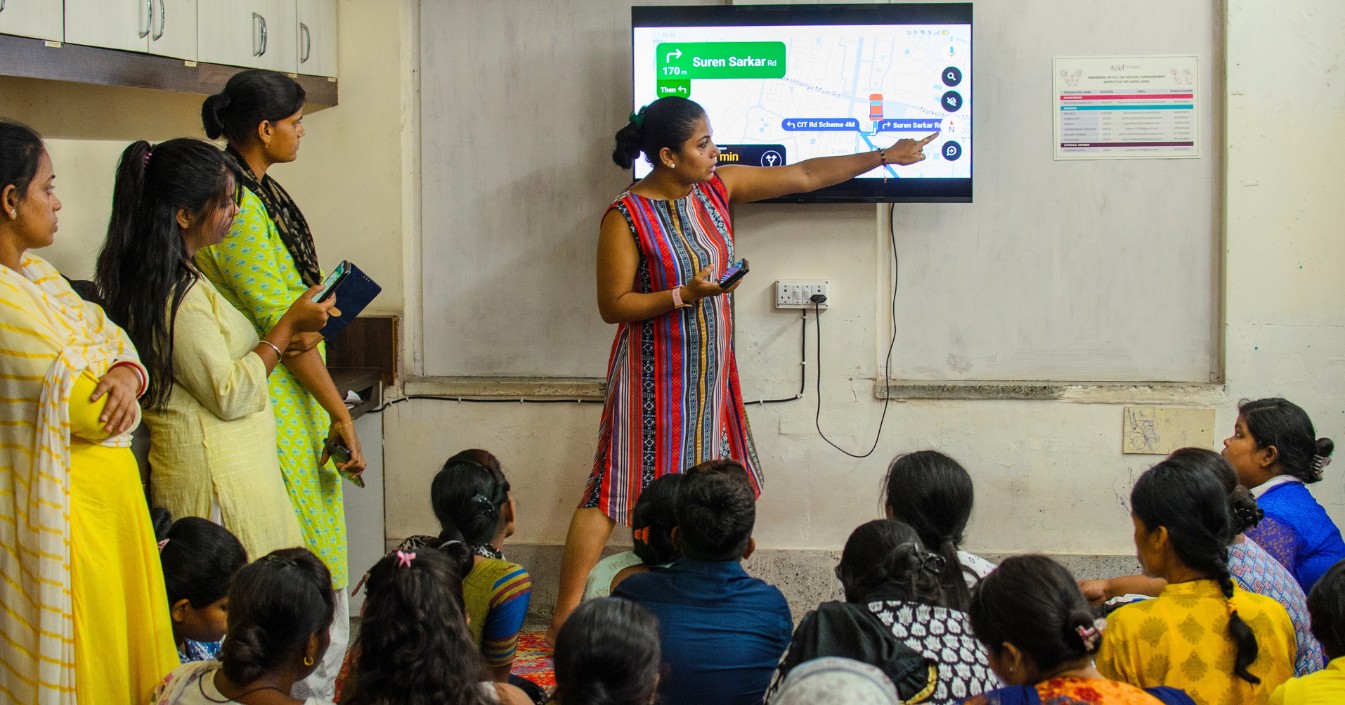
Since 2008, Delhi's Azad Foundation has trained 6,000+ marginalised women as taxi, delivery and two-wheeler drivers, placing 4,500+ in paid transport jobs and driving a 2022 policy change letting 93 women become Delhi's first women public-bus drivers.
6,000+
Women who obtained driving licences (since 2008)
4,500+
Women placed into paid driving/riding roles (since 2008)
$4.1 million+
Cumulative income generated (since 2008)
5 million+
Safe rides delivered (since 2008)
100–200%
Reported family income increase
532
Women who obtained licences (2024–25)
278
Women who joined the transport workforce (2024–25)
30
Women who joined Rapido as two-wheeler captains (2024–25)
93
First cohort of women public bus drivers in Delhi (46 trained by Azad) (2022)
Details
Maturity
Scaling
Promoter
Azad Foundation
Period
2008-present
Keywords
gig economy, ride-hailing & delivery, public transport, gender-based violence recovery, vocational training
Context
Azad Foundation was founded in New Delhi in 2008, working with its social-enterprise arm Sakha Consulting Wings (Sakha Cabs), to train resource-poor women — many survivors of domestic or gender-based violence — as professional commercial drivers, and more recently as delivery and two-wheeler riders and public bus drivers.
Activities
Since 2014 Azad has also engaged the Delhi Transport Corporation (DTC), the public bus operator, to remove entry barriers — minimum height, prior experience and training-fee requirements — that had long excluded women from driving public buses.
Results
Since 2008, more than 6,000 women have obtained driving licences and over 4,500 have been placed into paid driving or riding roles, cumulatively generating over $4.1 million in income and delivering more than 5 million safe rides; in 2024–25 alone, 532 women obtained licences and 278 joined the transport workforce, including 30 who joined Rapido as two-wheeler captains. In 2022 DTC relaxed its entry criteria, enabling 93 women, 46 of them trained by Azad, to become the first cohort of women driving Delhi's public buses.
Conclusions
The programme's outcomes are documented mainly through Azad's own annual reporting, corroborated by independent coverage and a 2018 McGill GrOW working paper that critically examined cost-effectiveness and scaling challenges. A 2015 Quartz investigation found the wider women-driver sector in India still counted only 200–250 professional drivers at the time, indicating this labour-market shift has moved slowly and that licensing costs, safety concerns and customer bias remain real barriers.
Implementation
Implementation detail (cost, timeline, staffing, conditions for success) is not yet available for this practice.
Commonly funded by
Philanthropic / foundation funding
Indicative funding routes for practices of this type — always check each programme's current calls and eligibility rules.
Do you run this practice?
Claim it —
verified implementers get a public contact pathway and can propose corrections.
Data sources
Where this practice's information was retrieved from, and when.
Grab's Women Driver-Partners Programme spans six SE Asian countries with gender-matching and safety training. A 42,000-respondent study (UNGCNS & Kantar) …