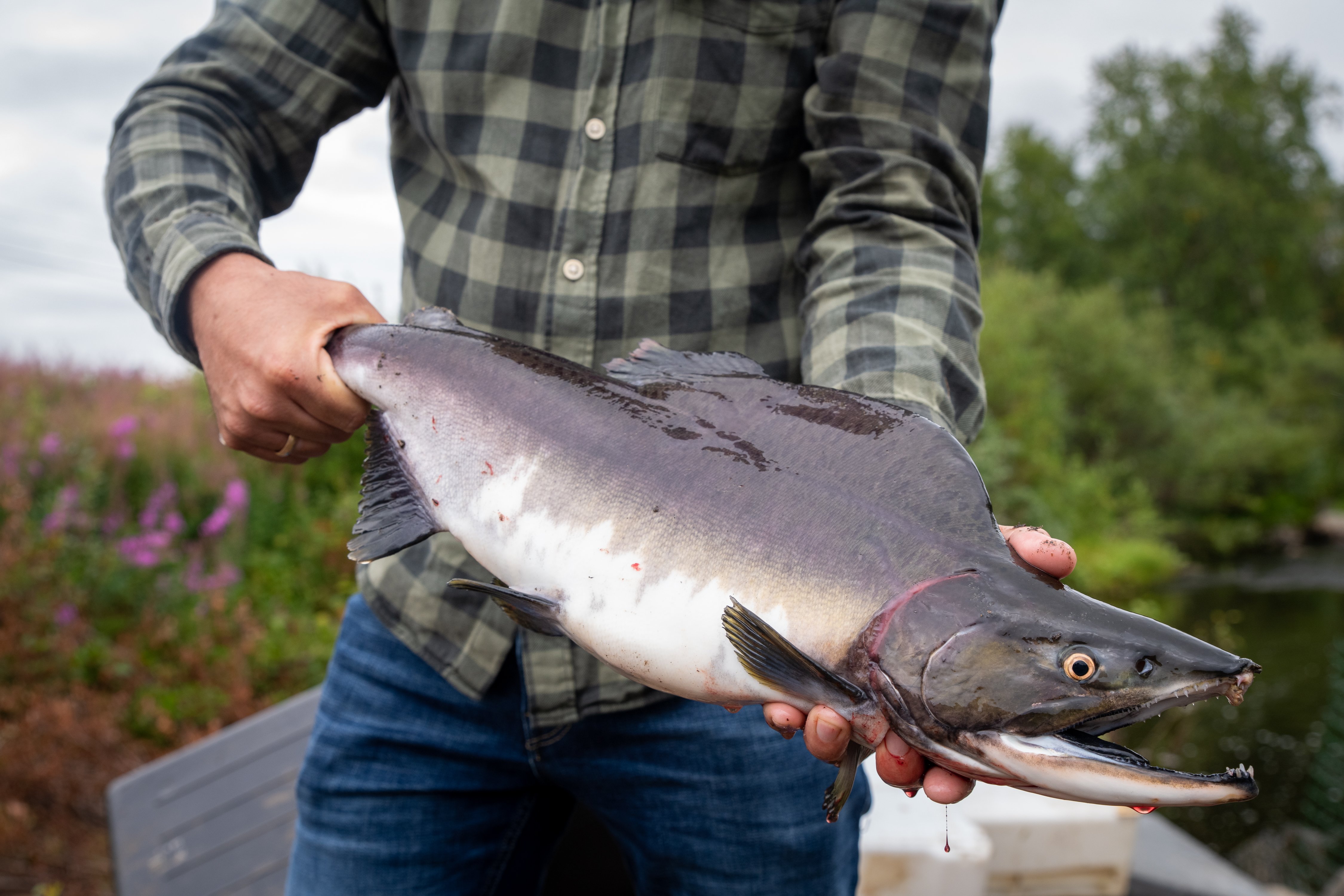
L'Agence norvégienne de l'environnement finance des pièges sur 53 des 63 rivières touchées — dont un à Seida, sur la Tana, ayant capturé 7 666 saumons roses en 2023 — pour protéger le saumon atlantique, désormais menacé d'extinction, d'une invasion biennale croissante.
Mean daily white-tailed eagle sightings, Skallelv river (2021-2022)
Détails
Maturité
En expansion
Promoteur
Miljødirektoratet (Norwegian Environment Agency) / Veterinærinstituttet / Statsforvalteren i Troms og Finnmark
Période
2021–present, biennial peaks in odd years (2021, 2023, 2025); expected to recur in 2027
Région (NUTS)
NO07
Mots-clés
invasive species control, fish trapping, salmon conservation, river management
Contexte
Pink salmon (Oncorhynchus gorbuscha), originally introduced to Russia's Kola Peninsula in the mid-20th century, now invade Norwegian rivers biennially, arriving in odd years (2021, 2023, 2025) with further recurrence expected in 2027. Norway's Environment Agency (Miljodirektoratet) describes native Atlantic salmon as 'at risk of extinction', with only approximately 323,000 wild spawners counted nationally in 2024. The Tana River, managed jointly with cross-border partners including Statsforvalteren i Troms og Finnmark, is one of the country's most significant salmon rivers.
Objectifs
To trap and remove invasive pink salmon before they can spawn and compete with native Atlantic salmon, while releasing incidentally-caught Atlantic salmon alive, in the context of a nationally expanding, state-funded control programme.
Activités
Miljodirektoratet, the Norwegian Veterinary Institute (Veterinaerinstituttet) and Statsforvalteren i Troms og Finnmark operate fish traps on Norwegian rivers during biennial pink salmon runs. The flagship installation is a 400-metre pole-row trap at Seida on the Tana River, run by the Veterinary Institute. By 2025, state-funded control measures were in place on 63 rivers nationally, with 53 fitted with fish traps. Trapped pink salmon are euthanised; incidentally caught Atlantic salmon are released alive.
Résultats
In 2023, 481,463 pink salmon were caught or observed nationally, including 7,666 at the Seida trap on the Tana River; officials nonetheless described the Tana trap as 'a pilot rather than a solution' since 'considerable quantities' of fish passed through unblocked that year. By mid-summer 2025, roughly 150,000 fish had been caught nationally, approximately 30,000 of them from the Tana River alone. On a single documented day, 47 incidentally-caught Atlantic salmon were released alive. A peer-reviewed ecosystem study on the Skallelv river found that white-tailed eagle sightings rose from a mean of 0.38 to 10.9 per day during the 2021-2022 pink salmon invasion, as carcasses became available as a food source.
Conclusions
Catch totals have grown across successive biennial cycles despite expanded trapping infrastructure, though available sources do not clarify whether this reflects rising invasion pressure, improved trapping efficiency, or both. The programme is transparently scaled and reported annually, but suppression efficacy at flagship sites like Tana remains unconfirmed by officials' own account.
Mise en œuvre
Coût indicatif
Moyen (50 k€–500 k€) — No consolidated budget figure is given in available sources. This is a state-funded national infrastructure programme spanning 63 rivers and 53 traps by 2025.
Délai jusqu’aux résultats
Long (> 3 ans) — Recurring biennial invasion and control cycles since 2021 (2021, 2023, 2025), with the next cycle expected in 2027; ongoing/recurring commitment rather than a fixed end date.
Personnel et compétences
Miljodirektoratet (Norwegian Environment Agency), Veterinaerinstituttet (Norwegian Veterinary Institute) - operates the Seida trap, Statsforvalteren i Troms og Finnmark
Conditions de réussite
National, state-funded infrastructure scaled across 63 rivers by 2025
Selective handling allowing incidentally-caught Atlantic salmon to be released alive
Modes d’échec courants
Officials describe the flagship Tana trap as 'a pilot rather than a solution'; 'considerable quantities' of pink salmon passed through unblocked in 2023
Unclear whether rising catch totals reflect invasion pressure, improved trapping efficiency, or both
Habituellement financé par
National / regional programmes
Pistes de financement indicatives pour des pratiques de ce type — vérifiez toujours les appels en cours et les règles d'éligibilité de chaque programme.
Vous portez cette pratique ?
Revendiquez-la —
les porteurs vérifiés obtiennent un contact public sur la page et peuvent proposer des corrections.
Sources de données
D'où proviennent les informations de cette pratique, et quand.