Details
- Maturity
- Pilot
- Region (NUTS)
FRJ13- Keywords
- food production, wheat, Agroforestry, Montpellier, walnut trees
Context
Montpellier is a city in Southern France. It is situated on hilly ground 10 kilometres inland from the Mediterranean coast on the River Lez. Montpellier has a Mediterranean climate (Köppen Csa), with mild, somewhat wet winters, and very warm, rather dry summers. The monthly mean temperatures range from 7.1 °C (44.8 °F) in January to 23.4 °C (74.1 °F) in July. Annual precipitation is around 660 millimetres, and is greatest in fall and winter, but not absent in summer. As projected by several studies, climate change is expected to impact the agricultural sector through more frequent droughts conditions and increased temperature. To cope with these impacts, it is urgent that agriculture in Montpellier take appropriate adaptation measures. The challenge is to make food production more efficient, sustainable and able to cope with the projected effects of climate change.
Objectives
The objective is to make the Montpellier agricultural systems more resilient to the effects of climate change, such as increasing temperatures, droughts, water and biotic stresses, and more extreme events.
Activities
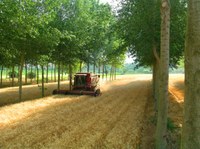
Agroforestry is the combination of trees and crops cultivation. The agroforestry scheme adopted in Montpellier, within the SAFE project, is a combination of walnut trees and wheat cultivation. Agroforestry provides a different land use option, compared with separated traditional arable and forestry systems and optimizes the benefits from the biological interactions created when trees and crops are combined. The complementarity between trees and crops allows a more effective exploitation of the available resources. Agroforestry helps to better control soil erosion and increases the sustainability and resilience of agriculture. It is a practice that respects the environment and has an obvious landscape benefit. The agroforestry plot remains productive for the farmer and generates continuous revenue, which is not the case when arable land is exclusively reforested. Agroforestry then allows for the diversification of farm activity and makes better use of environmental resources. In addition, over time, agroforestry farms can become less dependent on crop subsidies, and less susceptible to crop price variations, as timber generates a significant part of their income. The amenity value of silvoarable parklands in the near future may also be a valuable asset to farm enterprises.
Results
The agroforestry systems are usually profitable systems. What is costly is the agroforestry transition, which takes time and which must be supported. Agroforestry schemes are a long term investment. It takes some time until trees mature and provide the expected functions and benefits. Main benefits can be summarized as follow: INRA showed that the production from one hectare of a walnut/wheat mix is the same as for 1.4 hectares with trees and crops separated (corresponding to a 40% increase in productivity). Agroforestry is less vulnerable to climate change. Trees provide shelter to crops and reduce damages due to high spring temperature. Biodiversity is increased since it creates a diverse habitat where wildlife species can live. It also acts in controlling pests and enhancing pollination. Farmers can diversify their products, increase their income and improve soil and water quality, reduce (wind) erosion and prevent damage due to flooding. Soil and water quality is improved, so preventing from erosion. Agroforestry plays a role in maintaining land for future generation. Properly designed and managed agroforestry systems may help to increase the sequestration of atmospheric carbon, improve soil quality and soil conservation.
Conclusions
SAFE project provided models and databases for assessing the profitability of silvoarable systems, and suggested policy guidelines for implementing agroforestry. In particular SAFE developed biophysical and socio-economic tools to inform farmers and policy-makers of the potential for silvoarable agroforestry to contribute to the integrated and sustainable development of European rural areas. The knowledge developed during the SAFE Project, provided opportunities for farmers to improve their competitiveness.
Implementation
Implementation detail (cost, timeline, staffing, conditions for success) is not yet available for this practice.
Commonly funded by
National / regional programmes
Indicative funding routes for practices of this type — always check each programme's current calls and eligibility rules.
Do you run this practice?
Claim it —
verified implementers get a public contact pathway and can propose corrections.
Data sources
Where this practice's information was retrieved from, and when.
Attachments