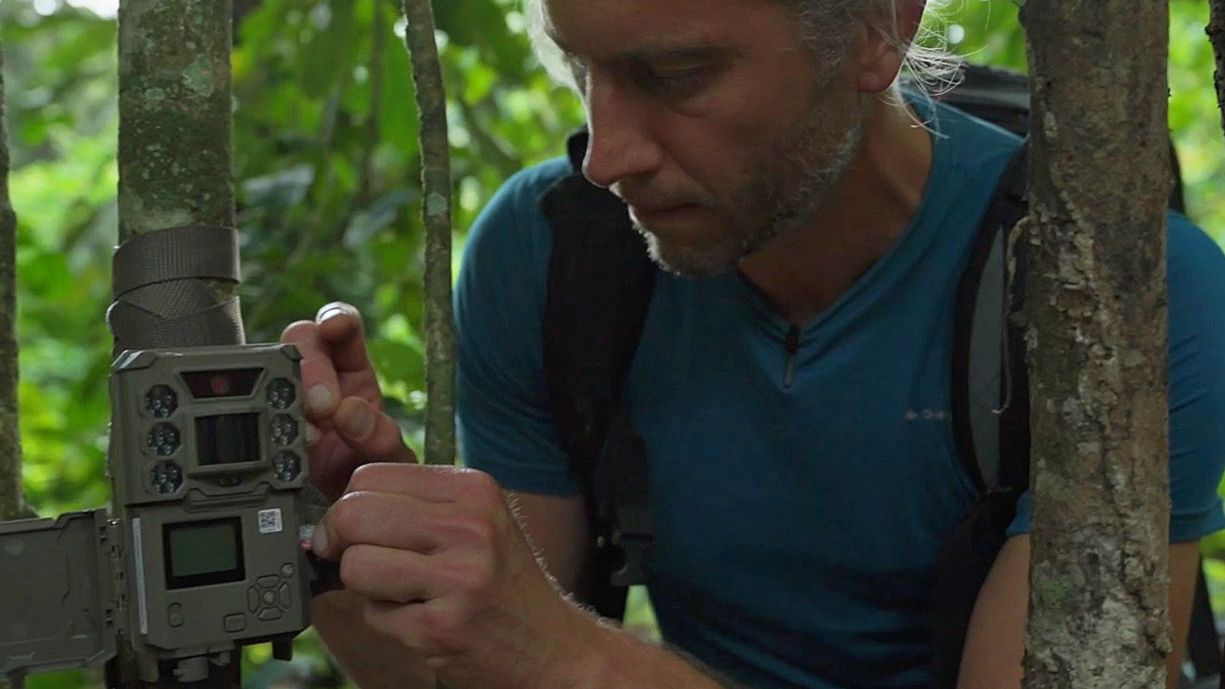
Gabon's parks agency ANPN pilots solar-powered, satellite-linked camera traps running on-device AI to detect elephants and alert rangers in real time. A peer-reviewed 72-day trial (5 units) recorded 82% detection accuracy, though nationwide deployment remains too costly.
72 days
Field trial duration
5
Camera units deployed in the trial
800+
Total images captured
217
Elephant photographs identified
82%
Elephant detection accuracy
Details
Maturity
Pilot
Promoter
Agence Nationale des Parcs Nationaux (ANPN); University of Stirling; Hack the Planet; Panthera; Wildlife Conservation Society
Period
72-day field trial reported 2022; peer-reviewed 2023; ongoing park deployment
Gabon is roughly 80% forest-covered — the second-highest share globally — with only about 2.2 million inhabitants, leaving vast areas of the Congo Basin effectively unmonitored for illegal logging and poaching.
Objectives
Detect elephants, and potentially armed individuals, in real time using solar-powered, satellite-connected camera traps running on-device AI, without requiring local network infrastructure, and alert rangers via GPS-tagged messages over the Iridium satellite network.
Activities
Gabon's national parks agency (ANPN) and the water and forests ministry developed standardised camera-trap protocols with the University of Stirling, the Dutch start-up Hack the Planet, Panthera and the Wildlife Conservation Society. In a peer-reviewed 72-day field trial (Whytock et al., Methods in Ecology and Evolution, 2023) covering five camera units in and around Lopé National Park, the system captured over 800 images, of which 217 were elephant photographs. ANPN separately built 'Mbaza AI,' an offline image-classification tool letting rangers process camera-trap photos on laptops in the field without uploading to cloud services. GPS coordinates are deliberately stripped from shared images to stop poachers exploiting location data.
Results
The trial achieved 82% accuracy in recognising elephants among the images captured.
Conclusions
Independent reporting (Mongabay) tempers the promise: a researcher surveying forest elephants nationally found camera trapping too expensive despite its precision and chose DNA analysis instead, and a Wildlife Conservation Society scientist cautioned that 'technology rarely solves problems; people do' — the cameras augment, rather than replace, ranger and researcher work, and the system cannot yet reliably identify individual elephants.
Implementation
Indicative cost
Medium (€50k–€500k)
Time to results
Medium (1–3 years)
Staffing & skills
Agence Nationale des Parcs Nationaux (ANPN) rangers/eco-guards, Gabon's water and forests ministry, University of Stirling researchers, Hack the Planet (Dutch start-up), Panthera, Wildlife Conservation Society
Conditions for success
On-device AI processing avoids the need for local network/cellular infrastructure in remote forest
Satellite (Iridium) connectivity enables real-time, GPS-tagged alerts to rangers
Offline 'Mbaza AI' tool lets rangers process images locally without cloud upload
Multi-institution research partnership (Stirling, Hack the Planet, Panthera, WCS) providing technical development capacity
Common failure modes
A national forest-elephant survey researcher found camera-trap technology too costly and chose DNA analysis instead
The system cannot yet reliably identify individual elephants
A WCS scientist cautions the technology augments rather than replaces ranger/researcher work
Where it fits
Governance type
national parks agency with international NGO/research partners
Scale
pilot (5 camera units, single national park), designed for wider Congo Basin extension
Income level
upper-middle-income (Gabon)
Commonly funded by
National / regional programmesPhilanthropic / foundation funding
Indicative funding routes for practices of this type — always check each programme's current calls and eligibility rules.
Replication kit
Reusable artefacts from this practice — as published by their sources.
Digital Earth Pacific, run by the Pacific Community (SPC), turns open satellite data into AI-processed disaster-risk, coastline and mangrove products …