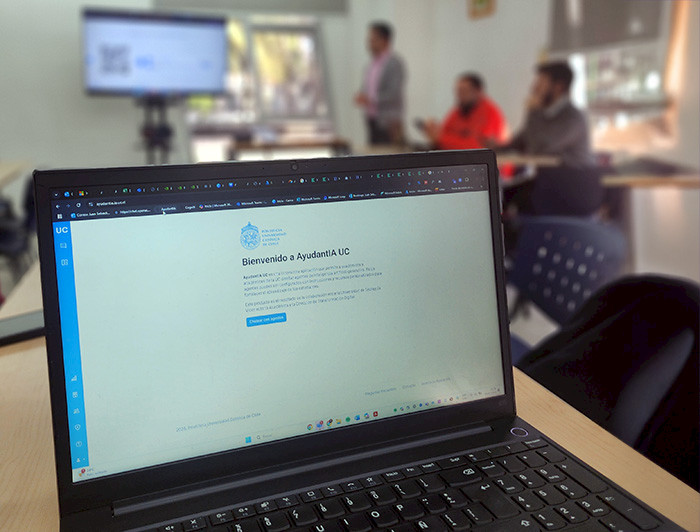
UC Chile's AyudantIA trains professors to build course-specific AI tutoring chatbots; by 2026, 194 agents across ~100 courses reached 4,600+ students, with 60%+ reporting the tutors aided learning and two-thirds of professors rating the impact positively.
194 agents
AI tutoring agents deployed (2026)
~100 courses
Courses using AyudantIA (2026)
4,600+ students
Students actively engaging with agents (2026)
92 professors
Professors trained to build agents (early 2026)
60+ %
Students who said agents contributed to their learning (first-semester evaluation)
90 %
Students wanting continued access (first-semester evaluation)
~67 (two-thirds) %
Professors rating the impact positively (first-semester evaluation)
>6 on 1–7 scale
Average seminar grade after adoption (Microbial Biology course) (post-adoption)
Details
Maturity
Scaling
Promoter
Pontificia Universidad Católica de Chile (UC Chile) — Vice Presidency for Digital Intelligence
Period
2025–2026
Keywords
higher education, AI tutoring, faculty development
Context
AyudantIA is an institution-wide initiative at the Pontificia Universidad Católica de Chile (UC Chile) that trains professors to build their own course-specific AI tutoring agents — chatbots populated with each course's own materials and bibliography — run jointly by UC Chile's Vice Presidency for Digital Intelligence and Vice Presidency for Academic Affairs on Microsoft Azure OpenAI infrastructure integrated with the Canvas learning platform.
Objectives
Give students on-demand, 24/7, instructor-validated AI tutoring support as a safe alternative to unsupervised generative-AI use — UC Chile cites survey data showing 94% of its students already use AI tools informally.
Activities
By early 2026, 92 professors had built 171 agents (59 on GPT-4o, 112 on GPT-4o-mini) across 26 general-education and 68 discipline-specific courses; a later count reported 194 agents deployed across roughly 100 courses. UC Chile is collaborating with the University of Sydney and Microsoft to study responsible scaling toward a stated goal of 5,000 courses.
Results
The agents reached over 10,000 students with access, with 4,600+ students actively engaging in sessions averaging 13–23 minutes. A first-semester evaluation found over 60% of students said the agents contributed to their learning, 90% wanted continued access, and two-thirds of professors rated the impact positively; one Microbial Biology course reported average seminar grades above 6 on Chile's 1–7 scale after adoption.
Conclusions
AyudantIA shows strong early engagement and largely positive self-reported perceptions at meaningful scale, but the evidence to date is a first-semester institutional survey without a comparison group, not a controlled evaluation of learning gains.
Implementation
Indicative cost
Medium (€50k–€500k) — Institutional Microsoft Azure OpenAI infrastructure (GPT-4o and GPT-4o-mini) plus faculty training investment across 92 professors; no public cost figures disclosed — conservative medium estimate pending curator review.
Time to results
Medium (1–3 years) — Grew from an initial pilot to 194 agents across ~100 courses within about a year (2025–2026), with a multi-year scaling plan toward 5,000 courses.
Staffing & skills
UC Chile Vice Presidency for Digital Intelligence (led by Paula Aguirre), UC Chile Vice Presidency for Academic Affairs, 92 trained professors building course agents
Conditions for success
Microsoft Azure OpenAI infrastructure integrated with the Canvas learning platform
Instructor validation of each agent's course materials and bibliography
Structured faculty training programme to build agents
Collaboration with the University of Sydney and Microsoft on responsible-scaling research
Common failure modes
Evidence to date is a first-semester institutional survey without a comparison group
Equity gains ('reduced disparities between degree programs') were an observed side-effect rather than a designed target
Where it fits
Governance type
university institution
Scale
institution-wide, scaling toward a stated goal of 5,000 courses
Commonly funded by
Own resources / municipal budget
Indicative funding routes for practices of this type — always check each programme's current calls and eligibility rules.
Do you run this practice?
Claim it —
verified implementers get a public contact pathway and can propose corrections.
Data sources
Where this practice's information was retrieved from, and when.
A 13-week controlled study at four Hungarian universities found a ChatGPT-based adaptive tutor using Bayesian Knowledge Tracing nearly doubled programming …
Two experiments (175 university, 234 high-school students) found a learning-theory-based chatbot beat ChatGPT on conceptual knowledge, trust and enjoyment; gains …